
Your dream pair of sneakers is sitting in a listing right now, but without a firm handle on understanding sneaker reseller terminology, you might be about to lose hundreds of dollars on a pair that isn't what you think it is. It's frustrating to feel like an outsider in a community you love just because you haven't memorized an alphabet soup of acronyms. You want to secure your next grail without the nagging fear that a misunderstood detail will result in a box of beat-up shoes arriving at your door.
With the global sneaker market projected to reach $110 billion in 2026, mastering this language has become a vital skill for anyone looking to shop safely. The era of flipping every release for a quick profit has evolved into a more discerning marketplace where heritage matters as much as hype. This guide will transform you from a confused observer into a fluent collector who knows how to spot rarity and condition grades at a glance. We'll break down the essential slang and grading standards used by pros so you can shop with total confidence at authentic sources like Lab X Supply.
Key Takeaways
- Learn to distinguish "Deadstock" from lesser condition grades so you always pay a fair price for your next pair.
- Master understanding sneaker reseller terminology to decode abbreviations like WTS, L/C, and P/C used in community listings.
- Identify the difference between General Releases and Quickstrikes to accurately judge the rarity of a specific silhouette.
- Avoid the frustration of a bad fit by learning how to use technical sizing terms like TTS when shopping online.
- Discover how sourcing sneakers and slides from professional retailers like Lab X Supply protects you from the uncertainty of private trade groups.
The Foundation: Condition Codes and What They Mean for Value
Condition is the heartbeat of sneaker valuation. A shoe's price isn't just about the model or the year it was released; it's about the state of the materials and the history of its wear. Mastery of sneaker collecting terminology prevents you from overpaying for a pair that looks good in photos but lacks structural integrity. In the 2026 market, where heritage and authenticity are the primary drivers of value, understanding these grades is your best defense against bad deals.
The hierarchy of condition creates clear price tiers. A single hour of wear can slash a shoe's market value by 20% or more. This is why understanding sneaker reseller terminology is essential before you enter any negotiation. If you can't tell the difference between a factory-fresh pair and a "tried on" pair, you're likely leaving money on the table or buying into a lie. Professional collectors prioritize the "Deadstock" standard because it guarantees the item hasn't been altered by human use.
Deadstock (DS) vs. PADS: The Unworn Debate
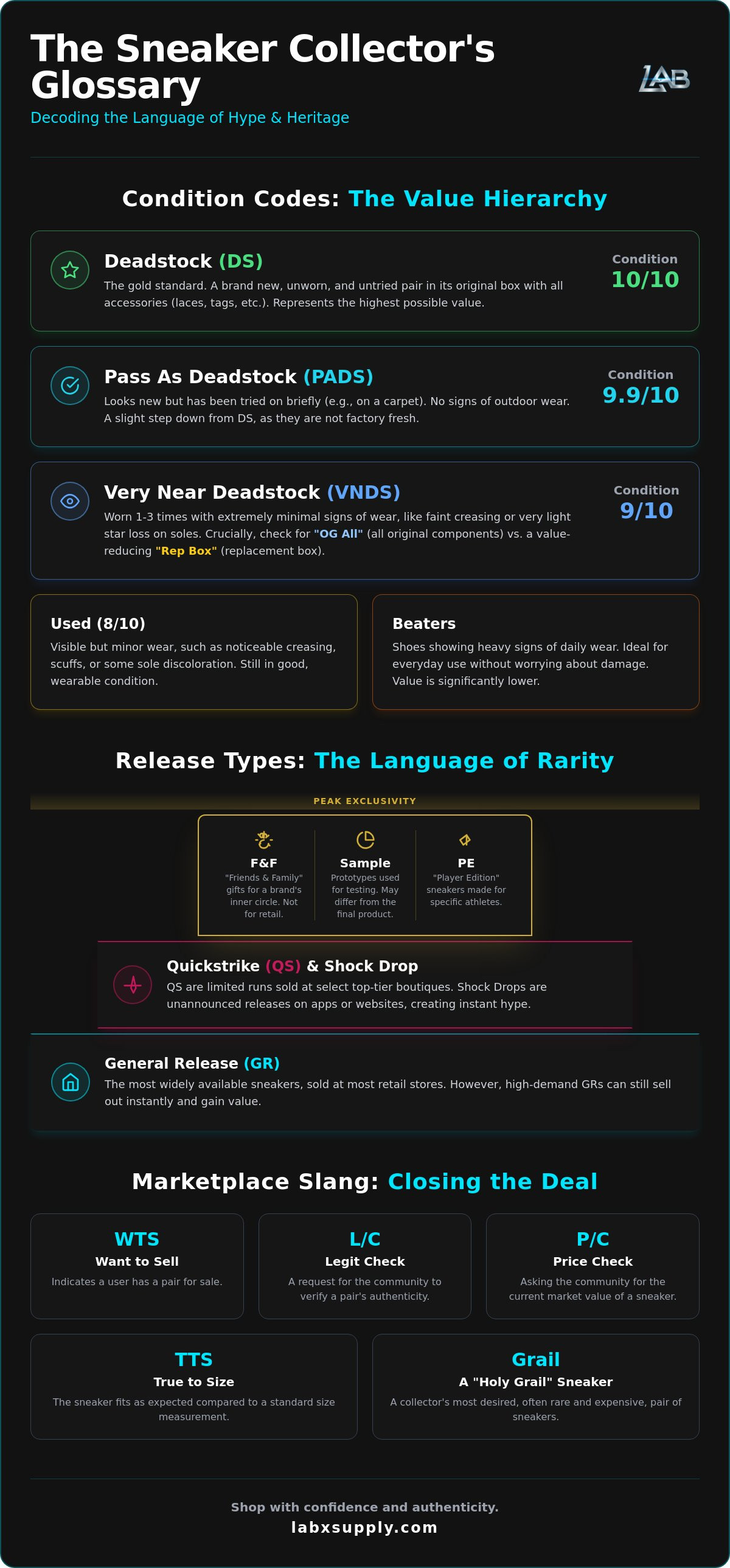
Deadstock is the industry gold standard. It refers to a pair that is factory fresh, never tried on, and includes all original accessories like extra laces, hangtags, and the original box. It's the most expensive tier because it represents a pristine piece of history. However, the term PADS (Pass as Deadstock) has created a gray area. PADS usually means the owner tried them on once, perhaps walked across a carpeted room, and decided to sell. While they look new, they aren't technically Deadstock. Deadstock is the ultimate tier for collectors seeking The Ultimate Guide to Authentic Sneakers in 2026.
VNDS and Used Tiers: Understanding Wear and Tear
VNDS (Very Near Deadstock) is the next step down. These pairs show minimal wear, such as light star loss on the soles or a faint crease in the toe box. When shopping this tier, always look for "OG All," which means the shoes come with every original component. If a listing says "Rep Box," it means the original box was lost or damaged, which significantly lowers the resale value. Understanding sneaker reseller terminology helps you navigate the subjective 1-10 grading scale often used in private listings.
- 9/10: Worn 1-3 times, looks almost new, no major flaws.
- 8/10: Visible creasing or minor scuffs, but still clean.
- Beaters: Sneakers intended for daily use that show heavy wear.
Restored pairs are another budget-friendly option. These are "beaters" that have been professionally cleaned or had their paint touched up. While they look great, their value is lower than an original, untouched pair in similar condition. Always ask for detailed photos of the soles and inner linings to verify the true grade before you buy.
Release Types: GR, QS, and the Language of Rarity
Rarity in the sneaker world is often misunderstood. It isn't just about production numbers; it's about the category of the release. Many beginners assume that a "General Release" (GR) is always easy to find at a local mall. However, certain GR models become cult classics or essential colorways that sell out instantly. Supply rarely meets demand for these staples. This is a core part of research on Sneakerhead culture, which suggests that the shared knowledge of these release tiers defines the community's social structure. When you focus on understanding sneaker reseller terminology, you stop chasing every drop and start targeting the pairs that hold long-term value.
Quickstrikes (QS) represent the next level of exclusivity. These are produced in smaller numbers and distributed only to top-tier boutiques. Shock Drops take this a step further by appearing on apps or websites without any prior warning. These tactics keep the market competitive and reward those who stay plugged in to the community. By understanding sneaker reseller terminology, you can distinguish between a standard marketing push and a truly rare opportunity.
For the highest tier of collectors, specific categories define the peak of rarity:
- Player Editions (PE): Custom sneakers made specifically for athletes, often featuring unique logos or colors.
- Samples: Prototype pairs used for testing materials or design concepts before a final version is approved.
- Friends and Family (F&F): Ultra-exclusive pairs gifted only to a brand's inner circle, never intended for retail.
Retail vs. Resale: The Supply Chain Terms
The Manufacturer's Suggested Retail Price (MSRP) is often just a starting point. Secondary market value is dictated by scarcity and cultural relevance. Sometimes, a shoe that looks hyped becomes a "Brick" if a surprise restock floods the market. This causes prices to crash overnight. You might also hear whispers of "Backdooring." This happens when store employees sell stock to resellers before the official release date. It bypasses the public lottery system entirely. If you want to skip the lottery and secure a guaranteed authentic pair, you can browse our curated selection of sneakers today.
Special Editions and Collaborations
Special Editions (SE) and Limited Editions (LE) often feature premium materials or unique packaging. While they are rarer than standard pairs, they don't always carry the same weight as a Collaboration. A "Collab" involves two brands joining forces, such as Nike x Off-White. This creates a unique aesthetic that appeals to multiple fanbases. These partnerships often drive the highest resale premiums. They bridge the gap between sportswear and high fashion, making them highly sought after by collectors worldwide.
Marketplace Slang: WTS, L/C, and Closing the Deal
Entering a community marketplace for the first time feels like landing in a foreign country without a map. You need to know the specific code of conduct to get a response from serious sellers. Understanding sneaker reseller terminology is your passport to these digital spaces. If you don't speak the language, sellers might ignore your messages or assume you aren't a serious buyer. Most listings begin with three-letter acronyms that tell you exactly what the person wants. WTS means "Want to Sell," while WTB means "Want to Buy." If you see WTT, the owner is looking for a "Want to Trade" scenario. These abbreviations keep the feed clean and help users filter through hundreds of posts quickly.
When you're ready to move forward, you'll encounter pricing terms like BIN and H/O. BIN stands for "Buy It Now," which is the firm price the seller will accept to end the listing immediately. On the other hand, H/O stands for "Highest Offer." This tells you what other buyers have already bid, giving you a baseline for your own offer. Don't be a "Flaker" by agreeing to a price and then disappearing when it's time to pay. Community groups often have "blacklists" for people who back out of deals. If you want to keep the post active and visible, you can "Bump" it, which simply means posting a comment to move the thread back to the top of the feed.
The Legit Check (L/C) Process
Never skip a Legit Check (L/C). This is a crowdsourced authentication process where you post detailed photos of a shoe so the community can verify its authenticity. You should always look for "POP" (Proof of Purchase) or a digital receipt from a reputable retailer. Be extremely careful if a seller uses the term "UA" or "Unauthorized Authentic." This is deceptive slang used to describe high-quality fakes. There's no such thing as a factory-sanctioned "extra" pair. If it isn't an official release, it's a replica. Understanding sneaker reseller terminology helps you spot these red flags before you send any money.
Negotiation and Payment Lingo
Negotiation is an art form in the resale world. "Lowballing" is the quickest way to get blocked; it refers to offering a price significantly below the market value or the seller's H/O. When you reach an agreement, clarify the "Out the Door" price. Sellers often say "Add Ship and Fees," meaning you need to cover the shipping costs and the transaction fees. Always pay via a PayPal Invoice or "Goods & Services." Never send money as a "Gift" or "Friends & Family" to a stranger. Gifted payments offer zero buyer protection. If the seller insists on a gifted payment, it's usually a sign of a scam. Using protected payment methods ensures that you can get your money back if the shoes don't arrive as described.
Sneaker Anatomy and Sizing: Technical Terms for a Perfect Fit
Buying shoes online is a gamble if you don't know your measurements. The most critical acronym you'll encounter is TTS, which stands for "True to Size." In theory, a TTS shoe should match your standard foot measurement across all brands. In practice, understanding sneaker reseller terminology requires knowing that every silhouette fits differently. A "Silhouette" refers to the specific shape and model of a shoe, like a high-top basketball sneaker or a low-profile runner. The "Colorway" (CW) is the specific combination of colors applied to that silhouette. Knowing both helps you identify exactly which release you're looking at in a crowded marketplace.
To talk like an expert, you must understand the basic anatomy of a sneaker. The "Upper" is everything above the sole, usually made of materials like Suede, Nubuck, or breathable Flyknit. The "Midsole" provides cushioning, while the "Outsole" is the rubber bottom that touches the ground. You might even hear collectors talk about the "Aglet," which is the plastic or metal tip at the end of a shoelace. Many modern designs also feature 3M reflectivity, a material that shines brightly when hit by direct light or a camera flash. This is a common feature on high-visibility running shoes and "Gorpcore" styles popular in 2026.
Sizing Nuances for Major Brands
Consistency is rare in footwear manufacturing. A size 10 in a Jordan 1 rarely feels the same as a size 10 in a Yeezy Slide, which often requires sizing up for a comfortable fit. When a retailer announces a "Full Size Run" (FSR), it means they have every size available from the smallest to the largest. You should also watch out for these specific size categories:
- GS (Grade School): Sizes 3.5Y to 7Y, often built with slightly different materials than adult pairs.
- PS (Pre-School): Smaller sizes for young children, usually featuring simpler lace systems.
- WMNS: Women's sizing, which typically runs 1.5 sizes larger than the equivalent men's size.
Aesthetic and Design Terminology
Sellers often describe the "Lateral" side (the outer side with the logo) or the "Medial" side (the inner side) to highlight specific details. The 2026 market is currently dominated by "Deconstructed" looks, which show exposed foam and raw edges, and "Reimagined" series that update classic silhouettes with vintage finishes. If you're buying older pairs, watch out for "Oxidization" or "Yellowing." This is a natural chemical reaction where clear rubber soles or white plastic parts turn yellow over time due to air exposure. Understanding sneaker reseller terminology ensures you don't mistake this natural aging for a defect. If you want to avoid the guesswork of sizing and condition, shop our premium collection of sneakers and slides today.
Buying Authentic: How Lab X Supply Simplifies the Language
Navigating peer-to-peer marketplaces can feel like a full-time job. While understanding sneaker reseller terminology gives you a significant edge, the daily stress of "Legit Checking" every individual listing and dodging "Flakers" often outweighs the excitement of a new purchase. Community groups are notorious for "Lowballing" and inconsistent grading. Professional curation changes that equation. At Lab X Supply, we eliminate the ambiguity of the secondary market by acting as your expert filter. You don't have to worry if a pair is "PADS" or if the "OG All" claim is actually true because our inventory is strictly vetted before it ever reaches our digital shelves.
We've built our reputation on a commitment to "Deadstock" and "Authentic" inventory. This means you skip the awkward negotiation phase and the fear of "UA" replicas entirely. Understanding sneaker reseller terminology is just the first step; the second is knowing where to apply that knowledge safely. When you shop with us, you're not just buying a pair of shoes. You're buying the peace of mind that comes with professional authentication and clear, honest condition ratings. We've removed the guesswork so you can focus on building a collection that reflects your style.
Why Curation Matters in 2026
Expert verification is non-negotiable in the current market. This is especially true for the evolution of the Slide Series, where iterative design changes often baffle casual buyers. We ensure every pair meets the "OG All" standard. This means you receive the original box and every factory accessory in pristine condition. By choosing a curated store, you bypass the headache of "Invoiced vs. Gifted" payment debates and the constant risk of "Backdoored" pairs. We handle the logistics and the "L/C" process so your experience is seamless from click to delivery.
Your Next Steps as a Pro Collector
Now that you've mastered this dictionary, you can browse our latest sneaker collections with the eyes of a veteran. You'll recognize why a certain "Colorway" carries a premium or why a "Quickstrike" is a mandatory addition to your rotation. If you ever need a "P/C" to understand current market trends or want extra photos of a specific "Silhouette" to check the materials, our team is ready to assist. You've moved from being a confused observer to a confident collector. Your next "Grail" is no longer a mystery; it's a calculated, secure addition to your wardrobe.
Step Into the Future of Collecting
Mastering the language of the resale market is about more than just fitting in. It's about protecting your investment and ensuring every pair you add to your rotation is exactly what you expect. From identifying the subtle differences between Deadstock and PADS to navigating the "Want to Sell" abbreviations of community groups, you now have the tools to shop like a professional. Understanding sneaker reseller terminology turns a high-stakes gamble into a calculated win.
You've learned how to spot "UA" red flags, decode technical sizing for different silhouettes, and recognize the rarity of a Quickstrike drop. This knowledge is your best defense against fakes and overpriced "bricks" that lose value overnight. Now that you speak the language, it's time to build a collection that stands the test of time.
Building a complete wardrobe goes beyond footwear; finding authentic vintage pieces to match your sneakers is part of the lifestyle. Shops like thrifted apart specialize in the kind of Y2K and vintage fleece that defines this aesthetic rebellion.
Ready to put your fluency to the test? You can browse our curated collection of 100% Authentic Sneakers at Lab X Supply. We specialize in Deadstock and high-heat releases with expert-verified authenticity on every pair. With global shipping for the world's most sought-after silhouettes, your next grail is closer than you think. Secure your sneakers with total confidence.
Frequently Asked Questions
What does DS mean in sneakers?
DS stands for Deadstock, which indicates a sneaker is in factory-fresh condition. It's never been worn or even tried on for size. A true DS pair includes the original box and all accessories like extra laces or hangtags. In the context of understanding sneaker reseller terminology, this is the highest possible grade. Collectors value DS pairs most because they represent a pristine, untouched product straight from the manufacturer.
Is VNDS worth buying compared to Deadstock?
VNDS, or Very Near Deadstock, is an excellent choice for those who intend to wear their sneakers rather than display them. These pairs show only the slightest signs of use, such as minimal star loss on the sole or a single light crease. Because they aren't factory fresh, they usually sell for less than Deadstock pairs. You get a nearly perfect shoe while saving a significant amount of money on the transaction.
What is a 'Grail' in sneaker culture?
A Grail is a sneaker that an individual collector desires above all others. These are typically rare, expensive, or have deep personal meaning. While the term is subjective, most grails are limited releases that are difficult to find in pristine condition. Owning a grail often represents the culmination of years of searching and saving. It's the centerpiece of any serious collection and often holds its value remarkably well over time.
Does 'True to Size' (TTS) mean the same thing for all brands?
No, True to Size (TTS) is not a universal measurement across all brands. While it refers to your standard foot size on a Brannock device, different silhouettes and materials change how a shoe feels. For instance, a leather basketball shoe might feel tighter than a mesh runner in the same size. Always research specific model reviews to see if you should go up or down a half size before committing to a purchase.
What is the difference between a General Release and a Quickstrike?
A General Release (GR) is produced in large quantities and sold at most major retailers. In contrast, a Quickstrike (QS) is a limited drop distributed only to top-tier boutiques and specialized accounts. Quickstrikes often feature higher-quality materials or unique collaborations. While GRs are easier to find initially, some classic GR colorways can still become highly sought after on the secondary market once they sell out at retail. This creates different tiers of rarity.
Why do people ask for a 'Legit Check' (L/C) before buying?
A Legit Check (L/C) is a vital security step to confirm a sneaker's authenticity before money changes hands. With the rise of high-quality replicas, buyers rely on the community's collective eye to spot tiny inconsistencies in stitching, logos, or box labels. Understanding sneaker reseller terminology helps you interpret these checks. Skipping this process puts you at high risk of losing money on a counterfeit product that has no actual resale value.
What does 'OG All' mean in a sneaker listing?
"OG All" means the sneakers come with every single item that was included in the original retail packaging. This includes the original box, tissue paper, cardboard shoe trees, and any extra sets of laces. For serious collectors, having the complete set is essential for maintaining the shoe's maximum market value. If a listing is missing even a small accessory, it's no longer considered "OG All" and should be priced accordingly.
Is it safe to buy sneakers that are listed as 'B-Grade'?
Yes, it's generally safe to buy B-Grade sneakers if you're looking for a deal. These are authentic pairs that have minor cosmetic flaws, like a small glue stain or a slightly crooked stitch, which prevented them from passing final inspection. They are usually sold at factory outlets at a discount. While they are perfect for daily wear, their resale value is lower than A-grade pairs because of the specific stamp usually found on the inner tag.