
Spending $500 on a pair of limited edition sneakers only to find they pinch your toes isn't just a mistake; it's a heartbreak that the resale market rarely forgives. You've likely felt that spike of anxiety when clicking 'buy' on a pair of Yeezys, wondering if your standard Nike size will actually translate to a comfortable fit. Sizing is notoriously inconsistent, and since many high-end purchases are non-refundable, you can't afford to get it wrong. This comprehensive sneaker sizing guide is designed to eliminate that guesswork by providing the exact measurements and brand-specific quirks you need to secure the right fit every time.
We understand the frustration of trying to convert between US, UK, and EU charts while juggling the different silhouettes of 2026 releases. Whether you're eyeing the 30th Anniversary Air Jordan 11 "Space Jam" or the latest Yeezy Slides, our expert breakdown covers everything from DIY foot measurement to brand-by-brand cheat sheets. You'll gain the confidence to shop the resale market knowing your next pair of sneakers will feel as good as they look. We'll explore the specific fit of various models and provide clear instructions to ensure your collection fits perfectly from the very first wear.
Key Takeaways
- Learn how to accurately measure your feet at home using simple tools to establish a precise baseline for every purchase.
- Understand the specific fit differences between popular silhouettes like the Air Jordan 1 and the Yeezy 350 V2 to avoid painful sizing mistakes.
- Navigate the "Whole Size Only" dilemma for slides and foam runners to ensure your loungewear is as comfortable as it is stylish.
- Use our comprehensive sneaker sizing guide to master international conversions using centimeters as the most reliable measurement standard.
- Discover why shopping deadstock sneakers ensures you receive the original factory fit without the stretching or wear found in used pairs.
How to Measure Your Feet for Sneakers at Home
Most collectors assume their shoe size is a fixed number established in their late teens. This is a myth. Factors like aging, weight fluctuations, and even gravity cause your feet to spread and change shape over time. If you haven't measured your feet in the last year, your data is likely outdated. A precise sneaker sizing guide begins with a fresh baseline. Relying on what you wore three years ago is a fast track to a painful and expensive mistake in the resale market.
Timing is everything when gathering these measurements. Your feet naturally swell throughout the day due to heat and activity. If you measure first thing in the morning, you'll get the smallest possible version of your foot. By the late afternoon, your feet have reached their maximum volume. This is the version of your foot that needs to fit into those new kicks. Always measure later in the day to ensure your sneakers don't become uncomfortably tight after just a few hours of wear.
This precision is even more critical when selecting performance apparel where movement is key. To find gear that meets these high standards, you can discover YES! Athletics for specialized wrestling singlets and competition wear.
You don't need professional equipment to get an accurate reading. Gather a sheet of blank white paper, a sharp pencil, a ruler or measuring tape, and find a hard, flat floor next to a wall. Carpet will distort your results, so stick to hardwood or tile. This simple toolkit provides the raw data needed to navigate the complex world of international sneaker retail.
The Step-by-Step Measurement Process
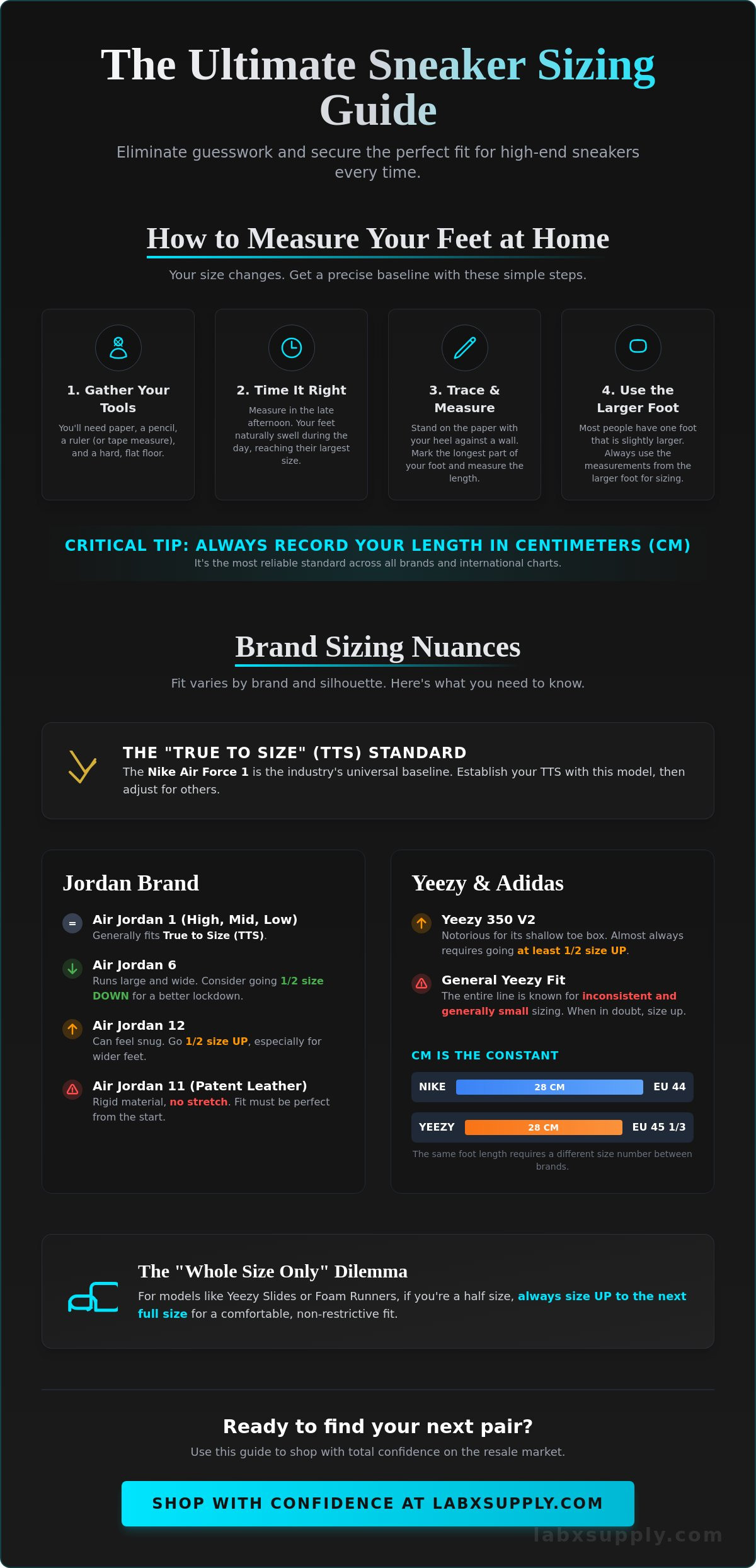
Start by placing the paper on the floor, flush against the wall. Stand on the paper with your heel touching the wall. It's helpful to wear the type of socks you plan to wear with your sneakers; thick basketball socks will yield a different result than thin liners. Keep your weight balanced and have a friend mark the longest part of your foot, usually the tip of the big toe or the second toe, with the pencil held vertically. Because there are so many different shoe-size systems used by global brands, you should always record your length in centimeters. This metric is the most consistent across Nike, Jordan, and Yeezy charts.
Accounting for Foot Width and Volume
Length is only half the battle. Many enthusiasts suffer from "muffin-topping," where the foot spills over the edge of the midsole because the shoe is too narrow. If you have a wide forefoot, you may need to prioritize width over length. To check this, wrap a soft measuring tape around the widest part of your foot, typically the ball. Comparing this girth to brand standards helps you identify whether you need wide-foot silhouettes, like the New Balance 990 series, or if you can handle narrower models.
Almost everyone has one foot that's slightly larger than the other. This is your dominant foot. When you finish measuring both, always use the larger dimensions to determine your size. It's much easier to accommodate a slightly loose shoe with a thicker insole than it is to stretch a shoe that's physically too small for your dominant foot.
Brand-Specific Sizing Nuances: Nike, Jordan, and Yeezy
Establishing a baseline is the most critical step in any sneaker sizing guide. In the industry, the Nike Air Force 1 is the universal "True to Size" (TTS) yardstick. If a size 10 AF1 fits you perfectly, that's your starting point. However, brand loyalty doesn't guarantee a consistent fit across different models. Luxury sneakers, such as Dior or Off-White collaborations, often utilize European sizing templates that don't align perfectly with standard US conversions. It's also vital to remember the 1.5 size difference between genders; a women's size 9.5 is equivalent to a men's size 8 in Nike and Jordan brands. For international purchases, always check the CM measurement. A Nike size 44 measures 28 cm internally, while you would need a size 45 1/3 in a Yeezy to get that same 28 cm length.
The Jordan Sizing Breakdown
Jordan Brand is famous for silhouette-specific fit quirks. While the Air Jordan 1 is generally true to size across High, Mid, and Low versions, other models require more precision. The Air Jordan 6 actually runs large and wide, so many collectors find that sizing down a half-size provides a much better lockdown. Conversely, the Air Jordan 12 can feel quite snug, making a half-size increase essential for wide-footed buyers. Materials also play a massive role in your experience. The patent leather used on the 2026 Air Jordan 11 "Space Jam" 30th Anniversary is rigid and won't stretch. Unlike tumbled leather, which molds to your foot, patent leather requires a perfect fit right out of the box.
Deciphering Yeezy and Adidas Fit
The Yeezy line is notorious for its inconsistent and generally small sizing. The Yeezy 350 V2 is the most prominent example; the shallow toe box almost always requires you to go up at least half a size. If you have particularly wide feet, a full size up is often necessary to prevent your toes from feeling crushed. Interestingly, the Yeezy 500 and 700 series tend to fit much closer to true to size, offering a more traditional internal volume. When compared to Nike, Adidas models like the Ultraboost offer more flexibility due to the Primeknit material. This stretch factor allows for a more forgiving fit, though you should still prioritize your measured CM length for the best results.
Finding your perfect fit is much easier when you're browsing a curated selection of authentic sneakers and slides from a trusted source. Whether you're hunting for a rare vintage pair or the latest 2026 drop, knowing these nuances ensures you won't be stuck with a pair you can't wear.
Finding the Perfect Fit for Slides and Foam Runners
Slide sizing has become one of the most debated topics in sneaker forums, often overshadowing the discussion around traditional footwear. This confusion stems from the unique, chunky proportions of modern "slide series" footwear that don't always follow standard rules. While your sneaker sizing guide for leather kicks focuses on toe room, slide fitting is all about the footbed. You need to ensure your foot sits entirely within the raised rim of the footbed. If your heel rests on the back ridge or hangs over the edge, you've chosen a size too small. This isn't just an aesthetic issue; it's a safety and comfort concern that can lead to foot fatigue or blisters over time.
The "Whole Size Only" dilemma is the biggest hurdle for collectors who usually wear half sizes. Most high-demand slides and foam runners aren't manufactured in half increments. If you're a true US 10.5, the decision to round up to an 11 or down to a 10 can make or break your experience. In almost every scenario, rounding up is the safer bet. A slightly loose slide can be adjusted with the "Streetwear Fit"—simply adding a pair of thick crew socks. However, a slide that's too small offers no room for adjustment and will likely be unwearable.
Yeezy Slide Sizing Strategy
Yeezy slides are notorious for running small, especially the versions released before 2022. For these models, going a full size up from your standard Nike size is the gold standard recommendation. Even for more recent releases, a half-size increase is the bare minimum for a comfortable fit. These slides are constructed from injected EVA foam, which is designed to be durable yet responsive. Over time, the heat from your feet and the pressure of your weight will cause the foam to mold slightly to your specific foot shape. When checking the fit, look for a small gap between your heel and the back of the slide. This ensures you have enough room for the natural movement of your foot as you walk.
Adidas Adilette and Recovery Slides
Adidas offers more variety in their slide lineup, which adds another layer of complexity to sizing. The Adilette "Boost" model features a more substantial, cushioned sole that might feel tighter across the strap than the "Comfort" or "Aqua" versions. If you're buying slides for recovery purposes, a slightly looser fit is actually beneficial. It allows for better blood flow and accommodates the natural swelling that occurs after a workout. For a deeper look at the specific materials and design changes in recent years, you can check out The Ultimate Guide to Adidas Slides. Always remember that your goal is a secure lockdown without the strap digging into your bridge.
International Sneaker Size Conversion Charts
Relying solely on US or UK numbers is a gamble when navigating the global resale market. Every sneaker sizing guide should emphasize that centimeters (CM) represent the only objective measurement of a shoe's internal length. While a "size 10" can vary significantly between a narrow designer boot and a chunky basketball sneaker, 28 centimeters remains 28 centimeters regardless of the brand's origin. This metric is often listed as "JP" or "CM" on the size tag inside the tongue. If you know your foot's length in centimeters, you can bypass the confusion of regional sizing and shop international listings with total certainty.
The relationship between US Men's and Women's sizing is a common point of failure for new collectors. In the world of Nike and Jordan, the standard conversion is a 1.5-size difference. For example, if you wear a US Men's 8, you'll need a US Women's 9.5. This rule is consistent across most major athletic brands, but it's not universal. European (EU) sizing adds another layer of complexity because the increments don't align perfectly with US half-sizes. A size 42 EU is frequently mapped to a US Men's 8.5 or 9 depending on the manufacturer's specific last. Similarly, UK sizing is typically one full size smaller than US Men's sizing; a US 10 usually equates to a UK 9.
Men’s and Women’s Conversion Table
| US Men | US Women | UK | EU | CM |
|---|---|---|---|---|
| 7.0 | 8.5 | 6.0 | 40.0 | 25.0 |
| 8.0 | 9.5 | 7.0 | 41.0 | 26.0 |
| 9.0 | 10.5 | 8.0 | 42.5 | 27.0 |
| 10.0 | 11.5 | 9.0 | 44.0 | 28.0 |
| 11.0 | 12.5 | 10.0 | 45.0 | 29.0 |
The Mondopoint system serves as the most accurate metric for global shipping because it measures the foot's length and width in millimeters. Avoid "trap" sizes like US 9 and 9.5, where EU conversions often jump from 42 to 43 without a 42.5 option in some luxury brands.
Big Kids and Toddler Sizing
Understanding the transition from "C" (Children) to "Y" (Youth) sizing is essential for parents and savvy shoppers alike. Toddler and preschool sizes are marked with a "C," while Grade School (GS) sizes use the "Y" designation. A major "hack" in the sneaker community involves women with smaller feet purchasing Grade School sizes. A 7Y is physically identical in length to a Women's 8.5, often retailing at a lower price point for the same hype releases. When buying for toddlers, always account for a "thumb's width" of space at the toe. Since children's feet can grow up to half a size every three months, buying exactly true to size often leads to a shoe that's outgrown in weeks.
Once you've mastered these conversions, you can browse authentic sneakers and slides with the peace of mind that your next pickup will fit perfectly.
Buying with Confidence at Lab X Supply
Even the most accurate sneaker sizing guide can't save you if the product itself is a poor-quality replica with inconsistent manufacturing. At Lab X Supply, we understand that finding the right fit is the final step in a journey that begins with trust. When you shop at a reputable sneaker store, you're not just paying for footwear; you're paying for the peace of mind that the dimensions match the brand's official specifications. Counterfeit sneakers often use cheaper lasts and inferior materials that don't follow standard CM measurements, making it impossible to predict how they'll actually feel on your feet.
We prioritize "Deadstock" condition to ensure you receive the original factory fit. Used sneakers often stretch and mold to the previous owner's foot shape, which can lead to a sloppy fit even if the size tag is correct. By providing only unworn items with original tags and packaging, we guarantee that the break-in period is entirely yours. If you're still uncertain about a specific silhouette, our customer support team is available to provide guidance on known fit issues. This level of service is essential when you're investing in high-heat 2026 releases like the Air Jordan 11 Retro "Space Jam" 30th Anniversary or the Air Jordan 5 Retro "Black University Blue."
The Lab X Supply Authentication Guarantee
Every pair undergoes a rigorous multi-point inspection process before it ever reaches our inventory. This is especially important for our slide series, where slight variations in foam density and strap tension can affect how the footwear sits against your bridge. We've curated our selection to include only verified, authentic products. Building a collection in 2026 requires more than just luck; it requires a partner that understands the technical nuances of every silhouette we sell.
Final Checklist Before You Click "Buy"
Before finalizing your purchase, take sixty seconds to run through this final checklist. First, verify the CM measurement on the size tag of your most comfortable current pair to ensure it aligns with our conversion charts. Second, check our blog for specific silhouette deep-dives to see if your chosen model is known to run small or large. Finally, remember that our return window typically spans 14 to 30 days from the date of purchase, provided the items remain unworn and in their original packaging. Once your sneakers arrive, try them on indoors on a clean surface to confirm the fit. Following these steps turns a high-stakes resale purchase into a confident, long-term addition to your rotation.
Step Into Your Next Pair with Certainty
Mastering centimeter-based measurements and understanding the specific quirks of models like the Yeezy 350 V2 or the Air Jordan 6 is the only way to navigate the resale market safely. You've learned that "true to size" is often a relative term and that measuring your feet annually is non-negotiable for long-term comfort. This sneaker sizing guide provides the framework you need to eliminate the anxiety of non-refundable online purchases. By prioritizing the internal length of the shoe over regional size tags, you ensure every addition to your rotation feels as good as it looks.
Beyond footwear, you can visit 78+ Designers to discover how to find the perfect fit and fabric for your luxury apparel collection.
Ready to put your new knowledge to the test? Browse our curated collection of authentic sneakers and slides to find your next grail. We offer an expert-curated selection of 2026 trending styles with authenticity guaranteed on every pair. Whether you're local or international, our global shipping ensures your perfect fit arrives right at your door. Don't let sizing uncertainty hold your collection back any longer. Your next favorite pair is just a few clicks away.
Frequently Asked Questions
Do Jordan 1s run true to size?
Jordan 1s typically run true to size across the High, Mid, and Low silhouettes. The toe box is famously accommodating, making them a safe choice for those with slightly wider feet. If you prefer a very snug feel for performance, some collectors choose to go down a half size, but the vast majority of buyers find their standard measurement works perfectly. This model remains one of the most consistent fits in the industry.
Should I size up or down for Yeezy Slides?
You should almost always size up for Yeezy Slides because they are known for a notoriously tight fit. For pairs released before 2022, a full size increase is the standard recommendation. For more recent drops, a half-size increase is usually sufficient. Since these slides only come in whole sizes, rounding up to the next full size is the safest way to ensure your heel stays within the footbed.
What is the difference between US and UK shoe sizes?
US Men's sizes are typically one full size larger than the equivalent UK size. For instance, a US Men's 10 usually translates to a UK 9. This distinction is critical when shopping on international resale platforms where listings might default to the seller's local metric. Always double-check the label or the original box to confirm which region's sizing is being displayed before you commit to a purchase.
How can I tell if my sneakers are too small?
Your sneakers are too small if your toes touch the front of the shoe while standing or if you experience bulging over the sides of the midsole. You should ideally have about a thumb's width of space between your longest toe and the front of the sneaker. Constant pressure on your pinky toe or a heel that pinches during movement are clear indicators that you need to go up at least a half size.
Are mens and womens sneaker sizes the same?
No, men's and women's sneaker sizes differ by 1.5 sizes in major brands like Nike and Jordan. A woman who wears a size 9.5 will find that a men's size 8 provides the same internal length. While the length might match, keep in mind that women's models are often built on a narrower last. Men with narrow feet can sometimes find a better fit in women's versions by following this conversion rule.
Is it better for sneakers to be slightly big or slightly small?
It is generally better for sneakers to be slightly big rather than too small. You can easily fix a slightly loose fit by adding a thicker insole or wearing heavier socks. A shoe that is too small can cause physical pain, blisters, and permanent damage to the sneaker's structure. If you are stuck between two sizes in this sneaker sizing guide, choose the larger option for better long-term comfort.
What does "TTS" mean in the sneaker community?
"TTS" stands for "True to Size," referring to the size you most commonly wear across standard brands like Nike or Adidas. When a reviewer says a shoe is TTS, they mean you should buy your measured baseline size without adjusting up or down. Using a consistent sneaker sizing guide helps you establish this baseline so you can accurately interpret community feedback on how specific new releases actually fit.
How do I convert my foot length in cm to US shoe size?
To convert your foot length in centimeters to a US size, refer to the brand's official size chart because increments can vary by manufacturer. Generally, a 27 cm measurement corresponds to a US Men's 9, while 28 cm aligns with a US Men's 10. Because centimeters are an objective metric of length, this is the most reliable way to ensure an accurate fit when shopping across different international brands.