
Your post-run flip-flops might actually be making your recovery worse. While most athletes obsess over training plans and nutrition, the footwear they slip on the moment they cross the finish line is often an afterthought. That's a costly mistake, and it's exactly why Hoka recovery slides have earned a reputation that goes far beyond typical poolside sandals.
If you've ever kicked off your running shoes after a hard effort and felt that familiar throb of heel pain or arch fatigue, you already know the problem. Standard slides offer little more than a thin layer of rubber between your foot and the floor. Hoka's recovery slides are engineered differently, built around biomechanical principles that actively support the foot's transition from high-impact stress to a state of genuine healing.
This guide covers everything you need to make a confident decision: the science behind the cushioning technology, a practical sizing breakdown, the 2026 colorway trends worth knowing about, and how to find an authentic pair when popular styles sell out fast. Whether you're managing plantar fasciitis or simply want to bounce back faster between sessions, you're in the right place.
Key Takeaways
- Hoka recovery slides are engineered around biomechanical principles that actively support foot recovery, making them a fundamentally different product from standard post-workout footwear.
- The oversized midsole technology and evolving material choices — including a shift toward more sustainable compounds in 2026 models — reflect a design philosophy rooted in athletic science, not just comfort aesthetics.
- Sizing Hoka slides correctly matters more than most buyers realize, especially for those with wider or higher-volume feet who struggle to find a supportive fit elsewhere.
- With popular colorways and styles frequently selling out at official retailers, knowing how to identify authentic pairs from verified resellers is a critical buying skill this guide will teach you.
- The 2026 "Gorpcore" trend has pushed technical recovery footwear into everyday style territory, meaning your post-run slides can do double duty in your athleisure wardrobe.
The Science of Active Recovery: Why Your Feet Need More Than Just Cushion
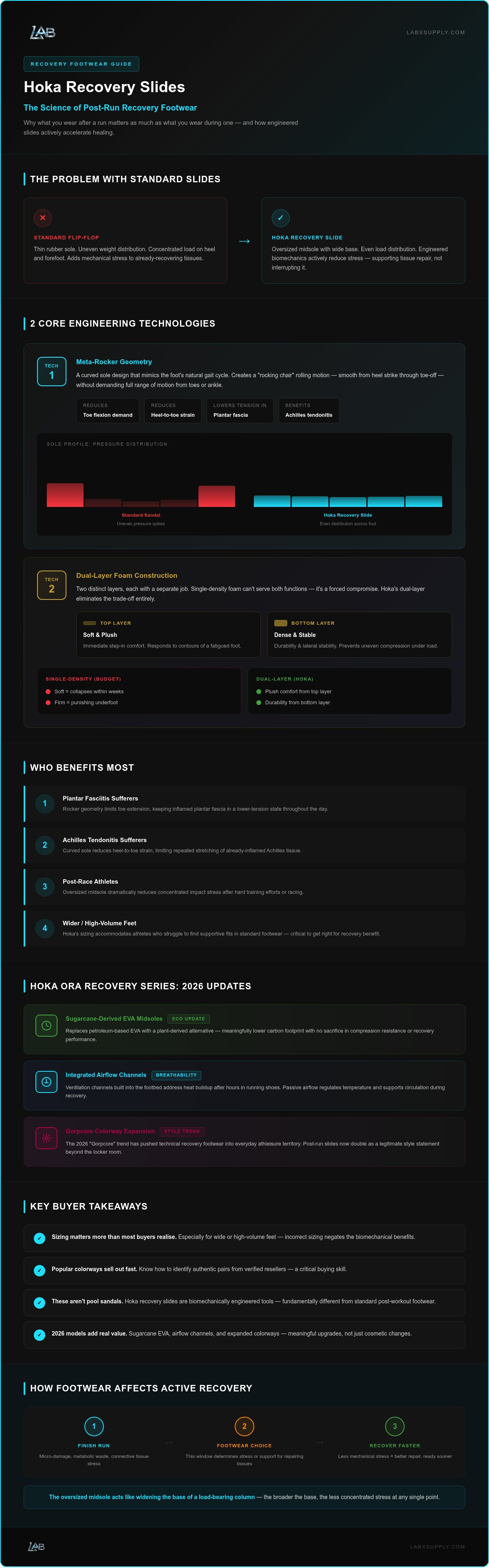
Active recovery isn't passive. It's a deliberate physiological process where the body repairs micro-damaged muscle fibers, clears metabolic waste, and restores connective tissue integrity between training sessions. The footwear you choose during this window directly influences how efficiently that process unfolds. Slip on a flat, unsupported sandal and you're adding low-grade mechanical stress to tissues that are already under repair. Choose engineered recovery footwear and you're actively removing that stress from the equation.
The difference comes down to architecture. Standard flat-soled sandals distribute your body weight unevenly, placing disproportionate load on the heel and forefoot with every step. Hoka's approach inverts that logic entirely. The oversized midsole, a hallmark of the brand's design philosophy, dramatically increases the surface area absorbing vertical impact forces. Think of it as widening the base of a load-bearing column: the broader the base, the less concentrated stress at any single point.
Understanding Meta-Rocker Geometry
Meta-Rocker geometry is a curved sole design that mimics the foot's natural gait cycle while reducing pressure on the forefoot. In practice, this creates what biomechanists describe as a "rocking chair" effect: the sole rolls smoothly from heel strike through toe-off without demanding full range of motion from the toes or ankle. For a foot recovering from a hard long run, that reduction in toe flexion is significant. Tendons and plantar fascia that have been repeatedly loaded don't need to keep working during recovery hours. The rocker geometry essentially does the propulsion work for them.
For athletes managing plantar fasciitis or Achilles tendonitis, this geometry offers a measurable functional benefit. Both conditions are aggravated by repeated stretching of already-inflamed tissue. A curved sole that limits toe extension and reduces heel-to-toe strain keeps those structures in a lower-tension state throughout the day, supporting tissue repair rather than interrupting it.
Dual-Layer Construction vs. Single-Density Foam
Not all foam is equal, and the distinction matters most when you're on your feet for hours post-race or post-workout. Hoka recovery slides use a dual-layer construction that separates two distinct functional jobs. The softer top layer provides immediate, plush step-in comfort that responds to the contours of a fatigued foot. The denser bottom layer handles durability and lateral stability, preventing the sole from compressing unevenly under load.
Single-density foam, common in budget slides, can't serve both functions simultaneously. It either feels soft initially and collapses quickly, or it's firm enough to last but feels punishing underfoot. The dual-layer approach eliminates that trade-off, which is precisely why athletes who've experienced cheap slides "bottoming out" within weeks notice an immediate difference in long-term support.
Deep Dive: The Hoka Ora Recovery Series Evolution
What started as a niche tool for ultramarathon runners has become one of the most recognizable silhouettes in athletic footwear. The Ora Recovery series didn't earn that position by accident. Hoka iterated deliberately across each generation, solving specific biomechanical problems while gradually building a design language that crossed over from the locker room into everyday wear. By 2026, the Ora line sits at an unusual intersection: clinically credible recovery footwear that also functions as a legitimate style statement.
One of the more significant material shifts in the 2026 models is the broader adoption of sugarcane-derived EVA compounds. Traditional petroleum-based EVA has long been the industry standard for midsole foam, but sugarcane-based alternatives offer a meaningfully lower carbon footprint without sacrificing the compression resistance that makes recovery footwear effective. For athletes who factor environmental impact into their purchasing decisions, this update adds a layer of value that goes beyond performance specs.
Breathability has also received genuine attention in the latest designs. Airflow channels integrated into the footbed address a real problem: feet that have been inside performance running shoes for hours tend to run warm. Passive ventilation built into the slide's architecture helps regulate temperature during recovery, which supports circulation without requiring any active effort from the wearer.
Ora Recovery Slide 2 vs. Slide 3: What Changed?
The gap between these two generations is wider than the version number suggests. Three updates stand out:
- Airflow vents: The Slide 3 introduced expanded vent channels across the footbed, improving thermoregulation compared to the more minimal ventilation of the Slide 2. For post-run use specifically, this reduces the clammy feeling that plagued earlier iterations.
- Footbed texture: Hoka added a more pronounced surface texture to the Slide 3's footbed, which significantly reduces slipping when worn with recovery or compression socks. This was a consistent complaint among Slide 2 users and a practical fix that matters for cold-weather recovery routines.
- Weight reduction: The Slide 3 is lighter than its predecessor. That reduction contributes directly to the "barely there" sensation that makes hoka recovery slides feel less like footwear and more like an extension of the foot itself.
The Slide 3 is now the dominant option in the all-gender recovery slide category, and its combination of updates explains why it displaced the Slide 2 so quickly in the market.
The Ora Luxe and Ora Primo: Premium Alternatives
The Ora Luxe suits athletes who need a more secure fit during extended recovery walks or light errands. Its adjustable strap system accommodates foot swelling that commonly occurs in the hours after long efforts, something a fixed single-band slide can't address. The Ora Primo takes a different direction entirely: its exaggerated "puffy" profile reflects the 2026 Gorpcore aesthetic, where technical outdoor and recovery gear has moved firmly into fashion territory. It functions as a recovery shoe rather than a traditional slide, offering more coverage and a more substantial sole stack. For a detailed look at how this design philosophy developed across generations, The Evolution of the Slide Series breaks down the iterative decisions that shaped where the line stands today.
If you're tracking down a specific Ora model that's sold out at official retailers, verified resellers specializing in authentic Hoka footwear are often the most reliable path to finding genuine pairs without compromising on the recovery technology you're actually paying for.
Performance Comparison: Hoka vs. The Competition
Choosing a recovery slide isn't just about brand loyalty. It's about understanding what your feet actually need after a hard effort and whether the shoe you're considering can deliver it. The recovery slide market has grown crowded, and not every option earns its price tag. Here's how Hoka stacks up against the most common alternatives serious athletes consider.
Hoka vs. OOFOS: The Recovery Showdown
OOFOS built its reputation on one thing: softness. The brand's proprietary OOfoam technology absorbs a meaningful amount of impact energy compared to standard EVA, and the step-in sensation is genuinely plush. For athletes whose primary complaint is general foot fatigue, OOFOS delivers.
The gap between these two brands opens up when structural support enters the conversation. Hoka recovery slides use dual-layer EVA construction that pairs immediate comfort with lateral stability. OOFOS's single-material approach prioritizes that signature "squish" but offers less resistance to uneven compression under load. For runners managing arch fatigue, overpronation tendencies, or plantar fasciitis, the Hoka's architectural support is doing work that OOfoam simply isn't designed to do.
Durability is another point of separation. OOfoam's softness is a feature, but it's also a liability over time. High-mileage athletes often report that OOFOS slides compress noticeably after extended use. Hoka's denser bottom layer resists that degradation, maintaining its geometry longer through repeated recovery cycles.
Aesthetically, the two brands occupy different spaces. OOFOS leans streamlined and understated. Hoka's maximalist sole stack is a deliberate design statement that has moved well beyond the gym bag in 2026.
Hoka vs. Luxury and Lifestyle Slides
Comparing hoka recovery slides to lifestyle options like the Adidas Adilette or high-fashion slides is a bit like comparing a sports car to a concept car: one is built to perform, the other to impress. The Adilette is a poolside classic with genuine comfort credentials, but its flat contoured footbed isn't engineered around gait mechanics or post-workout tissue recovery. For a detailed breakdown of what Adidas slides actually offer, The Ultimate Guide to Adidas Slides covers the full picture.
Luxury recovery-inspired slides from fashion houses have also entered the market in 2026, riding the Gorpcore wave. They borrow the visual language of technical footwear without the underlying biomechanical engineering. For athletes, the price-to-value math doesn't hold up. You're paying a premium for aesthetics while leaving real recovery benefits on the table.
For serious athletes, the calculus is straightforward: Hoka competes on function first, and the style follows. That's a difficult position for lifestyle brands to replicate, regardless of how convincing their midsoles look from a distance.
Buyer's Guide: Sizing, Fit, and Authenticity
Getting the right pair of hoka recovery slides starts before you ever add them to your cart. Sizing errors are the most common reason buyers end up with slides that underdeliver on the recovery benefits the technology promises, and in 2026's active resale market, authenticity has become an equally pressing concern. Both problems are solvable with the right information.
Finding Your Perfect Fit
Hoka uses a unisex sizing system across its Ora recovery line, which creates confusion for first-time buyers. The conversion is straightforward: women should generally size down 1.5 sizes from their standard women's size to find the equivalent men's/unisex size. A women's 9, for example, corresponds to a men's 7.5 in the unisex chart.
Half sizes don't exist in the Ora range, so the practical rule is to size up when you're between sizes. Recovery slides are typically worn with thicker socks, compression socks, or barefoot depending on the season. The "sock test" is a reliable calibration method: try your slides while wearing the thickest socks you'd realistically pair them with, then check two things. First, your heel should sit fully within the footbed with no overhang. Second, the arch contour should align with your own arch, not sit a centimeter behind it. Both misalignments are warning signs that the size is wrong, and no amount of adjustment corrects them.
Hoka's wide footbed geometry is a genuine advantage for high-volume feet. Where standard slides pinch across the forefoot or force the foot into an unnatural narrowing, Hoka's platform accommodates broader foot shapes without requiring a specialty wide-width model. Athletes who've historically struggled to find supportive slides that don't compress the forefoot often find that the standard Ora fits them better than competing "wide" options from other brands.
Spotting Fakes: The Lab X Supply Checklist
The 2026 resale market has produced increasingly convincing counterfeit recovery slides, and the stakes are higher than they are with purely aesthetic footwear. A fake slide doesn't just look wrong; it fails to deliver the biomechanical support you're purchasing. Three checks catch the majority of fakes:
- Meta-Rocker profile: Genuine Hoka slides have a pronounced, consistent rocker curve that's visible from the side. Counterfeits typically flatten this curve, producing a sole that looks chunky but lacks the functional geometry. Place the slide on a flat surface and look at the heel-to-toe arc from eye level.
- Foam density: Press your thumb firmly into the midsole. Authentic Hoka foam resists compression with a specific firmness before slowly rebounding. Fakes often use single-density foam that either feels hollow and plasticky or compresses too easily without spring-back.
- Logo and packaging details: The embossed Hoka logo on the footbed should be crisp and evenly applied. On counterfeit pairs, it's frequently shallow, off-center, or slightly blurred. Packaging fonts on genuine pairs are consistent and clean; fakes often show minor kerning irregularities that are easy to spot once you know to look.
For a broader framework on verifying authentic footwear purchases across brands in 2026, The Ultimate Guide to Authentic Sneakers in 2026 covers the verification process in depth, including how the resale landscape has shifted and what buyers need to know before purchasing high-demand styles.
When official retailers are sold out of a specific colorway or model, buying from a verified reseller is the safest path to a genuine pair. Browse authentic Hoka slides at Lab X Supply to find verified pairs without the authenticity risk that comes with unvetted resale platforms.
Elevating Your 2026 Athleisure Routine
Recovery gear has crossed a threshold. What once lived exclusively in locker rooms and post-race tents is now a legitimate part of how athletes dress throughout the day. The 2026 Gorpcore movement accelerated this shift, pulling technical footwear into street style with a force that no trend forecaster fully anticipated. Hoka slides sit at the center of that crossover, functioning as recovery tools that also read as intentional style choices.
Styling Hoka Slides for Every Day
The socks-and-slides aesthetic has moved from ironic to aspirational in 2026. Pairing hoka recovery slides with ribbed compression socks, wide-leg joggers, and an oversized technical fleece creates a cohesive look that signals athletic credibility without trying too hard. The key is proportion: the chunky midsole already commands visual weight, so the rest of the outfit should stay relaxed rather than structured.
Colorway choice shapes the versatility of your pair. Hoka's neutral tones, think chalk whites, warm taupes, and slate grays, transition cleanly from gym to coffee shop without visual friction. The brand's signature neon palettes, electric yellows and coral oranges, work best as a deliberate contrast pop against monochrome or earth-toned outfits. Neither approach is wrong; it depends on whether you want the slides to anchor the look or punctuate it.
Transitioning from a training session to city errands doesn't require a wardrobe change if your slides are doing their job. Swap the running shoes, keep the compression tights, add a structured jacket. The slide's silhouette is bold enough to carry the look on its own.
Maintenance and Longevity
EVA foam is sensitive to heat. Leaving your slides on a car seat on a warm day isn't a minor inconvenience; sustained heat exposure causes the foam cells to contract, permanently shrinking the midsole and compromising its geometry. Store them in a cool, shaded space and the foam maintains its structure significantly longer.
Cleaning is straightforward. Mild soap, lukewarm water, and a soft brush handle most dirt without degrading the foam. Avoid machine washing or soaking, both can cause delamination between the footbed layers over time. Rinse thoroughly and air dry at room temperature.
Knowing when to replace a pair matters as much as knowing how to care for one. Watch for these signs of foam fatigue:
- Visible sole compression: The midsole looks visibly thinner or uneven, particularly under the heel.
- Loss of rocker feel: The smooth heel-to-toe roll feels flat or effortful instead of fluid.
- Arch misalignment: The footbed contour no longer matches where your arch naturally sits.
When those signs appear, the recovery benefit is largely gone regardless of how the slides look from the outside.
Final verdict: investing in authentic hoka recovery slides isn't a luxury purchase; it's a long-term health decision. Genuine foam geometry, real rocker mechanics, and durable dual-layer construction deliver compounding returns across every recovery session. Counterfeit or poorly engineered alternatives cost less upfront and far more over time in slower recovery, persistent foot pain, and repeated replacement costs. When popular styles are sold out at official retailers, Lab X Supply offers verified authentic pairs so you're never forced to compromise on the technology that actually does the work.
Your Next Recovery Step Starts Here
Your feet do the hard work. What happens after the run matters just as much as the training itself. Hoka recovery slides deliver genuine biomechanical support through real rocker geometry and dual-layer foam construction, not just a thick sole that looks the part. Pair that with the right fit using the sizing guidance covered here, and you're giving your body a legitimate recovery advantage between sessions.
The 2026 market has also made authenticity a real concern. Counterfeit pairs look convincing but can't replicate the engineering that makes these slides worth owning. Buying from a verified source isn't overcautious; it's the only way to guarantee the technology actually works for you.
When official retailers are sold out of the colorway or model you're after, Lab X Supply offers guaranteed-authentic Hoka footwear with expertly curated 2026 selections and fast global shipping. You don't have to settle for a compromised pair or an unverified listing.
Shop authentic Hoka recovery slides at Lab X Supply and give your recovery the foundation it deserves.
Frequently Asked Questions About Hoka Recovery Slides
Are Hoka recovery slides good for plantar fasciitis?
Yes, hoka recovery slides are genuinely well-suited for plantar fasciitis management. The Meta-Rocker geometry limits toe extension and reduces tension on the plantar fascia throughout the gait cycle, keeping inflamed tissue in a lower-stress state during recovery hours. This is a meaningful functional benefit, not just marketing language.
That said, severity matters. For mild to moderate plantar fasciitis, Hoka slides can meaningfully reduce daily aggravation. For acute or chronic cases, they work best as part of a broader management approach that includes stretching, strengthening, and guidance from a podiatrist or sports medicine professional.
Do Hoka slides run big or small?
Hoka slides generally run true to size, but the unisex sizing system catches many buyers off guard. Women need to size down approximately 1.5 sizes from their standard women's size to find the correct unisex equivalent. Since half sizes aren't available in the Ora range, sizing up when you're between sizes is the safer call, particularly if you plan to wear them with thicker or compression socks.
Can you wear Hoka recovery slides outside?
Yes, Hoka slides are designed to handle light outdoor use. The rubber outsole provides adequate traction on pavement, light trails, and wet surfaces around pools. They're a practical choice for post-run errands, walking to a car, or navigating a gym parking lot.
They aren't designed for extended outdoor walks or uneven terrain. For anything beyond casual outdoor movement, the lack of a heel strap on standard slide models means less foot security than a dedicated outdoor sandal would provide. The Ora Luxe's adjustable strap makes it a better fit for longer recovery walks.
How long do Hoka recovery slides last before losing their cushion?
With regular daily use, most athletes find that Hoka slides maintain their cushioning integrity for roughly one to two years before noticeable foam fatigue sets in. Signs to watch for include a visually compressed midsole, a flattened rocker feel, and arch contour that no longer aligns with your foot. At that point, the recovery benefit is largely gone regardless of how the slides look externally.
Longevity depends heavily on storage habits. Heat is the main enemy of EVA foam; leaving slides in a hot car or direct sunlight accelerates foam cell degradation faster than wear does.
Are Hoka recovery slides unisex?
Yes, the Ora Recovery line uses a unisex sizing system across its core models. This means a single size run covers all genders, which simplifies the product lineup but requires buyers to apply the size conversion correctly. Women typically size down 1.5 from their standard women's size; men and those who wear men's sizing can use the listed size directly.
What is the difference between Hoka Ora Recovery Slide 2 and 3?
The Slide 3 introduced three meaningful improvements over its predecessor: expanded airflow vent channels for better post-run thermoregulation, a more textured footbed surface that reduces slipping when worn with socks, and a modest weight reduction that contributes to the lighter underfoot feel. These aren't cosmetic updates; each one addresses a specific complaint that Slide 2 users reported consistently.
The Slide 3 is now the primary option in the range for most athletes, and it's the version you'll find most commonly available through both official retailers and verified resellers. If you encounter a Slide 2 at a significant discount, the Slide 3's improvements are worth the difference for serious recovery use.
Can I wash my Hoka slides in the washing machine?
No, machine washing isn't recommended. The agitation cycle and prolonged water exposure can cause delamination between the footbed layers, which compromises both comfort and structural support. Cleaning is straightforward without a machine: mild soap, lukewarm water, and a soft brush handle most dirt effectively. Rinse thoroughly and air dry at room temperature away from direct heat sources.
Why are Hoka slides so thick?
The oversized midsole isn't a style choice that happened to become functional; it's a deliberate engineering decision. A thicker sole dramatically increases the surface area absorbing impact forces, which reduces the concentrated load at any single point on the foot. Combined with the rocker geometry, the extra stack height creates the smooth, propulsive feel that distinguishes Hoka slides from standard recovery footwear.
The thickness also accommodates the dual-layer foam construction, where the softer top layer handles comfort and the denser bottom layer provides stability. You can't achieve both in a thin sole without sacrificing one function for the other.