
What if your footwear could absorb 37% more impact than traditional materials, turning every step into a session of active healing? Many people assume a basic sandal is enough for post-workout lounging, but modern recovery slides have evolved into precision-engineered tools designed to reduce joint load and accelerate muscle repair. If you've ever dealt with persistent foot soreness after a long run or the sharp sting of plantar fasciitis, you know that standard footwear often falls short when your body needs rest the most.
We understand the frustration of feeling sidelined by foot fatigue or struggling with hard, unforgiving floors at home. This article explores the science of biomechanical engineering and how specific foam densities can significantly cut your recovery time between workouts. You'll learn why the 2026 market is shifting toward active intervention rather than just passive comfort. We'll also preview the latest technology and help you find a versatile slide that offers both immediate pain relief and professional-grade support for your daily routine.
Key Takeaways
- Understand the evolution of recovery slides from basic sandals to performance-grade equipment that actively supports muscle repair.
- Discover how specialized foam chemistry and rocker-bottom soles work together to minimize physical effort while you walk.
- Learn to identify the durability markers that distinguish high-quality recovery tools from standard slides that flatten over time.
- Find your ideal fit by matching footwear technology to your specific arch height and daily recovery needs.
- Explore the active recovery philosophy to build a balanced rotation of sneakers and slides for optimal foot health.
What Are Recovery Slides? Defining the 2026 Standard
Recovery slides represent a professional shift in how we approach foot health after physical exertion. By 2026, these products have moved far beyond the thin, rubber flip-flops of the past. They're now recognized as essential performance equipment designed to reduce the mechanical load on your joints and muscles. While a standard slide might focus on simple aesthetics or basic protection from hot pavement, a true recovery model uses biomechanical engineering to facilitate active healing. This evolution is driven by a growing understanding that what you wear after your workout is just as vital as the sneakers you wear during it.
You'll notice the technical difference immediately in the physical silhouette of the shoe. These slides typically feature oversized midsoles, deeply contoured footbeds, and anatomical arch support that mimics the natural shape of the human foot. This design ensures your weight is distributed evenly across the entire sole. By 2026, the market has expanded to include "all-day recovery" options, making this technology accessible for everyone from marathon runners to people who simply spend long hours standing on unforgiving household floors.
The Core Purpose: Impact Absorption vs. Style
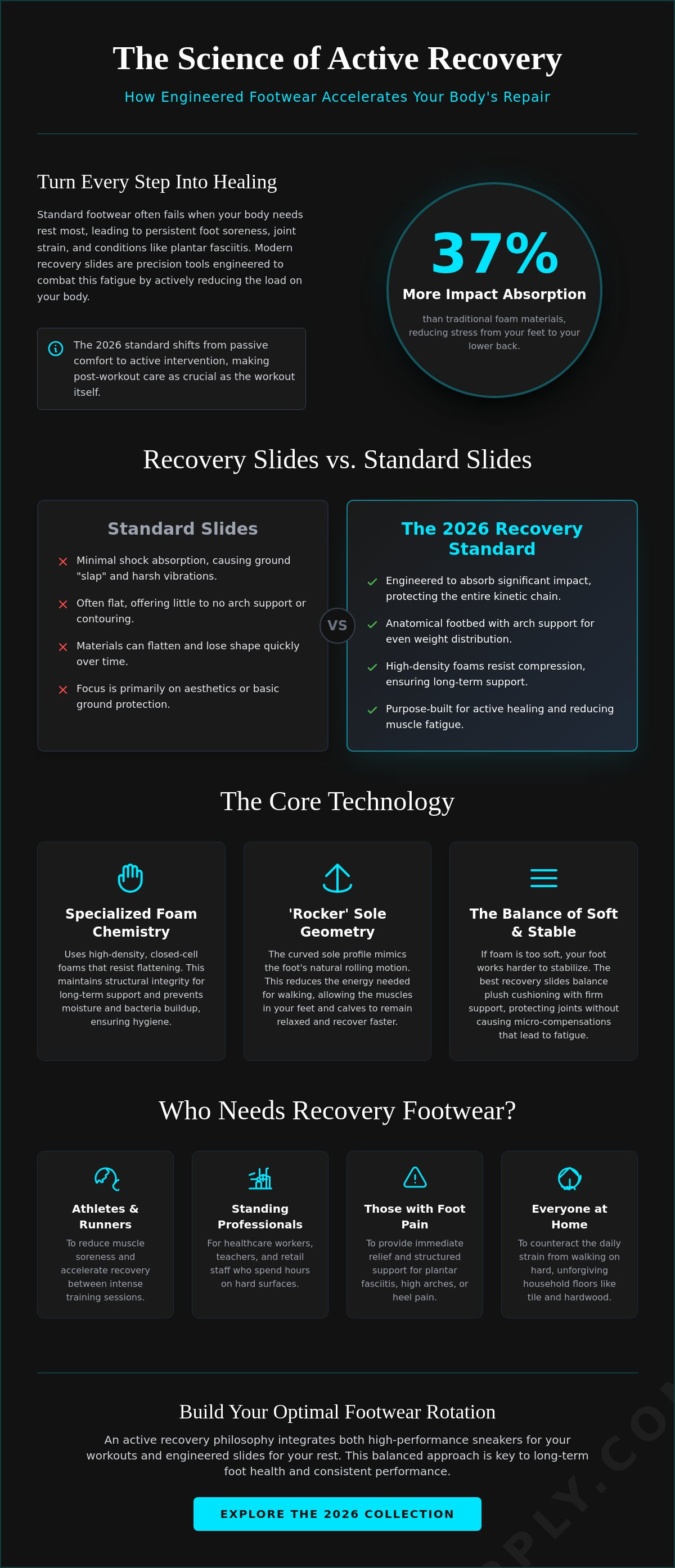
The primary distinction between recovery footwear and standard beach sandals lies in energy management. Basic sandals offer minimal shock absorption, often causing the wearer to "slap" the ground. This sends harsh vibrations up the kinetic chain, impacting the ankles and knees. In contrast, high-end Oofos recovery footwear utilizes proprietary technology validated to absorb 37% more impact than traditional foam materials. The goal is to reduce the energy required for walking during your rest phase. This protection extends from the foot up to the lower back, ensuring that every step you take contributes to your body's repair rather than adding to its fatigue.
Who Needs Recovery Footwear the Most?
While athletes were the early adopters, the 2026 landscape shows a much broader audience for these tools. Distance runners and gym enthusiasts use them to bridge the gap between high-intensity training sessions. However, healthcare workers, retail professionals, and teachers who stand on hard surfaces for eight hours a day find them equally indispensable. They're also a critical resource for individuals managing chronic conditions like plantar fasciitis. Because these slides provide structured support that traditional slippers lack, they offer immediate relief for those with high arches or persistent heel pain, making them a versatile choice for both home and gym use.
The Science of Soles: How Recovery Technology Works
The effectiveness of modern recovery slides lies in the molecular structure of their foam. While many standard sneakers use traditional Ethylene Vinyl Acetate (EVA) for its lightweight bounce, recovery-specific footwear utilizes high-density, closed-cell foams. These materials aren't just softer; they're designed with higher compression set resistance. This means the footwear won't flatten out or lose its supportive properties after a few weeks of heavy use. This specialized chemistry allows the sole to cradle the foot while maintaining the structural integrity needed for long-term relief. The closed-cell nature of these foams also serves a practical hygiene purpose, as it prevents moisture, bacteria, and odors from penetrating the surface of the slide.
Beyond the material, the 'Rocker' geometry is a hallmark of 2026 design. This curved sole profile mimics the foot's natural rolling motion during a stride. By reducing the mechanical energy required for the 'toe-off' phase of walking, these slides allow the muscles in your calves and feet to remain relatively dormant. This mechanical advantage is a primary reason why medical experts often discuss how recovery sandals can help alleviate the strain associated with common overuse injuries. If you want to experience this engineering firsthand, you can explore our latest collection of slides designed for post-training relief.
Foam Density and Energy Return
Many users mistakenly believe that the softest shoe is always the best for recovery. However, a paradox exists: if a foam is too "squishy," your foot must work harder to stabilize itself with every step. High-quality recovery slides find a precise balance between plush cushioning and firm support. This ensures that your foot is protected without being forced into micro-compensations that could lead to further fatigue or joint strain. Advanced materials like Nike's ReactX technology, set for a broad 2026 release, exemplify this shift toward active intervention by providing consistent pressure distribution across the entire footbed.
Biomechanical Support and Alignment
Alignment is about more than just the arch. Modern designs incorporate metatarsal support to encourage natural toe splay, which is often restricted by narrow athletic sneakers. Deep heel cupping is another critical feature; it centers the heel to reduce side-to-side wobble, protecting the ankle and Achilles tendon. This focused approach to geometry enhances proprioception, helping your brain and body recalibrate after the intense physical stress of a workout. Additionally, these materials are engineered for thermoregulation, using breathable textures to prevent heat buildup and ensure your feet stay cool during the critical hours of muscle repair.
Recovery Slides vs. Standard Slides: Is the Investment Worth It?
Choosing between a basic sandal and a dedicated recovery tool often comes down to a misunderstanding of materials. Standard slides are typically manufactured from inexpensive rubber or PVC. While these materials are durable enough for the beach, they provide almost no shock absorption. In fact, they often return energy directly into your tired joints, which can prolong soreness. Specialized recovery slides utilize advanced polymers designed specifically to dissipate impact. When you consider that proprietary foams can absorb significantly more impact than traditional EVA, the technical advantage becomes clear. You aren't just paying for a brand name; you're paying for a material that actively protects your kinetic chain from the heel to the lower back.
Durability is another area where the investment pays off. Cheap, mass-market slides tend to flatten out within a few months of consistent use. Once the foam compresses permanently, the support vanishes, leaving your feet to strike hard surfaces with every step. High-performance recovery footwear is engineered with superior compression set resistance. These pairs maintain their anatomical shape and "bounce" for much longer, providing a consistent level of relief. From a price-per-wear perspective, a single pair of high-quality slides often outlasts three pairs of budget alternatives while simultaneously reducing the risk of costly overuse injuries.
Performance vs. Aesthetics
The footwear industry has seen a massive shift toward "ugly-cool" aesthetics, where chunky, oversized midsoles are now a fashion statement. This trend was pioneered by brands like Hoka and OOFOS, who prioritized podiatric health over slim profiles. This shift has even influenced how legacy brands design their classic lineups, including the latest iterations of adidas slides. Today's consumer doesn't have to choose between looking good and feeling supported. You can find options that offer sophisticated arch mapping while still fitting into a modern, street-ready wardrobe.
When Standard Slides Are Sufficient
There are still moments where a standard slide is the appropriate choice. If you only need footwear for a quick transition in a gym locker room or a walk across hot sand at the beach, a basic pair will suffice. Similarly, if your priority is high-fashion social settings, luxury options like gucci slide sandals mens offer unparalleled style for your rotation. However, these shouldn't be your primary choice for "hard floor" environments at home. For those who spend hours walking on tile or hardwood, the mechanical support of Adidas slides men or dedicated recovery models is essential to prevent the cumulative strain that leads to conditions like plantar fasciitis.
Selection Guide: Finding Your Perfect Pair of Recovery Slides
Selecting the right pair of recovery slides requires more than just picking a brand you recognize. To maximize the biomechanical benefits discussed earlier, you must match the footwear to your specific foot profile and lifestyle. Follow these five steps to ensure your choice supports your body's healing process rather than hindering it.
- Step 1: Identify your primary use case. If you need a pair for post-run relief, look for maximum impact absorption. For home use on hardwood or tile, focus on arch support to prevent the cumulative fatigue of walking on flat, hard surfaces.
- Step 2: Determine your arch type. High arches require a contoured footbed that fills the gap under the foot to distribute pressure. Neutral arches can handle a wider variety of designs, but they still benefit from structured support.
- Step 3: Evaluate the 'squish' factor. While a plush, soft feel is immediately satisfying, firm support is often better for long-term joint alignment. You want a material that yields under your weight but doesn't bottom out.
- Step 4: Check for adjustable straps. If you have high-volume feet or a high instep, a fixed strap can cause uncomfortable pressure or restricted blood flow. Adjustable uppers allow for a customized fit.
- Step 5: Account for post-workout swelling. Your feet can expand significantly after a long workout or a day on your feet. Sizing that feels slightly roomy in the morning might be perfect after a high-intensity session.
Ready to upgrade your post-workout routine? You can shop our full range of recovery slides to find the perfect fit for your specific needs.
Matching Slides to Foot Conditions
For those managing Plantar Fasciitis, look for slides with deep heel cups and rigid arch support. These features help stabilize the plantar fascia ligament and reduce the sharp pain often felt during the first steps of the day. Wide feet benefit from 'flex' models or adjustable uppers that prevent pinching at the forefoot. People with flat feet should avoid overly soft, non-contoured slides because they lack the necessary structural support to prevent overpronation.
Material and Maintenance Considerations
Most recovery footwear is made from closed-cell foam, which is easy to maintain. Some models are machine washable on a cold cycle, while others require a simple hand-wash with mild soap. Always check the outsole pattern; deep grooves and multi-directional traction are essential if you plan to wear them on wet surfaces like pool decks or gym showers. Finally, keep an eye out for 'foam fatigue.' If you notice deep horizontal creases in the midsole or a significant loss of 'bounce,' it's time to replace your pair to ensure you're still getting the intended orthopedic benefits.
Building Your 2026 Footwear Rotation
The concept of a footwear rotation has shifted from a fashion-focused hobby to a health-focused necessity. By 2026, the "Active Recovery" philosophy has become the gold standard for anyone who values long-term mobility. This approach suggests that your feet should never be left to fend for themselves on hard, flat surfaces. Instead of only caring about your shoes during a workout, you treat the hours between training sessions as a critical window for repair. A balanced rotation requires high-performance sneakers for your active hours and dedicated recovery slides for your downtime.
Looking ahead, the technology in this space continues to move toward extreme personalization. We're already seeing the rise of 3D-printed custom lattices that can be tuned to an individual's specific pressure points. Some high-end models in 2026 even integrate biosensors that monitor gait and foot temperature, providing real-time feedback through mobile apps. These advancements ensure that your recovery isn't just passive; it's data-driven and tailored to your body's unique needs. Integrating these tools into your daily life means you're not just resting; you're actively preparing for your next physical challenge.
Authenticity and the Resale Market
As the demand for specialized recovery footwear grows, so does the risk of the "counterfeit foam" trap. Many secondary marketplaces are flooded with replicas that mimic the look of popular slides but use generic, low-grade EVA foam. These fakes cannot replicate the proprietary chemical makeup required to achieve significant impact absorption. Without the correct foam density, a slide is just a piece of shaped plastic that offers zero orthopedic benefit. Lab X Supply ensures the authenticity of every product, providing customers with the peace of mind that their gear will actually perform as advertised. Buying from a trusted marketplace is the only way to guarantee you're getting the biomechanical support your feet require.
Final Verdict: Are They a Gimmick?
It's easy to dismiss specialized footwear as marketing hype, but the clinical data tells a different story. When a material is validated to absorb 37% more impact than traditional foams, the benefit to your joints is objective and measurable. Prioritizing foot recovery isn't about luxury; it's about reducing the cumulative strain that leads to chronic injuries. By investing in the right tools, you're shortening the gap between your workouts and protecting your body for years to come. If you're ready to feel the difference that professional engineering makes, explore our curated selection of high-performance slides at Lab X Supply and take the first step toward a more effective recovery routine.
Step Into the Future of Foot Health
The innovation seen throughout 2026 has proven that the hours you spend resting are just as vital as the minutes you spend training. By choosing recovery slides engineered with specialized foam densities and rocker soles, you're giving your body a mechanical advantage. These tools do more than just provide temporary comfort. They actively reduce joint load and support the natural alignment of your feet, whether you're recovering from a high-intensity workout or a long day on hard household floors.
Don't settle for generic sandals that lack the technical support your body deserves. Building a balanced footwear rotation is the most effective way to ensure your mobility remains intact for years to come. At Lab X Supply, we provide an expertly curated selection of top performance brands with guaranteed authenticity on every pair. You can also count on fast shipping across the United States to get your gear exactly when you need it. Shop Authentic Recovery Slides and Sneakers at Lab X Supply. Your body works hard every day, so give it the professional-grade support it needs to bounce back stronger.
Frequently Asked Questions
Can I wear recovery slides as my primary shoes all day?
You can wear them for extended periods, but they shouldn't be your only footwear for all activities. While they offer excellent support for walking on hard surfaces at home or after the gym, they lack the lateral stability required for sports or heavy lifting. Most experts suggest a rotation that includes structured sneakers for activity and recovery slides for rest periods to ensure your feet stay adaptable.
Do recovery slides really help with plantar fasciitis?
Yes, recovery slides are highly effective for managing plantar fasciitis symptoms. The deep heel cups and built-in arch support take pressure off the plantar fascia ligament, which is often most painful after periods of rest or intense exercise. By providing a contoured surface that mimics the foot's natural shape, these slides prevent the ligament from overstretching on flat ground during the healing process.
How should recovery slides fit compared to normal sneakers?
Recovery slides should generally fit slightly looser than your standard training sneakers. This extra room is intentional to accommodate the natural foot swelling that occurs after a workout or a long day of standing. You want a secure fit across the top of the foot, but your toes should have plenty of space to splay naturally without hitting the edges of the footbed.
What is the difference between Hoka recovery slides and OOFOS?
The main difference lies in the foam technology and the sole geometry. Hoka utilizes a dual-layer construction with a soft top layer and a durable CMEVA midsole featuring their signature early-stage meta-rocker. OOFOS uses proprietary OOfoam technology, which is verified to absorb 37% more impact than traditional footwear materials. Both brands offer professional-grade relief, but they feel different underfoot due to these distinct chemical compositions.
Are recovery slides better than Crocs for foot pain?
Recovery slides are generally superior for therapeutic foot pain relief because they're specifically engineered for biomechanical recovery. While Crocs offer general comfort and a wide fit, they often lack the aggressive arch mapping and rocker-bottom technology found in performance recovery gear. If you're dealing with specific conditions like high arches or heel pain, the specialized foam in a recovery slide provides more targeted support.
How long do recovery slides last before the foam loses its effectiveness?
Most high-quality recovery slides maintain their effectiveness for approximately six to twelve months with daily use. You'll know it's time to replace them when the foam feels noticeably flatter or when you see deep compression wrinkles in the midsole. Once the material loses its ability to rebound, it can't provide the same level of impact absorption or joint protection as a fresh pair.
Can recovery slides be worn with socks?
Yes, wearing socks with your slides is a perfectly acceptable and common practice. Many athletes prefer this combination to keep their feet warm after a workout, which can help maintain blood flow to the muscles. It also adds a layer of hygiene if you're using the slides in public spaces like gym locker rooms or during travel after a long race.
Are there recovery slides specifically designed for flat feet?
Yes, individuals with flat feet should look for models that emphasize structured arch support and a firm footbed. While it's tempting to choose the softest possible slide, flat feet actually require more stability to prevent overpronation. Choosing a model with a rigid, contoured arch helps maintain proper alignment and prevents the foot from collapsing inward during each step you take.