
The New Balance 550 isn't just narrow; it's a rigid 1980s basketball relic that requires a "Lock-and-Stretch" approach to sizing. You've likely spent time staring at a resale listing, worried that the narrow toe box or the heavy sole will lead to uncomfortable heel drag. It's a common anxiety for collectors because getting it wrong means dealing with a stiff leather upper that doesn't forgive easily. When you're dropping money on a classic silhouette, you want to ensure it feels as good as it looks.
We understand that hesitation, especially when you're investing in a design that has dominated the scene since its 2020 resurgence. This guide offers the definitive new balance 550 sizing advice to ensure you find a perfect fit without the guesswork. We'll break down exactly how they stack up against Nike's standard fit, the best way to lace them to prevent slipping, and whether your specific foot shape requires going up a half size. By the end of this breakdown, you'll have the confidence to click buy and the knowledge to keep your sneakers comfortable all day long.
Key Takeaways
- Learn whether to stick with your True to Size fit or go up a half size based on your specific foot width and the 550's narrow construction.
- Discover why our new balance 550 sizing advice suggests a specific lacing technique to combat the common issue of heel slip caused by the heavy rubber cupsole.
- Compare the 550’s tapered toe box and rigid build against other popular sneakers like the Nike Air Force 1 and Dunk Low to find your ideal fit.
- Understand the break-in process required for the stiff leather uppers to ensure your sneakers transition from rigid to comfortable.
- Use sizing consistency and build anatomy as a primary method for authenticating pairs when shopping for sneakers in the resale market.
Understanding the New Balance 550 Silhouette and Build
The New Balance 550 didn't start as a street-style staple. It began in 1989 as a low-top performance basketball shoe designed by Steven Smith. You can explore the full New Balance 550 history to see how it sat in the archives for decades before its massive 2020 resurgence. Because it was built for the hardwood of the late 80s, the construction is fundamentally different from the lightweight, flexible runners most people wear today. It relies on a thick, heavy rubber cupsole and layered leather panels. This vintage build means the shoe doesn't naturally flex or stretch. It's a rigid frame that demands a specific approach to fit.
In 2026, material standards have shifted toward more sustainable, recycled components. While this is better for the planet, these newer synthetic and eco-leather blends often feel even stiffer out of the box than the plush leathers seen in earlier releases. This lack of natural elasticity is a core reason why new balance 550 sizing advice often leans toward a careful break-in period. You aren't just wearing a shoe; you're molding a piece of 80s architecture to your foot. The dense rubber sole won't compress quickly, so that initial "stiffness" you feel is a feature of its basketball heritage, not a sign of the wrong size.
The Role of the Shallow Heel Cup
One of the most frequent complaints about the 550 is the sensation of heel slip. This happens because the 550 features a notably shallow heel collar compared to its high-top sibling, the 650. The inclusion of a thick Ortholite insole provides excellent cushioning, but it also lifts your foot higher within the shoe. This reduces the vertical space available to lock your heel in place. If you plan on wearing thick athletic socks, you may find the heel feels even more "short" at the back. This is a critical factor when deciding your size, as a shoe that's too long will exacerbate this slipping sensation.
Leather vs. Suede: Does Material Change the Fit?
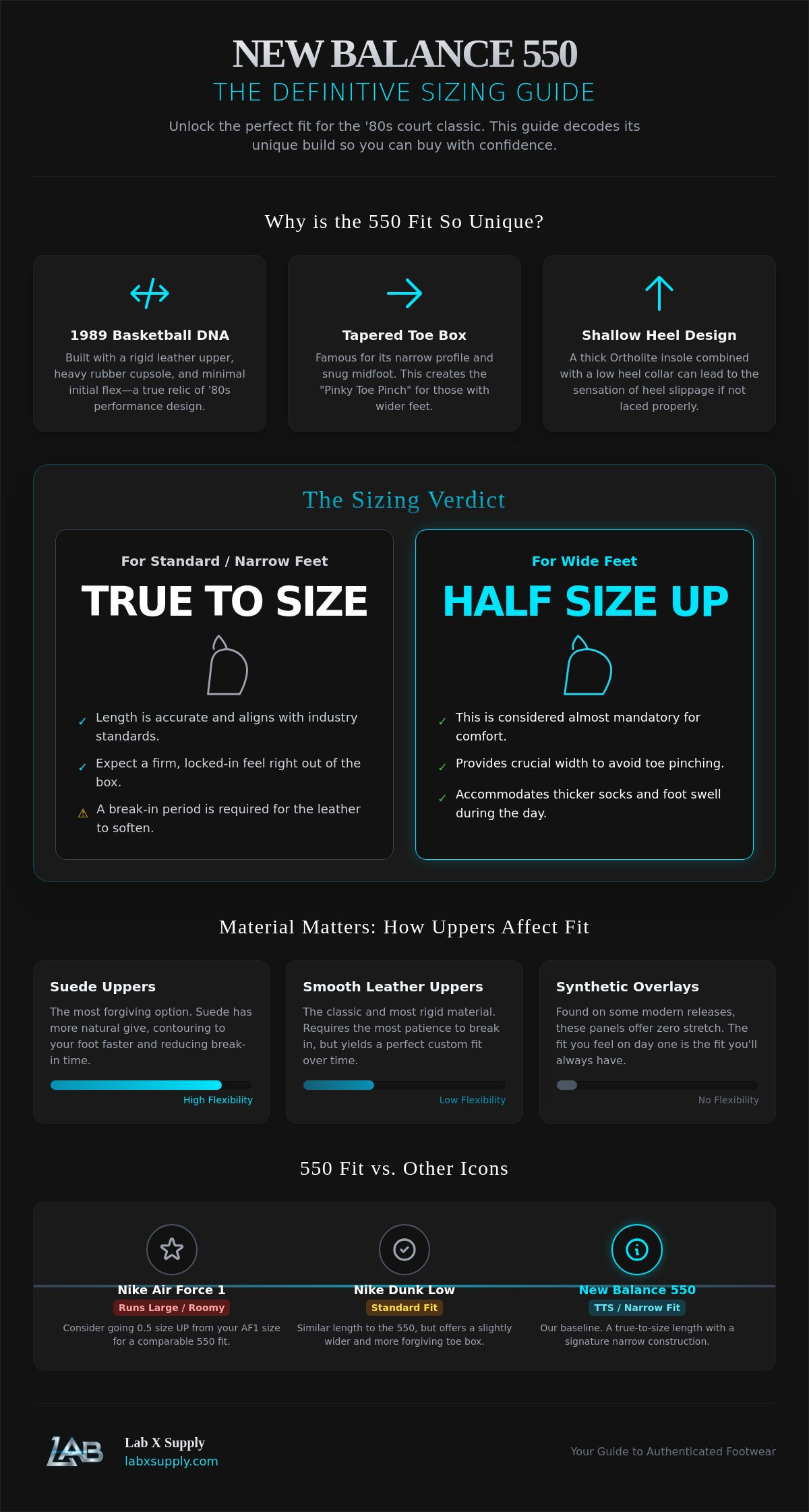
The material you choose significantly impacts the initial comfort. Suede 550 models are generally more forgiving. The fibers in suede have more natural give, allowing the shoe to contour to a wider foot faster than traditional leather. Classic white colorways, typically made of smooth leather, remain the most rigid. Some 2026 releases also feature synthetic overlays. These specific panels don't stretch at all, meaning if the shoe feels tight in the store, it will likely stay tight for months. Understanding these material differences is the first step toward mastering new balance 550 sizing advice.
New Balance 550 Sizing: True to Size or Half Size Up?
The most common question for any prospective buyer is whether to stick with their standard size or adjust for the shoe's unique shape. For the majority of wearers, the verdict is clear: stick to your True to Size (TTS). While the 1980s basketball build is inherently stiff, the actual length of the shoe aligns well with standard industry measurements. If you typically wear a US 10 in most brands, a US 10 in the 550 should provide the correct distance between your toes and the end of the footbed. According to The Sole Supplier's 550 sizing guide, staying TTS is the safest bet for anyone with a standard or narrow foot profile.
However, the "Narrow" factor is where things get complicated. The 550 is famous for its snug midfoot and tapered toe box. It doesn't offer the voluminous interior of a modern chunky sneaker. Instead, it hugs the arch of your foot quite tightly. This can create a sensation of being "too small" even if the length is perfect. To get the most accurate results, measure your foot at home by tracing it on a piece of paper and measuring the length in centimeters. Comparing this to the official New Balance scale is the best way to apply new balance 550 sizing advice before you commit to a purchase.
You may find that the shoe fits perfectly in length but causes significant discomfort at the outer edge of your foot. This is the "Pinky Toe Pinch," a common symptom of the 550's rigid side walls. If you experience this during a trial fitting, it's a sign that the width, not the length, is the issue. If you're looking for a pair that offers a bit more flex from day one, you might want to browse the latest suede sneakers in the 550 lineup, as they tend to accommodate the foot's width more readily than smooth leather.
The Wide Foot Survival Guide
If you have wide feet, going up a half size (0.5) is almost mandatory. The tapered front of the 550 leaves very little room for the forefoot to splay. Without that extra half-size of wiggle room, the leather overlays will press against your metatarsals, leading to a painful break-in period that may never actually resolve. In some specific regions, New Balance occasionally releases "Wide" (2E) versions of the 550, though these are rare in the resale market and usually limited to core colorways like white and grey.
Sizing for Women and Kids
The 2026 lineup is largely unisex-first, but the sizing labels can still be confusing. To convert Men's or Unisex sizing to Women's, use the standard 1.5 size rule. For example, a Men's US 7 is equivalent to a Women's US 8.5. If you're looking at Grade School (GS) sizes, be aware that these models often feel stiffer than adult pairs. The materials used in "Big Kids" versions are frequently less premium, meaning they won't stretch as much over time. Always check the specific size chart for the model you're eyeing to ensure the new balance 550 sizing advice you're following applies to that specific age category.
Solving the Heel Slip and Comfort Challenges
Heel slip is the most common grievance for 550 owners. It isn't always a sizing error; it's physics. The heavy rubber cupsole acts like a lever. Because the heel collar is notably shallow, your foot wants to lift out of the shoe before the stiff sole can flex. This is why a brand-new pair will almost always slip for the first 5 miles of walking. You need that time to break the "spine" of the rubber so it moves with your gait. Once the sole softens, the slipping usually subsides.
Effective new balance 550 sizing advice must include lockdown strategies. If you find your heel lifting, don't immediately assume you need a smaller size. A smaller size might crush your toes while the heel still slips due to the shoe's geometry. Instead, focus on how you're securing the foot within that rigid 1980s frame. The goal is to minimize internal movement without cutting off circulation to your midfoot.
The Lace-Locking Solution
The extra eyelet at the top of the 550 is the key to a better fit. Using the "Runner's Loop" technique is the most effective fix for persistent slipping. To do this, thread the lace through the final eyelet to create a small loop on each side. Cross the laces and pull them through the opposite loops before tying normally. This creates a cinch around the ankle that pulls the foot back into the heel cup.
Lace material also matters. Thicker cotton laces provide significantly better friction than the flat synthetic laces found in some 2026 releases. Cotton stays tied and prevents the lacing system from loosening as you walk. However, avoid pulling the top laces too tight. The 550's tongue is relatively thin, and over-tightening to fix a slip can cause "lace bite," which is a sharp, nagging pressure on the bridge of your foot.
Sock Selection for the Perfect Fit
The socks you choose can make or break the experience. No-show socks are the enemy of the 550. They sit below the heel line, allowing your skin to rub directly against the stiff leather collar. This increases the "slick" feeling that causes slipping and often leads to blisters during the break-in period. For the best experience, consider these choices:
- Quarter Socks: These provide a protective barrier between your heel and the leather without being too bulky.
- Cushioned Crew Socks: If your pair feels slightly large, a thicker crew sock fills the volume gap and provides the necessary friction for a secure fit.
- Cotton Blends: Stick to cotton for grip. Avoid high-percentage polyester or moisture-wicking synthetics, as these materials are often too smooth, making the interior of the shoe feel slippery.
By combining the right lacing technique with appropriate hosiery, you can overcome the 550's structural challenges. This approach ensures your new balance 550 sizing advice works in practice, allowing the shoe to feel like a natural extension of your foot rather than a heavy attachment.
Comparative Sizing: How the 550 Matches Against Other Icons
Understanding how this silhouette fits relative to the industry's most popular models is the fastest way to avoid a return. Most sneakerheads use Nike as their baseline, but applying that same logic to New Balance can be tricky. Because the 550 is built on a 1980s basketball last, it has a distinct shape that differs from modern lifestyle shoes. This new balance 550 sizing advice focuses on these direct comparisons to help you translate your existing collection into the right 550 size.
When comparing the 550 to the Nike Dunk Low, the most immediate difference is the toe box. The Dunk Low features a more rounded, traditional shape that offers a bit more vertical room for your toes. In contrast, the 550 is significantly more tapered at the front. If you find the Dunk Low to be a perfect fit, you might feel a slight pinch in the 550 unless you have a narrow foot. Similarly, the Reebok Club C offers a similar retro aesthetic but uses much softer, thinner leather. This makes the Club C feel more flexible and roomier than the 550, which maintains its rigid structure even after months of wear.
The 550 vs. Nike Air Force 1
The Nike Air Force 1 is the most common point of comparison, but the two shoes fit very differently. The Air Force 1 is notorious for running large, often requiring users to size down. Interestingly, the new balance 550 sizing advice for those coming from the AF1 is often to go 0.5 size down from your AF1 size if you prefer a very snug, locked-in feel, though most find that the 550's narrowness makes it feel smaller. Both shoes share a flat-sole 80s basketball heritage, meaning neither offers the aggressive arch contours of a modern runner.
Weight is another factor to consider. While the Air Force 1 is a heavy shoe, the 550 often feels more "bottom-heavy" because of its dense rubber cupsole. This weight distribution can make the shoe feel like it's pulling away from your heel, a sensation you won't find as prominently in the AF1. If you want to compare these iconic styles for yourself, you can find a wide selection of sneakers to help you decide which silhouette suits your foot shape best.
Internal Brand Comparison: 550 vs. 990v6
If you're coming from New Balance's "Made in USA" series, like the 990v6, prepare for a completely different experience. The 990 series is built for performance and long-distance comfort, offering a much wider natural footprint and significant arch support. The 550 is a lifestyle-focused retro with a much flatter internal bed. This lack of structure means your foot might splay differently than it does in a technical runner. The 550's firm EVA foam provides a stable, retro feel that contrasts sharply with the plush, energy-returning FuelCell cushioning found in the 990v6. Because the 990v6 has so much more internal volume, you should not assume your 990 size will fit the same in a 550.
Finding Your Perfect Pair: Authentication and Selection Tips
Sizing isn't just about comfort; it's a vital tool for verification. In the 2026 resale market, counterfeiters have become increasingly sophisticated, but they still struggle with the structural nuances of the 550. An authentic pair follows a very specific blueprint. If you've absorbed all the new balance 550 sizing advice regarding the narrow toe box and rigid midfoot, you're already better equipped to spot a fake. Counterfeit versions, often called "reps," frequently use generic lasts that result in a wider, more forgiving fit than the genuine 1989 design. If a pair feels "roomy" in the arch right out of the box, it's a significant red flag.
Beyond the fit, the size tag itself is a giveaway. On an authentic New Balance 550, the font on the interior tongue tag is crisp, with precise spacing between the US, UK, and EU size conversions. Spacing errors, blurred ink, or a font that appears too "bold" are immediate warning signs. Always cross-reference the SKU on the box with the tag inside the shoe. At Lab X Supply, we prioritize these details so you don't have to worry about the technicalities of verification. We ensure that every pair matches the factory specifications for that specific production year.
Authenticity and Sizing Consistency
One of the hardest features for counterfeiters to replicate is the 550's weight. Because the authentic model uses a solid, dense rubber cupsole, it should feel substantial in your hand. If a pair feels unexpectedly light or "airy," it likely contains a cheaper foam core instead of the heavy rubber required for that vintage basketball feel. This structural difference directly affects how the shoe fits and breaks in over time. For a deeper dive into protecting your collection, check out our Authentic Sneakers: The Ultimate Collector's Buying Guide. This resource covers the latest 2026 trends in sneaker verification and trust.
Ready to Buy? Shop the 550 Collection
Now that you've mastered new balance 550 sizing advice, you're ready to secure your pair. Shopping with a trusted source is the only way to ensure the dimensions and materials match the high standards set by New Balance. Lab X Supply offers a curated selection of verified sneakers, where every pair undergoes a rigorous inspection for both size accuracy and authenticity. We check the tension of the leather, the weight of the sole, and the alignment of the embroidery to ensure your investment is protected. Our guarantee means you can shop with the confidence that your 550s will fit exactly as the heritage design intended.
As a final tip for your purchase: if you find yourself sitting exactly between two sizes, always lean toward the larger option. The 550's rigid leather and tapered front are much easier to manage with a slightly thicker sock or a heel-lock lacing method than they are if the shoe is even a millimeter too small. A pair that is too tight will likely never stretch enough to be comfortable, whereas a slightly roomy pair can be perfected with the techniques we've discussed throughout this guide.
Step Into Your Perfect Pair Today
You now understand that the New Balance 550 is a rigid 80s classic that demands a specific approach to fit. Whether you're navigating the narrow toe box by staying true to size or opting for a half size up to accommodate a wider foot, you have the tools to avoid the most common buyer pitfalls. Remember that the initial stiffness and slight heel slip are structural traits of the design. These can be managed effectively with the right lacing techniques and sock choices we've discussed.
This definitive new balance 550 sizing advice ensures you won't be left with a pair that pinches your toes or slides off your heel. Once you've found your ideal fit, it's time to secure your pair from a source you can trust. Secure your authentic New Balance 550s at Lab X Supply, where we offer a curated selection of 2026's most wanted colorways. Every pair undergoes our expert multi-point authentication process and is available with global shipping on all rare sneaker releases. Don't let sizing anxiety hold you back from owning this lifestyle icon. With the right knowledge and a verified source, you're ready to wear your 550s with total confidence.
Frequently Asked Questions
Do New Balance 550s run big or small?
New Balance 550s generally fit true to size in terms of length, but they often feel small because of their narrow midfoot and tapered toe box. If you have a narrow or standard foot, your usual size should be correct. However, if you prefer a roomier feel or have a slightly wider foot, you might perceive the shoe as running small due to its rigid 1980s basketball construction.
How do I stop my heels from slipping in New Balance 550s?
To stop your heels from slipping, use the "Runner's Loop" or "Heel Lock" lacing method by utilizing the extra top eyelet. This technique cinches the ankle collar and pulls your foot deeper into the heel cup. Combining this lacing style with thicker cotton crew socks provides the necessary friction to counteract the heavy rubber sole's tendency to pull away from your foot during your stride.
Are New Balance 550s comfortable for walking all day?
New Balance 550s are comfortable for all-day walking once you have moved past the initial break-in period. While they feature a cushioned Ortholite insole, the overall underfoot feel is firm and stable rather than soft or bouncy. They provide excellent support for long periods of standing, though they lack the high-energy return and flexibility found in modern performance running sneakers.
Should I size up in New Balance 550 if I have wide feet?
Yes, you should go up a half size if you have wide feet. The 550 is built on a notably narrow silhouette that can cause a painful "pinky toe pinch" for those with broader forefoots. This specific new balance 550 sizing advice is the most reliable way to ensure the stiff leather panels don't cause long-term discomfort or blisters during the break-in process.
What is the difference in sizing between New Balance 550 and 650?
The 550 and 650 share the exact same footbed and midsole, so their length and width measurements are identical. The primary difference is the ankle collar height; the 650's high-top design offers naturally better lockdown and less perceived heel slip than the low-top 550. If you fit a certain size in the 550, you should order the same size in the 650 for a consistent fit.
How long does it take to break in a pair of New Balance 550s?
It typically takes between 5 and 10 miles of walking, or roughly three to five full days of wear, to properly break in a pair of 550s. The stiff leather uppers and dense rubber cupsole require time to soften and flex with your natural foot movement. You'll notice a significant improvement in comfort once the "spine" of the rubber sole begins to bend more easily.
Do New Balance 550s fit the same as Nike Dunks?
No, the 550 fits narrower and more snugly than the Nike Dunk Low. While the length is comparable between the two models, the Dunk features a more rounded and spacious toe box that offers more wiggle room. Following new balance 550 sizing advice often means preparing for a tighter fit through the midfoot than you would experience in a standard pair of Dunks.
Can I wear New Balance 550s for actual basketball?
You can technically wear New Balance 550s for basketball since they were originally performance shoes in 1989. However, they lack the modern breathability, lightweight materials, and advanced impact protection found in today's performance court shoes. They are best suited for light shooting or casual lifestyle wear rather than high-intensity competitive games where modern ankle support and traction are critical factors.