
Buying the same size Jordan 4 you wore a few years ago is often the fastest way to end up with a return label or a bruised pinky toe. It's a frustrating experience; investing in a premium sneaker should result in total comfort, not a painful break-in period that leaves your shoes sitting in the box. This jordan 4 sizing and fit guide ensures you never make a sizing mistake again by breaking down the technical changes made to the silhouette in recent years.
We'll help you master the nuances of the 2023 shape evolution and provide material-specific tips so your next pair feels as good as it looks. You'll learn the difference between the updated, more accommodating "SB-style" construction found in newer releases and the narrower fit of older retros. We also preview how to handle the fit for upcoming 2026 drops like the "Toro Bravo" and "Bred" models, giving you the confidence to buy the right size the first time, whether you have narrow or wide feet.
Key Takeaways
- Modern Jordan 4s generally fit true-to-size (TTS), but you should still consider sizing up half a size for pre-2023 releases if you have wider feet.
- The specific material of the upper, such as stiff leather versus tumbled leather, significantly dictates the break-in time and how much the shoe will eventually stretch.
- Use this jordan 4 sizing and fit guide to understand why the AJ4's firm midsole platform requires a different fit perspective than the flatter sole of a Jordan 1.
- Simple lacing adjustments and "loose lacing" techniques can effectively solve the notorious pinky toe discomfort caused by the silhouette's internal stitching.
- Focusing on 2026 releases and "Reimagined" versions ensures you receive the updated, more comfortable construction that has become the new industry standard.
Are Jordan 4s True to Size? The 2026 Standard
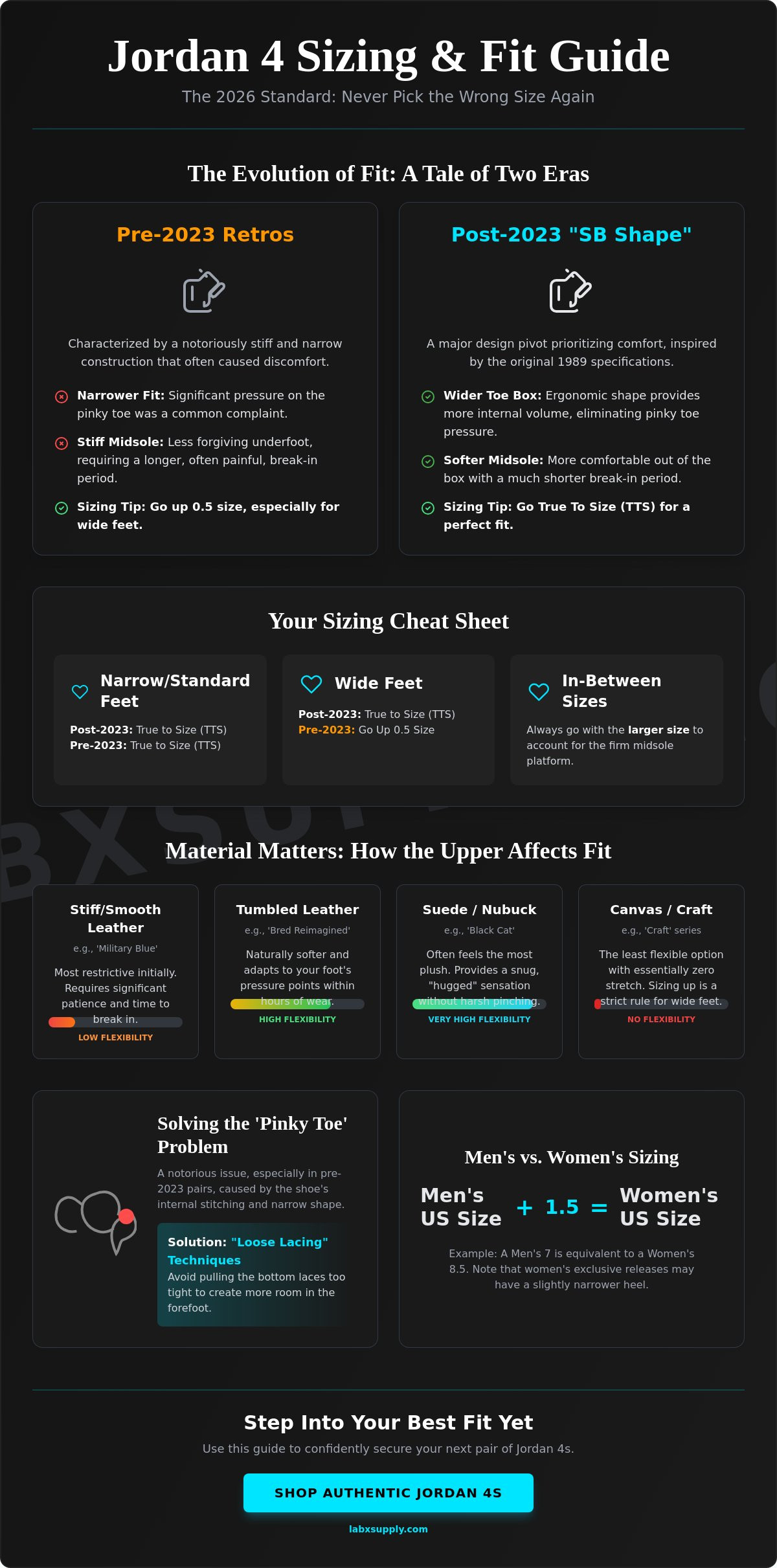
For years, the consensus on Jordan 4s was simple: they're beautiful, but they're going to hurt your feet. In 2026, that narrative has shifted. Most collectors should now go True to Size (TTS) for modern releases. This change stems from a major design pivot in 2023, when the 'Pine Green' SB Jordan 4 introduced a revamped mold that prioritized comfort and internal volume. This updated construction drastically reduces the "pinky toe" pressure that plagued older iterations. If you're using this jordan 4 sizing and fit guide to evaluate a pair released between 2024 and 2026, TTS is the gold standard for a standard foot. However, if you're hunting for a pre-2023 retro, going up half a size is still the safest bet to avoid discomfort.
Understanding the 'New Shape' Evolution
The "SB Shape" isn't just for skate shoes anymore. This wider, more ergonomic toe box has been integrated into almost every major release since 2023, including the "Bred Reimagined" and the 2026 "Toro Bravo" (releasing May 30, 2026). This design choice was a correction for the silhouette, drawing from the Air Jordan 4 history to bring the fit closer to the original 1989 specifications while softening the midsole. Because of this, 2026 releases like the "Comic" (July 25, 2026) and the "Bred" retro (November 28, 2026) offer a much more forgiving experience than the stiff, narrow pairs from the mid-2010s.
Women's vs. Men's Jordan 4 Sizing
Understanding gender-specific sizing requires a simple math trick. For US sizing, there's a 1.5 size difference; a men's 7 is equivalent to a women's 8.5. Many 2026 releases now feature "Extended Sizing," where the same colorway is produced in a full range from small women's sizes to large men's sizes. While the length follows the 1.5 rule, women's-exclusive lasts are often slightly narrower in the heel. If you're a man buying a women's-exclusive release, stick to your converted size unless you have a very wide foot. In that case, that extra half-size jump becomes crucial for long-term comfort.
Quick sizing rules for 2026:
- Narrow/Standard Feet: Go True to Size for all post-2023 releases.
- Wide Feet: Go True to Size for 2023-2026 releases; go up 0.5 size for pre-2023 pairs.
- Between Sizes: Always go with the larger size to account for the firm midsole.
Material Matters: How Leather, Suede, and Canvas Affect Fit
While the mold of the shoe sets the foundation, the upper material determines how much that shape will actually yield to your foot. This jordan 4 sizing and fit guide wouldn't be complete without acknowledging that a size 10 in canvas fits very differently than a size 10 in tumbled leather. Each material has a unique "give" coefficient that impacts how snug the shoe feels during your first few weeks of wear. If you ignore these differences, you might find yourself with a pair that never quite breaks in correctly.
Stiff, smooth leather requires the most patience. Releases like the "Military Blue" feature a high-density leather that can feel restrictive around the forefoot initially. Tumbled leather is the opposite. It's naturally softer and adapts to your foot's unique pressure points within just a few hours of wear. Suede and nubuck models, such as the "Black Cat," often feel the plushest. These pairs typically feature thicker internal foam, which creates a snug, "hugged" sensation without the harsh pinching associated with stiffer hides. Because these premium materials are a target for fakes, ensuring you buy from a legitimate source is vital. Low-quality replicas often use synthetic materials that feel like cardboard, which is one of the many dangers of counterfeit goods in the high-end sneaker market.
Canvas and "Craft" materials are the least flexible options. There is essentially zero stretch in these fabrics. If you have wide feet and are eyeing a canvas release, that half-size up recommendation from the previous section becomes a strict rule. You won't be able to "wear them in" to a comfortable width like you can with a leather pair.
The 'SB' Exception: Why Suede and Extra Padding Matter
The 2023 SB Pine Green changed the internal architecture of the silhouette. By reducing the "stiffener," which is the plastic piece that holds the toe's rounded shape, designers created a roomier feel. These SB-style releases also include extra padding in the tongue and heel collar. This makes the shoe feel more secure on your foot while simultaneously offering more space in the toe box. Most 2026 retros have adopted the improved toe box shape, but they often lack the extra-thick SB tongue padding, making the SB versions feel slightly more cushioned overall.
Break-in Expectations by Material
Your "break-in" period will vary wildly based on what the shoe is made of. Leather pairs usually take 3 to 5 wears to fully soften the polyurethane midsole and the upper. Canvas pairs are much more stubborn. You should expect 10 or more wears before the forefoot begins to feel natural, and even then, the material won't stretch significantly. For more on how material quality impacts the longevity and feel of your footwear, check out our Ultimate Guide to Authentic Sneakers. If you're ready to find a pair that fits your specific comfort needs, you can explore our current sneaker inventory to see the latest material options available.
One of the biggest mistakes collectors make is assuming their size in a Jordan 1 will translate perfectly to the Jordan 4. While both are basketball icons, their internal architectures are fundamentally different. This jordan 4 sizing and fit guide helps you navigate these discrepancies so you don't end up with a pair that's either too loose or painfully tight. The Jordan 1 features a relatively flat, thin sole, whereas the Jordan 4 utilizes a thick polyurethane midsole with a visible Air unit. This "Midsole Factor" makes the AJ4 feel much firmer and less flexible right out of the box.
The Jordan Sizing Matrix
To help you visualize the differences, here is how the Jordan 4 compares to other popular silhouettes in the line:
| Model | Fit Relative to Jordan 4 | Key Difference |
|---|---|---|
| Air Jordan 1 | Runs Larger | AJ1 has a thinner upper and longer toe box. |
| Air Jordan 3 | Runs Larger | AJ3 has an "open" ankle structure and softer leather. |
| Air Jordan 11 | True to Size | Both feature a snug, locked-in feel with less stretch. |
Most users find the Jordan 4 feels "shorter" in the toe box than an AJ1. If you're coming from the Adidas or Yeezy ecosystem, you'll generally want to go down half a size when switching to Nike, as Nike's sizing tends to be slightly more generous in length. If you've spent the summer in our slide series, remember that slides often have a much wider last. Don't assume your slide size matches your sneaker size without checking the CM measurement on the interior tag.
Why the AJ4 Feels 'Heavier' On-Foot
The AJ4 isn't just a shoe; it's a piece of engineering. The combination of the visible Air unit and the dense polyurethane midsole adds significant weight compared to modern mesh runners. This weight can make the shoe feel "clunky" if the size isn't perfect. Unlike the Jordan 3, which offers a more open and flexible ankle, the Jordan 4 uses "wings" to lock your foot down. This lacing system provides incredible support but limits ankle mobility. If the shoe is even slightly too small, these wings will pull the upper tight against the bridge of your foot, causing localized pressure that rarely goes away even after the break-in period.
Troubleshooting Comfort: The Pinky Toe & Lacing Hacks
Even with the improved 2023 mold discussed earlier, the "pinky toe rub" remains the most cited complaint for new owners. It's not always a matter of the shoe being too small. The internal stitching where the tongue meets the side panel creates a structural ridge exactly where your smallest toe rests. This jordan 4 sizing and fit guide focuses on non-invasive solutions to this anatomical mismatch, ensuring you don't have to suffer through a painful break-in phase or resort to damaging the lining. If you're tired of guessing which pairs offer the best out-of-the-box comfort, browse our curated selection of sneakers to find your next daily driver.
If the fit feels tight across the top of your foot, consider an insole swap. The stock foam in many retros is relatively thick and flat. Replacing it with a thinner, more contoured orthotic can drop your foot just a few millimeters, which is often enough to move your pinky toe away from that aggressive internal seam. For the first three wears, try the "double sock" method. Wearing a thin liner under a standard athletic sock creates a friction barrier, allowing the shoe to rub against the outer sock rather than your skin. This accelerates the softening of the leather without the blisters.
3 Steps to Fix the Pinky Toe Pinch
- Step 1: Unlace the shoe all the way to the bottom eyelets. Re-lace them with "flat" tension, ensuring the laces aren't twisted as they pass through the wings. This prevents uneven pressure points.
- Step 2: Insert a cedar shoe tree into the pair whenever you aren't wearing them. Unlike plastic trees, cedar provides consistent, gentle outward pressure that can expand the leather by a fraction of an inch overnight.
- Step 3: Switch to thick "quarter" socks. These provide extra padding specifically in the rub zones near the ankle and forefoot, which is where the AJ4's internal architecture is most restrictive.
Lacing Styles and Their Impact on Fit
How you tie your shoes changes the internal volume. "Loose lacing," a favorite in the streetwear community, involves leaving the laces untied and pulling them just enough to keep the shoe on. This allows your forefoot to splay naturally, providing relief for wide-footers, though it can lead to slight heel slip. Standard lacing offers the best lockdown and support for all-day walking but increases the downward pressure from the plastic "wings." If you want a clean look without the pinch, the "Deadstock Knot" is your best bet. It keeps the laces snug and organized inside the shoe while maintaining a consistent shape that won't tighten over the bridge of your foot as you move.
Securing Your Pair: Buying Authentic Jordan 4s in 2026
Finding the right size using this jordan 4 sizing and fit guide is only half the battle. In a market where high quality replicas are increasingly common, ensuring your pair is authentic is the only way to guarantee the fit and comfort technology you're paying for. Authentic 2026 releases, such as the "Toro Bravo" or the "Bred" retro, utilize specific foam densities and updated internal molds that counterfeits rarely replicate with precision. When you buy from a trusted marketplace like Lab X Supply, you're not just buying a look; you're securing the ergonomic improvements that make the modern Jordan 4 wearable all day.
For those who prioritize comfort above all else, the 2026 "Reimagined" models are the best entry point. These pairs consistently use the most up-to-date, foot-friendly construction. Before you finalize your purchase, remember the "Golden Rule" of Jordan 4 sizing: stick to your True to Size (TTS) measurement for any pair released from 2023 onwards unless you have exceptionally wide feet. For vintage or pre-2023 retros, that half-size jump remains the safest way to protect your toes from the narrower, legacy forefoot shape.
Why Authentication Matters for Fit
Authentication is about more than just verifying a logo. "Reps" often rely on outdated or generic molds that don't account for the 2023 shape update, meaning a fake pair might feel significantly tighter or stiffer than a genuine one. At Lab X Supply, every pair is inspected for structural and sizing accuracy to ensure the internal volume matches the retail standard. Unverified pairs often suffer from "warped" midsoles that can cause your foot to sit at an awkward angle, leading to long term discomfort regardless of the size you choose.
Final Checklist Before You Buy
- Verify the Release Year: Is it a post-2023 "SB-style" mold or an older, narrower retro?
- Check the Material: Remember that canvas and stiff leather won't stretch, while tumbled leather will.
- Know Your Foot Type: Wide-footers should still consider a half-size up for maximum comfort in non-SB models.
- Confirm the Source: Only buy from marketplaces that provide a physical inspection of the sneaker's architecture.
Ready to Level Up Your Collection?
Whether you're hunting for the latest holiday drop or a classic colorway, getting the fit right is the difference between a shelf-piece and a daily favorite. You can shop the latest Jordan 4 releases at Lab X Supply with the confidence that your pair is 100% authentic and sized correctly. If you're looking for something more relaxed for your recovery days, don't forget to check out our Ultimate Guide to Adidas Slides to find the perfect off-court companion for your new sneakers.
Step Into Your Best Fit Yet
Finding the right pair of AJ4s doesn't have to be a gamble. By understanding the shift toward the roomier 2023 mold and accounting for the specific break-in periods of materials like leather and canvas, you can finally enjoy this silhouette without the usual discomfort. Whether you're adjusting your lacing for extra width or swapping insoles to manage that notorious pinky toe rub, the right preparation makes all the difference. This jordan 4 sizing and fit guide has provided the technical foundation you need to shop with total confidence.
Now that you've mastered the fit, it's time to secure your next grail. Lab X Supply offers a curated selection of 2026's most anticipated colorways with 100% Authenticity Guaranteed on every pair. With global shipping available on all rare sneaker releases, you can get the latest drops delivered directly to your door regardless of where you live. Secure your authentic pair of Jordan 4s at Lab X Supply today!
Enjoy your new sneakers and the unmatched comfort of a perfect fit.
Frequently Asked Questions
Do Jordan 4s run big or small?
Jordan 4s typically run true to size for most modern releases. If you're buying a pair from 2023 or later, stick with your standard sneaker size. Older retros from before the shape update tend to run slightly small due to a narrower forefoot, which often requires going up half a size for a comfortable fit.
Should I size up for Jordan 4s if I have wide feet?
Yes, sizing up by half a size is highly recommended for wide feet, especially with non-SB models. While the post-2023 mold is more forgiving, the firm polyurethane midsole doesn't allow the shoe to expand much. Going up half a size prevents the side panels from pinching your foot during long periods of wear.
Why do Jordan 4s hurt my pinky toe?
The notorious "pinky toe rub" is caused by a thick internal seam where the tongue connects to the upper. This structural ridge creates a pressure point that presses directly against the outer edge of your foot. Using a jordan 4 sizing and fit guide to identify the roomier 2023 shape can help you avoid this common issue in future purchases.
How can I make my Jordan 4s more comfortable?
You can improve comfort by using "loose lacing" techniques or replacing the stock foam insole with a thinner orthotic. Using cedar shoe trees between wears also helps maintain the shape and gently stretches the leather. For the first few wears, try the double-sock method to create a protective barrier against friction and blisters.
Are Jordan 4s the same size as Jordan 1s?
Most people find that Jordan 4s feel tighter and "shorter" than Jordan 1s. The AJ1 has a thinner upper and a flatter sole, while the AJ4 features heavy padding and a rigid midsole that takes up more internal volume. If your AJ1s fit perfectly with no room to spare, you'll likely need to go up half a size for the AJ4.
Do Jordan 4s stretch over time?
Leather and suede Jordan 4s will stretch slightly after a break-in period of about three to five wears. However, pairs made from canvas or synthetic materials have almost no give and will maintain their original snugness forever. This makes following a jordan 4 sizing and fit guide essential when choosing between different material colorways.
What is the difference between the 2023 shape and older Jordan 4s?
The 2023 shape update, often called the "SB mold," features a wider toe box and a softer midsole for improved comfort. Older versions from the mid-2010s were known for being much narrower and stiffer. This update was a correction aimed at making the silhouette feel closer to the original 1989 release while reducing toe pinch.
How do I convert my women's size to men's in Jordan 4s?
To convert from women's to men's sizing, subtract 1.5 from your US women's size. For example, a women's size 8 is equivalent to a men's size 6.5. If you're between sizes or have a wider foot, it's safer to round up to the next half size to account for the AJ4's structured and padded internal fit.