
The global sneaker market is projected to reach a staggering $96.37 billion in 2026, yet if you have tried to flip a pair lately, it feels like the gold rush is over. With reseller profit margins compressing from 100% peaks down to a modest 10% or 25%, many collectors are asking: is the sneaker bubble going to pop? It is a valid concern when you see once-hyped releases like the Air Jordan 1 High 'Stealth' selling for as low as $80, which is nearly $100 below its original retail price. You are likely feeling the frustration of a market saturated by brands and the decline of the "instant sellout" era.
The good news is that the market is not crashing, but evolving into a more mature, utility-driven economy. This article will help you understand these shifting market cycles and why the "cool down" is actually a win for true enthusiasts. You will discover how to navigate the 2026 landscape with confidence, identifying which styles like slides are still growing in demand. We will also provide a clear strategy for buying authentic sneakers at fair prices, ensuring you never overpay for manufactured hype again.
Key Takeaways
- Understand why the 2026 market is moving away from speculative bot-driven flipping toward a more stable, long-term collector economy.
- Learn the difference between a market crash and a healthy correction to finally understand if the sneaker bubble is going to pop or just stabilize.
- Discover why comfort-focused footwear like slides has become a permanent status symbol and a safer investment than many traditional high-heat releases.
- Adopt a new framework for building your collection by prioritizing wearability and "long-tail" value over short-lived social media hype.
- Gain insights on how to navigate the 2026 resale landscape by focusing on authentic, curated selections that offer lasting durability and style.
Defining the Sneaker Bubble: What Does a "Pop" Actually Look Like in 2026?
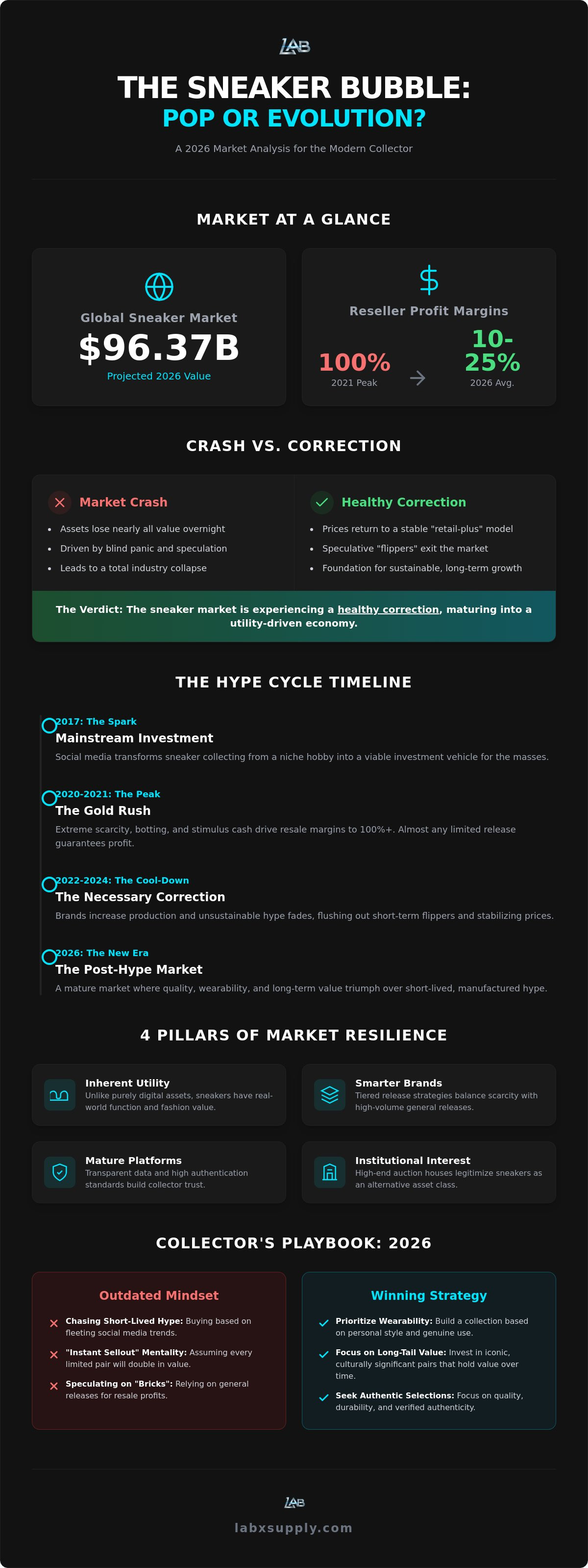
To understand the current state of your collection, we first have to define the term. A sneaker bubble is a specific type of Economic bubble where the resale price of footwear becomes completely detached from its utility or retail value. Between 2020 and 2021, this was driven by extreme scarcity, aggressive botting, and a global influx of stimulus cash. During that peak, profit margins for resellers often hit 100%. By mid-2026, those margins have compressed to a range of 10% to 25% for most pairs. This shift leads many to ask: is the sneaker bubble going to pop?
The reality is more nuanced than a total collapse. In a true market "pop," assets lose nearly all their value overnight. That isn't happening here. Instead, we are seeing a market correction. Prices are returning to a "retail-plus" model where only the most culturally significant pairs command a premium. With the global sneaker market projected to reach $96.37 billion in 2026, the industry is actually growing, not dying. It's simply shedding the speculative "flippers" who treated shoes like meme stocks rather than footwear. For those looking to professionalize their resale business in this mature landscape, ObjectionLab offers a searchable library of battle-tested responses to help handle common buyer objections and maintain healthy margins.
The History of the Footwear Hype Cycle
The journey to our current climate began around 2017 as social media turned sneaker collecting into a mainstream investment. This trend accelerated into the 2021 peak, where almost any limited release could be flipped for double its price. The subsequent dip between 2022 and 2024 was a necessary cooling period that flushed out unsustainable hype. The Post-Hype Era is a market where quality outranks rarity.
Why 2026 is Different: The End of the "Brick" Era
For years, resellers relied on "bricks," which were general release pairs that still sold out due to high demand. Major brands eventually responded by increasing production volumes, effectively killing the "every-pair-flips" model. We see the result in 2026; shoes like the Adidas Samba OG, which retails for $100, can occasionally be found for as low as $50 at major retailers. This overproduction has shifted consumer focus toward finding authentic sneakers that offer genuine style rather than just resale potential. General release pairs no longer drive bubble anxiety because collectors know they can buy what they like without fighting a bot. This stability is the hallmark of a maturing market that prioritizes the wearer over the speculator.
Why the Sneaker Market Resisted a Total Crash
While many wonder if the sneaker bubble is going to pop, the resilience of the market suggests otherwise. Unlike purely speculative assets, sneakers possess inherent utility. You can't wear a digital coin, but you can wear a pair of retro runners. This transition from a "get rich quick" scheme to a permanent fixture of global fashion has created a floor for prices. The industry's massive financial footprint across multiple continents isn't characteristic of a fleeting fad.
Brands have also become smarter. Instead of trying to make every shoe limited, they've pivoted to a tiered system. They maintain perceived scarcity through high-profile collaborations while keeping the lights on with high-volume general releases. This strategy ensures that while the "hype" might feel lower, the brand heat remains constant. In modern retail outlets, this high-volume approach is often managed through digital shelf solutions from ESLtags, Corp., which streamline the pricing of diverse inventory. By spreading demand across different age groups and regions, the industry has insulated itself against the kind of localized collapse that usually signals the end of a bubble.
The Influence of Global Resale Platforms
Resale platforms have matured alongside the collectors. In the early days, a price drop might cause a blind panic. Today, transparent pricing data from major marketplaces keeps the market rational. Even with standard transaction fees, the volume of trades remains high because buyers trust the verification process. Authentication standards are at an all-time high, which removes the "risk premium" that used to plague the market. When you buy from established sneaker stores, you're participating in a regulated ecosystem rather than a Wild West gamble. If you're looking to add to your rotation, you can check out our latest sneakers to see how value is currently being priced.
Institutional Interest in Footwear
Sneakers are now a recognized alternative asset class. High-end auction houses like Sotheby’s and Christie's regularly host sales for rare pairs, often reaching six or seven figures. This institutional interest provides a "top-down" stability. When the world's wealthiest collectors treat footwear as art, it validates the entire hobby for everyone else. A scholarly analysis of the sneaker economy highlights how variables like cultural relevance and brand heritage create a predictable value structure. This framework protects the average collector from a total crash. It answers the question of whether the sneaker bubble is going to pop with a resounding "no," even if the market looks different than it did during the 2021 peak.
The Pivot to Comfort: Why Slides and Sandals Saved the Market
While high-top leather sneakers saw a necessary price correction, a different category quietly took over the cultural conversation. The rise of "Slide Culture" has been a major factor in why the industry hasn't collapsed. When people ask "is the sneaker bubble going to pop," they often forget that footwear isn't just about limited-edition basketball shoes. The massive growth of the slide series since 2023 shows a clear shift in consumer behavior. Comfort is no longer a secondary thought; it's the new status symbol.
Redefining daily wear, the "Home-to-Street" trend made relaxed silhouettes acceptable in almost any setting. In 2026, luxury and collaborative slides maintain surprisingly high resale values because they offer a lower price point for new collectors. Instead of dropping $500 on a rare collaboration, a teenager can enter the culture for $80 to $120. This lower barrier to entry keeps the ecosystem healthy by constantly bringing in fresh buyers who eventually graduate to more expensive sneakers.
The Yeezy and Adidas Slide Phenomenon
The impact of Adidas slides on the overall market volume cannot be overstated. These silhouettes proved that a simple foam mold could generate as much "hype" as a complex athletic shoe. Unlike leather sneakers that can sit in a box for years, slides have a much higher "burn rate." They are worn daily, they wear down, and they require replacement. This creates a cycle of repeat business that traditional collectors' items lack. Slides are the most recession-proof item in footwear because they combine essential utility with entry-level brand prestige.
Luxury Slides vs. Streetwear Staples
By 2026, the market performance of high-end slides from luxury fashion houses has begun to rival traditional performance sneakers. Consumers today prioritize versatility. A single pair of ergonomic slides can be worn at the beach, in the gym, or for a casual dinner. This multi-use functionality is why "Slide Culture" keeps sneaker stores profitable even during slow months for major sneaker drops. While the "hype" for chunky dad shoes has decreased, the demand for sleek, minimalist sandals continues to climb, providing a stable foundation for the entire footwear economy. This diversification is another reason why the answer to whether the sneaker bubble is going to pop remains a firm "no."
A Collector’s Framework for Buying in a Post-Bubble Market
Smart collectors have stopped asking "is the sneaker bubble going to pop" and started asking how they can build a resilient rotation. The era of blind flipping is over. To succeed in 2026, you need a framework that prioritizes long-term utility over short-term hype. This begins with shifting your focus toward wearability. Shoes that people actually put on their feet, like retro runners or versatile slides, will always retain more value than "shelf pieces" that are too uncomfortable or loud for daily use.
The first pillar of this framework is diversification. Just as you wouldn't put all your money into one stock, you shouldn't fill your closet with only high-heat sneakers. Balance your collection with high-utility items that have a lower "burn rate" and higher replacement frequency. This is where slides come in. They provide a stable floor for your collection's value because they are essential items people buy year-round. You should also monitor the retail-to-resale gap. If a shoe is reselling for five times its retail price, the bubble risk is high. If that gap is a steady 20% to 30%, you're looking at a healthy, stable asset.
Authenticity is your best capital protection. In an uncertain market, a pair without verified provenance is a liability. Before every purchase, ensure you are using a trusted source that prioritizes rigorous verification. To start building your post-bubble rotation with confidence, you can browse our curated collection of sneakers and slides today.
Identifying "Future Classics" in 2026
Traits that make a shoe hold value for five years or more include premium materials, a strong cultural story, and a timeless colorway. In 2026, collectors are moving away from neon, over-branded designs. They are choosing minimalist luxury instead. Look for silhouettes that use high-grade leather or suede, as these age better and appeal to a broader demographic as they mature. Historical data shows that "OG" colorways almost always outperform experimental ones over a three-year period.
Avoiding the "Hype Trap"
Artificial scarcity is a red flag. If a brand is over-leveraging a specific silhouette by releasing ten different colorways in a single month, that model's value will likely plummet. You should also adopt the "12-Month Rule." By waiting a year after a shoe's initial release, you can often save up to 40% on resale prices. This allows the initial hype to die down and the speculative flippers to exit their positions, leaving you with the true market price. It's the most effective way to ensure you never overpay for manufactured excitement again.
Why Lab X Supply is the Safe Choice for 2026 Collectors
If you are still wondering is the sneaker bubble going to pop, the best way to protect your capital is by choosing a partner that values authenticity over manufactured hype. At Lab X Supply, we don't just follow the latest social media trends. We curate a selection that prioritizes cultural longevity and wearable value. Our marketplace is built for enthusiasts who want to wear their collection, not just watch a volatile resale chart. By focusing on shoes with proven demand and timeless appeal, we help you avoid the speculative traps that lead to "bubble" anxiety.
Stability is the ultimate advantage for collectors in 2026. The cooling of speculative flipping means that current prices represent the true market value of footwear. This creates a safer entry point for collectors who want to buy without the fear of a sudden crash. We focus on pairs that have already proven their staying power, ensuring your rotation remains sound even as market cycles shift. Our commitment to 100% authenticity remains the cornerstone of our business, giving you the confidence to buy in an uncertain economic climate.
Curated Excellence in Sneakers and Slides
Our inventory is a direct reflection of the 2026 market reality. We offer a diverse range of authentic sneakers and high-performance slides that meet the modern demand for both comfort and prestige. Our sourcing process is rigorous. We verify every pair to ensure they meet "bubble-proof" quality standards before they ever reach your door. This curation includes:
- Strict verification protocols for every item to guarantee 100% authenticity.
- A focus on timeless silhouettes that hold their value better than fleeting fads.
- A balanced selection of daily-wear slides and rare sneakers for a diversified rotation.
We invite you to browse our 2026 collection to see the latest trending styles that balance modern aesthetics with long-term value. Whether you are looking for the latest low-profile retro runner or a pair of high-utility slides, our selection is designed to stand the test of time.
Join the Lab X Supply Community
Building a rotation that stands the test of time requires more than just buying the latest drop. It requires a trusted partner who understands the nuances of the sneaker reselling world. We help you navigate the 2026 landscape with expert curation and a commitment to transparency. We know that the question of whether the sneaker bubble is going to pop matters to you, which is why we only stock items we believe in. Whether you are adding your first pair of luxury slides or a classic retro runner, we are here to ensure you get exactly what you pay for. Take the guesswork out of your next purchase by choosing a marketplace that puts the enthusiast first. Secure your next authentic pair at Lab X Supply and start building a collection with confidence today.
Secure Your Collection for the Future
The 2026 market has clearly shifted from speculative gambling to a utility-driven economy that rewards true enthusiasts. By prioritizing wearability and diversifying your rotation with high-utility slides, you can build a collection that survives any market cycle. We've moved past the era of artificial hype into a more stable landscape where quality and authenticity are the primary drivers of value. Instead of fearing if the sneaker bubble is going to pop, savvy collectors are now embracing this era of realistic pricing and sustainable growth.
Finding a trusted partner is essential as you navigate this new terrain. Lab X Supply has specialized in authentic resale since 2018, offering a curated selection of the most stable styles for your rotation. We provide global shipping on all trending footwear to ensure you have access to the best pairs regardless of your location. It's time to stop worrying about market crashes and start focusing on the shoes you actually love to wear. Shop Authentic Sneakers and Slides at Lab X Supply today and invest in footwear that stands the test of time. Your passion for the culture has never been more sustainable than it is right now.
Frequently Asked Questions
Is the sneaker resale market dead in 2026?
The resale market isn't dead, but the days of easy profit on every release are over. In 2026, the global sneaker market is expected to reach $96.37 billion. While profit margins for resellers have compressed to 10-25%, the massive revenue generated in the U.S. alone proves demand is still robust. Collectors are now focusing on utility and long-term value rather than quick flips.
Which sneakers are holding their value the best right now?
Rare collaborations and low-profile silhouettes are currently the strongest performers. While chunky "dad" shoes have declined, retro runners and sneakers with suede or metallic details are gaining traction. Skate shoes have also seen a significant increase in resale value. If you want to know if the sneaker bubble is going to pop, look at these specific niches which continue to show growth despite the broader cool down.
Should I sell my collection before the bubble pops?
Selling depends entirely on the contents of your closet. If your collection is filled with general releases that are now sitting on retail shelves for $50 or $100, you might want to liquidate. However, rare colorways and culturally significant pairs remain insulated from the dip. The market is correcting, not crashing, so high-quality assets are still safe to hold for the long term.
Are Yeezy slides still a good investment?
Slides remain a solid choice because they are essential daily wear. Unlike performance sneakers that people might keep in boxes, slides have a high replacement frequency. This constant need for new pairs creates a stable floor for prices. They represent a lower entry point into the culture, making them a recession-proof part of any modern footwear rotation.
Why are sneaker prices falling on resale websites?
Prices are falling because brands have increased production to meet demand. When major retailers can offer popular models for 50% off retail, the resale premium disappears. This shift has killed the "brick" flipping model. Consumers now prioritize value and wearability, refusing to pay inflated prices for shoes that are readily available at the mall. It's a natural correction for the industry.
How can I tell if a sneaker website is selling authentic shoes?
Authenticity can be verified by checking a retailer's history and verification processes. Reputable stores often have years of experience and prioritize rigorous inspection of every pair. Avoid websites with anonymous owners or prices that are significantly below market averages. Trustworthy platforms build their reputation on transparency and consistent service, ensuring you receive genuine products every time you shop.
Is it better to buy sneakers or slides for long-term value?
Sneakers and slides serve different roles in a balanced collection. Rare sneakers offer the potential for significant appreciation if they have cultural relevance. On the other hand, slides offer consistent demand and are less likely to lose value due to shifting trends. If you're worried about whether the sneaker bubble is going to pop, diversifying between these two categories is the safest strategy.
What is the "Post-Hype" era in footwear?
The "Post-Hype" era is a market phase where quality and wearability outrank rarity. Collectors are moving away from loud, neon designs and toward minimalist luxury. This era focuses on shoes that people actually wear daily rather than keeping them as speculative investments. It marks the maturity of the market, where personal style finally takes precedence over social media clout.