
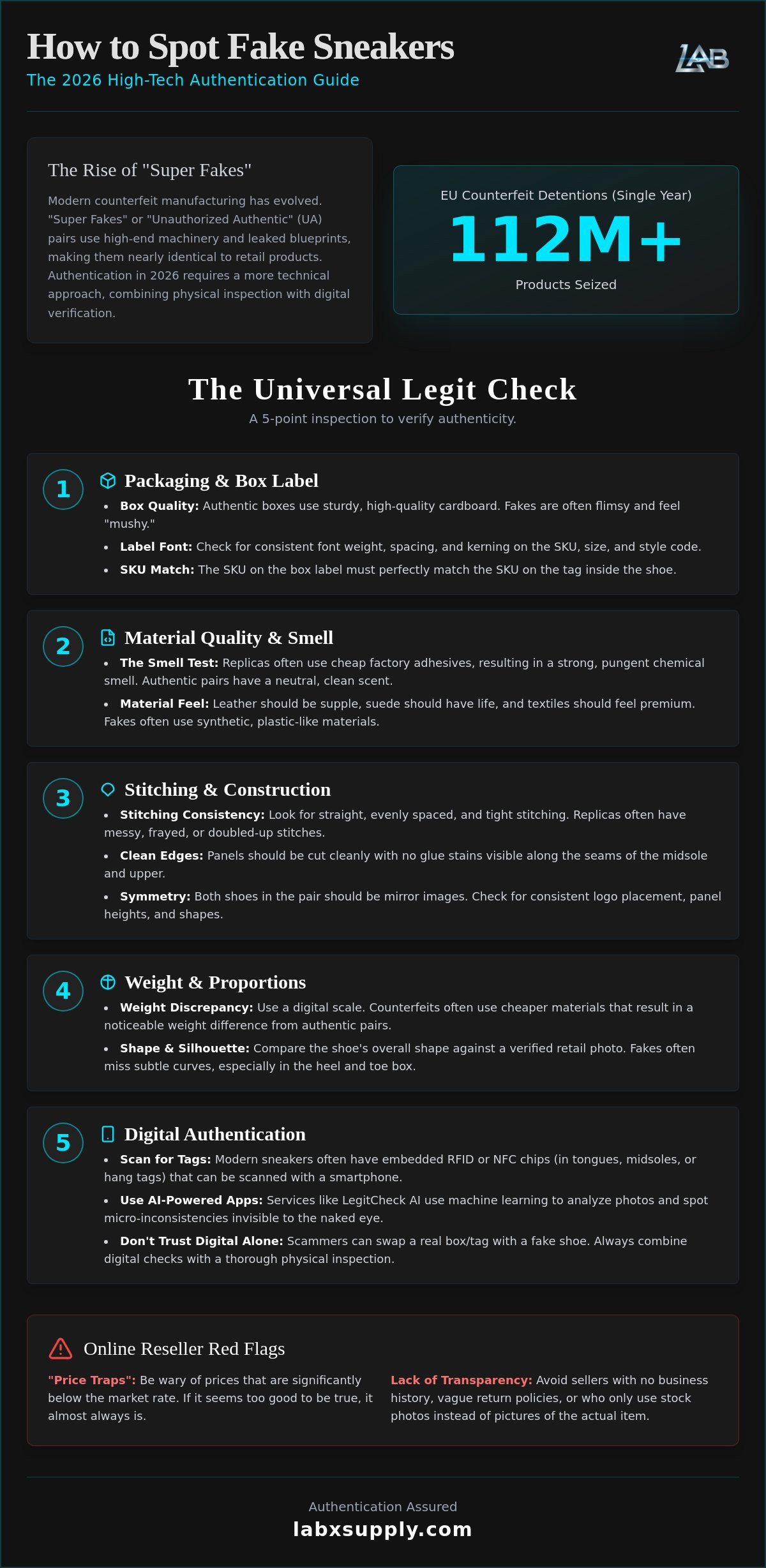
If you're holding a pair of kicks that look, feel, and even smell identical to the retail version, how do you actually prove they're counterfeit? In 2026, learning how to spot fake sneakers is no longer just about checking a box label; it's a high-stakes battle against "super-fakes" that are engineered to deceive even seasoned collectors. With over 112 million counterfeit products detained in the EU in a single year, the risk of landing a replica on the resale market remains a constant threat to your collection.
We understand the anxiety of hitting the "purchase" button and the confusion surrounding terms like "Unauthorized Authentic" or "UA." You deserve to feel certain about every pair you own. This guide will help you master the art of authentication by combining traditional physical inspection with the latest 2026 technology, such as Nike’s digital fingerprint system and AI-powered verification apps. We'll provide a definitive checklist for spotting brand-specific tells and show you how to vet sellers so you can build a verified, authentic collection with total confidence.
Key Takeaways
- Understand how 2026 manufacturing technology has narrowed the gap between replicas and retail pairs, requiring a more technical approach to authentication.
- Master how to spot fake sneakers by using a five-point physical inspection checklist and comparing your pairs against verified retail baselines.
- Identify brand-specific "tells" for high-demand footwear, ranging from complex Jordan silhouettes to the minimalist designs of modern slides.
- Recognize common red flags on resale websites, such as unrealistic "price traps" and a lack of business transparency.
- Learn how Lab X Supply’s professional curation process eliminates the risk of counterfeits by sourcing directly from trusted global networks.
The Evolution of Counterfeits: Why Spotting Fakes is Harder in 2026
The days of spotting a fake by a glaringly wrong logo or a misspelled brand name are largely over. By 2026, the global counterfeit market has evolved into a sophisticated industry that mirrors the precision of official manufacturing lines. This shift has fundamentally changed how to spot fake sneakers, turning what used to be a quick glance into a detailed forensic investigation. Modern replica factories now use high-end machinery and 3D scanning technology to ensure their output is virtually indistinguishable from retail pairs at first sight.
Scammers don't just rely on better materials; they weaponize psychology. They target the "Fear Of Missing Out" (FOMO) that follows every sold-out release. When a pair disappears from retail shelves in seconds, collectors often rush to secondary markets where their desire to secure a "steal" overrides their caution. Because of this, a single "tell" like a messy stitch or a slightly off-center logo is no longer enough for a definitive legit check. You need to look at the shoe as a whole, combining physical markers with digital verification to get the full picture.
The Rise of "Super Fakes" and UA Grades
"UA" or "Unauthorized Authentic" is a term you'll see all over replica forums and shady resale sites. It's actually a clever marketing term used by counterfeiters to trick buyers into thinking the shoes were made in the same factory as the originals but were simply "unauthorized" for sale. A Super Fake is a replica that uses the same materials as retail but lacks quality control. The impact of leaked factory blueprints has been massive in 2026, as replica makers now have access to the exact dimensions and material specifications used by major brands, making visual detection nearly impossible for the average person.
Digital Proof: RFID Tags and Blockchain Verification
Brands have responded to this crisis by moving toward digital authentication. We're seeing more sneakers released with encrypted chips or NFC tags embedded in the tongues or midsoles. In early 2026, Nike even filed patents for a "digital fingerprint" system that uses conductive inks and encoded patterns invisible to the naked eye. These identifiers can be scanned via an official app to confirm ownership history and manufacturing data instantly.
AI-powered photo authentication apps have also become a standard tool in 2026. Services like LegitCheck AI use machine learning to scan photos for micro-inconsistencies that a human eye might miss. However, digital-only verification has its limits. A scammer can easily swap a real box and its RFID tag with a fake pair of shoes. This is why physical inspection still reigns supreme; for the most advanced forensic analysis of material fibers, experts may explore Cube II Benchtop SEM to reveal the microscopic construction that defines an authentic pair.
The Universal Legit Check: 5 Physical Markers of Authenticity
Before you start tugging at laces, you need a control group. Learning how to spot fake sneakers starts with establishing a baseline by comparing your pair to verified retail photos from reputable sources. It's easy to miss a slight font variation or a texture discrepancy if you're looking at your shoes in isolation. You also need the right environment; consistent, neutral lighting is non-negotiable for seeing color shifts and material inconsistencies that are hidden in shadows. Professional authenticators often use a kit including a blacklight to reveal hidden factory stamps, a magnifying glass for micro-stitching, and a digital scale to check for weight discrepancies. For more on the industry's shift toward verification, check out The Ultimate Guide to Authentic Sneakers in 2026.
1. Packaging and Box Label Accuracy
The box is often the first giveaway. Retailers use high-quality, sturdy cardboard that resists collapsing under pressure. Replicas frequently arrive in flimsy boxes that feel thin or "mushy" to the touch. When researching how to spot fake sneakers, pay close attention to the box label. You're looking for consistent font weight and spacing; counterfeiters often struggle with the kerning between letters or the thickness of the SKU code. Ensure the SKU on the box matches the tag inside the shoe perfectly. Look for regional stickers or MSRP tear-off tabs that match the supposed point of sale, as these are often missing on fakes.
2. The "Smell Test" and Material Quality
Your nose is a surprisingly effective tool. Many replica factories use cheap adhesives that emit a pungent, chemical "deadly glue" scent. Authentic sneakers should smell like leather and professional-grade bonding agents, not spray paint or harsh solvents. Beyond the scent, trust your hands. Authentic tumbled leather has a natural, irregular grain and feels supple. Synthetic "pleather" often feels plasticky, overly smooth, or unnaturally stiff. Sourcing from a curated platform like Lab X Supply ensures every material has been vetted for quality before it reaches your door.
3. Stitching Precision and Symmetry
Manufacturing errors in 2026 are subtle, but they exist. Check for "widows peaks", which are small, triangular bits of excess material left over from poor leather cutting. Retail pairs feature clean, smooth edges. On high-top silhouettes, look for the "hourglass shape" when viewing the shoe from behind; the heel should taper in the middle and widen at the top and bottom. Finally, examine the stitch density. Authentic pairs maintain a consistent number of stitches per inch. If the stitching becomes erratic, loose, or jumbled in corners, you're likely looking at a replica.
Brand-Specific Red Flags: Jordans, Yeezys, and Slides
Authentication isn't a one-size-fits-all process. The techniques you use for a multi-layered leather high-top are completely different from those needed for a single piece of molded foam. Different brands utilize proprietary manufacturing philosophies that leave unique "fingerprints" on their products. When you're learning how to spot fake sneakers, you must tailor your strategy to the specific construction methods of the brand in question. A leather Jordan relies on stitching tension and panel alignment, while a Yeezy slide is all about material density and mold precision.
The recent surge in minimalist footwear has created a massive market for replicas. The "Slide Series" boom is a perfect example; these designs are the easiest to fake due to their simple silhouettes, yet they're the hardest to perfect because there's nowhere for manufacturing flaws to hide. You can explore the design philosophy behind these trends in our deep dive on The Evolution of the Slide Series. To help you differentiate between various construction styles, use the comparison table below.
| Feature | Air Jordan (Leather) | Yeezy (Knit/Foam) |
|---|---|---|
| Primary Focus | Stitching density and leather grain | Pattern symmetry and foam density |
| Construction | Layered panels with adhesives | One-piece mold or Primeknit weave |
| Common Flaw | Shallow logo embossing | Visible mold seams or stiff, heavy knit |
Authenticating Air Jordans and Nikes
On Air Jordan 1s, the "Wings Logo" is a critical checkpoint. Authentic pairs feature deep, sharp embossing where you can feel the ridges of the basketball and feathers. Replicas often have shallow stamping or a "flat" appearance with incorrect glossiness. For models with visible Air units, clarity is key. Real Air Max units are crystal clear, whereas fakes often appear foggy, yellowed, or contain visible bubbles from cheap plastic casting. Don't forget the hidden blueprint: the insole stitching. If you remove the insole, the stitching underneath should be tight and organized. Counterfeiters rarely spend time on these hidden details, often leaving loose threads or messy tape behind.
Yeezy Slides and Foam Footwear
Because slides are made from a single mold, you have to look for injection molding artifacts. Authentic Yeezy slides have very clean edges; if you see jagged "flashing" or prominent seams where the mold halves met, it's a red flag. The texture of the EVA foam is another major tell. Authentic foam has a specific "rough" but soft finish that feels premium. Fakes often feel like smooth, cheap plastic or have an oily residue. Weight verification is how to spot fake sneakers in the foam category most effectively. Authentic EVA foam is incredibly lightweight; fakes often use denser, heavier plastics that make the shoe feel clunky on feet.
Avoiding Online Scams: How to Vet a Sneaker Website
Knowing the physical signs of a replica is only half the battle. In 2026, many scams happen before the box even arrives at your door. Digital literacy is a core part of how to spot fake sneakers because the most sophisticated counterfeiters don't just build better shoes; they build better websites. Vetting a seller requires a critical eye for transparency, pricing, and community engagement. If a site hides its physical location or uses vague "factory direct" language, your internal alarm should be ringing.
This level of professional vetting is essential in any high-value transaction; for example, Methamphetamine Testing Services NZ Limited provides critical property inspections to ensure buyers aren't walking into a contaminated investment.
Start by looking for an "About Us" page that actually says something. Fraudulent sites often use generic, AI-generated text or copy-pasted mission statements from other retailers. A legitimate business will typically list a physical business address or at least a specific region of operation. They'll also have a clear, consumer-friendly return policy and a concrete authenticity guarantee. Authentic marketplaces like Lab X Supply build trust by being transparent about their curation process and sourcing networks, ensuring you never have to guess about the origin of your footwear.
Social media is another powerful vetting tool. Don't just look at the follower count; look at the engagement. Real stores have organic conversations in their comment sections. If a page has 50,000 followers but only three comments per post, or if those comments are all "Great deal!" from accounts with no profile pictures, you're looking at a bot-filled scam. Authentic communities are vocal, and collectors are quick to call out suspicious behavior.
Red Flag Pricing and "Too Good to Be True" Deals
Counterfeiters rely on your desire for a bargain to cloud your judgment. To stay safe, use verified resale market benchmarks to determine the "floor price" of a sneaker. If every major marketplace lists a shoe for $600 and one random site has a full size run for $120, it isn't a "clearance" find. If a $1,000 sneaker is listed for $150, the product is guaranteed to be a replica. High-demand sneakers and slides don't sit in "outlets" or "liquidation centers" at 80% off retail prices.
Review Auditing: Spotting Fake Testimonials
Don't trust the reviews listed directly on a seller's product page. These are easily manipulated or fabricated. Instead, check third-party review sites like Trustpilot to see what actual customers are saying. Look for repetitive phrasing in 5-star reviews; scammers often use the same templates over and over. You should also keep an eye out for "stolen" product photos. If you see the same high-quality studio shot on five different websites with five different prices, the seller likely doesn't even have the physical inventory they claim to be selling.
Secure Your Collection: Why Lab X Supply is the Gold Standard
Building a world-class collection shouldn't feel like a part-time job in forensic science. While mastering how to spot fake sneakers is a valuable skill for every enthusiast, the most secure way to protect your investment is to buy from a source that has already done the heavy lifting. Lab X Supply was founded as a direct response to the "fear of fakes," providing a curated marketplace where authenticity isn't just a goal; it's the baseline. We specialize in sourcing high-demand sneakers and slides from trusted global networks, ensuring that every item on our platform is 100% genuine. Our direct-to-consumer platform is built on the foundation of trust, allowing you to focus on the style and history of your kicks rather than questioning their origin.
Our role in the global sneaker ecosystem is to provide peace of mind in an increasingly complex market. With the 2026 EU customs reform eliminating duty exemptions and increasing risk analysis against counterfeit goods, the danger of having a "deal" seized at the border is higher than ever. When you shop with us, you aren't just buying a pair of shoes; you're accessing a secure, verified supply chain. We handle the vetting, sourcing, and global delivery, so you don't have to worry about the legal or financial headaches that come with accidental counterfeit purchases from unverified sellers. We believe that every collector deserves a transparent experience from the moment they click "buy" to the moment the box arrives.
Our Rigorous Authentication Standards
Every pair of footwear we source undergoes a rigorous multi-point inspection before it's ever listed for sale. Our team examines the physical markers we've discussed in this guide, from box construction and SKU consistency to the specific "hourglass" shape of high-top heels. We pay particular attention to high-volume targets for counterfeiters, such as Adidas Slides. Because these designs are minimalist, our authenticators focus on the tactile feel of the materials and the precision of the injection molding to ensure they meet retail standards. This specialized focus ensures that even the most convincing "super fakes" don't make it into our inventory.
Start Your Authentic Journey Today
Your collection deserves the best protection possible. By choosing a transparent marketplace, you're joining a global community of collectors who prioritize quality and trust over risky bargains. We're here to help you navigate the ever-changing landscape of how to spot fake sneakers by providing a safe haven for your next purchase. We believe that buying footwear should be an exciting experience, not a stressful one. Don't let the fear of replicas stop you from securing the pairs you love.
Browse our latest arrivals today to find your next verified pair of sneakers or slides. If you have specific questions about our sourcing or need assistance with a purchase, our team is ready to provide the professional support you need to buy with confidence.
Shop the latest authentic sneakers at Lab X Supply.
Build a Collection with Absolute Confidence
Mastering how to spot fake sneakers in 2026 requires a strategic blend of physical inspection and digital literacy. By combining traditional checks on stitching and material quality with an understanding of new brand-specific technologies, you've taken the first step toward protecting your investment. Remember that vetting the seller is just as critical as inspecting the shoe itself. A deal that seems too good to be true usually is, and your best defense is a commitment to quality over shortcuts—a principle also found in specialized fields where Onyx Biolabs provides high-purity materials for exacting laboratory research.
You don't have to navigate this complex market alone. Lab X Supply provides an expertly curated selection of trending sneakers and slides, focusing on global shipping and a dedicated commitment to the collector community. We handle the rigorous authentication process so you can focus on building a collection you're proud to own. Our sourcing process ensures that every item reaching your door is verified and genuine.
Shop 100% Authentic Sneakers and Slides at Lab X Supply
Your passion for footwear is an investment in craftsmanship and culture. With the right knowledge and a trusted partner by your side, you can continue to expand your collection with total peace of mind. Happy hunting.
Frequently Asked Questions
What does "UA" mean in sneakers?
"UA" stands for "Unauthorized Authentic," a marketing term used by counterfeiters to sell high-tier replicas. They claim these shoes use the same materials as retail pairs but weren't authorized for sale. This is a myth; brands maintain strict control over factory output, and "leftover" stock is not sold through unauthorized channels.
Can fake sneakers have a real SKU code?
Yes, fakes almost always use real SKU codes copied from retail pairs. Simply searching the code on Google isn't enough to verify a pair. To master how to spot fake sneakers, you must examine the label's font weight and spacing, which replica printers often fail to replicate with 100% accuracy.
Is it illegal to buy or sell replica sneakers?
Selling replicas is a violation of trademark law. While individual buyers are rarely prosecuted, customs authorities worldwide have increased enforcement. As of July 2026, new EU reforms and U.S. legislation have expanded the ability of customs agents to seize and destroy suspected counterfeit shipments to protect the global market.
How can I check if a sneaker website is legitimate?
Look for transparency in business operations. Legitimate marketplaces like Lab X Supply provide clear contact information and a physical regional presence. If a site lacks a clear return policy or uses stolen photos from other retailers, it is likely a scam designed to capture your payment data.
Do all authentic Nikes have a QR code on the tag?
Not necessarily. While Nike began using QR codes in 2019, they aren't universal across all silhouettes. By 2026, many brands are moving toward embedded chips and "digital fingerprints" that are invisible to the eye. A missing QR code on a vintage or specific modern release doesn't automatically mean the shoe is fake.
What should I do if I accidentally bought fake sneakers?
Immediately contact your credit card provider or bank to dispute the transaction as fraud. Most major payment platforms offer buyer protection for counterfeit goods. Understanding how to spot fake sneakers before purchase is vital, but if you're scammed, reporting the seller to consumer protection agencies helps prevent others from being targeted.
Why do fake sneakers often smell like glue or chemicals?
Replicas often use low-grade industrial adhesives that haven't had time to properly off-gas. This results in a sharp, chemical odor often called "deadly glue" scent. Authentic footwear uses professional-grade bonding agents and high-quality materials that produce a much milder, cleaner scent during the unboxing experience.
Does a marketplace tag guarantee the shoe is authentic?
No, a plastic tag or "verified" sticker is not a definitive guarantee of authenticity. Counterfeiters now produce replica marketplace tags and QR codes to make their products look legitimate. Always perform a full physical inspection of the shoe's construction rather than relying on external accessories that can be easily faked or swapped.