
Did you know that over 11% of sneakers submitted for professional authentication last year were actually fraudulent? With the global counterfeit market now worth over $450 billion, learning how to spot fake nike dunks is no longer just a hobby for collectors; it's a financial necessity. It's incredibly stressful to drop $130 or more on a new release like the "Patent Panda" only to worry that you've been scammed by a "super-fake" that looks almost perfect.
You've probably felt that sinking feeling when you see a loose thread or a slightly crooked logo. You shouldn't have to be a master of technical jargon like "vamp" or "quarter panel" just to feel secure in your purchase. In 2026, authenticating footwear is about looking for blueprint consistency rather than just perfect stitching, especially since retail quality control can vary between different factory batches.
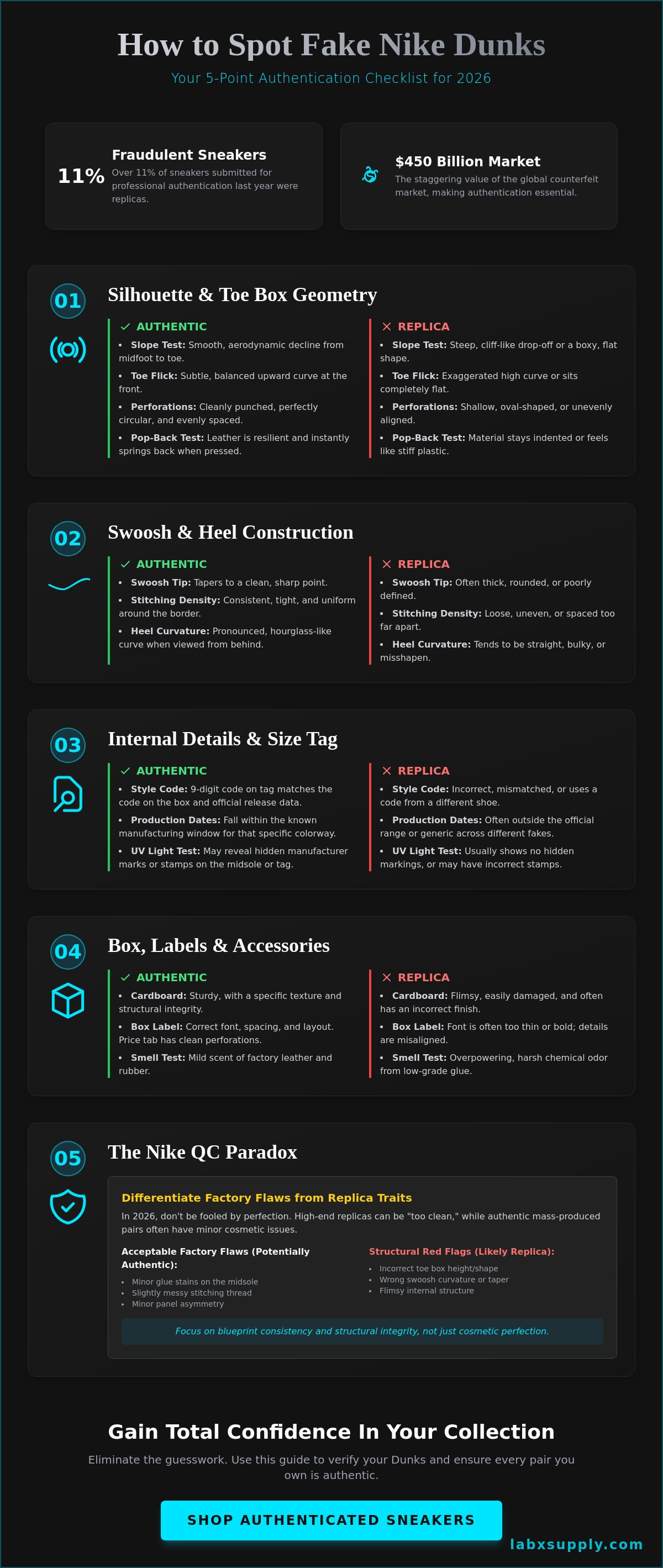
We've put together a definitive 5-point checklist to help you distinguish genuine Nike Dunks from even the most sophisticated replicas. This guide gives you the clear, actionable steps needed to verify your shoes and gain total confidence in your collection. You'll learn exactly what to look for in the current market so you never have to guess about your sneakers again.
Key Takeaways
- Master the "Slope Test" to analyze the geometric transition from the midfoot to the toe box for perfect silhouette alignment.
- Discover how to spot fake nike dunks by calculating the specific stitching density on the swoosh border and checking the sharpness of the logo tip.
- Identify authentic internal details by verifying style codes and production dates on the internal size tag against official release data.
- Evaluate packaging authenticity by examining cardboard thickness and the specific layout of the perforated retail price tabs.
- Learn to navigate the 2026 "Nike QC Paradox" to accurately differentiate between standard factory flaws and high-tier replica traits.
The 2026 State of Sneaker Authentication: Why Dunks Are Tricky
In 2026, the secondary market is flooded with "Unauthorized Authentic" (UA) and "Grade A" replicas. These terms often confuse buyers, but they essentially describe high-tier counterfeits. UA pairs are marketed as being made in the same factories as official releases using the same materials, though they lack Nike's authorization. Grade A replicas represent the top tier of craftsmanship in the replica world. Understanding how to spot fake nike dunks requires looking past the surface. You need a holistic approach that considers the shoe's shape, the box construction, and even the distinct scent of the materials.
The history of the Nike Dunk shows its evolution from a 1980s basketball staple to a global cultural icon. This massive popularity is exactly why it remains a primary target for sophisticated counterfeiters. However, a strange phenomenon has emerged: the Nike QC Paradox. Ironically, a pair with slightly messy stitching or a stray glue stain might be more likely to be authentic than a pair that looks mathematically perfect. This is because high-end replica factories often spend more time ensuring every thread is perfect to avoid detection, while Nike's mass production of millions of pairs naturally leads to more variance.
The Rise of the "Super-Fake"
Counterfeiters in 2026 now use advanced 3D scanning to replicate retail blueprints with terrifying accuracy. This means the "Are my sneakers real or fake" question can no longer be answered with a five-second glance. You must know the specific release details for your exact colorway. For instance, the 2026 "Mineral Slate" release may have different internal padding or tongue thickness compared to a "Hydrogen Blue" pair. Knowing your shoe's specific production timeline is the first step in successful authentication.
Retail Inconsistencies vs. Replica Flaws
Nike's factory standards can vary, often resulting in cosmetic issues like slight asymmetry or minor glue marks on the midsole. In contrast, the replica community deals with "batch flaws." These are specific errors, like a slightly off-center heel logo, that appear across thousands of fake pairs from the same factory. When learning how to spot fake nike dunks, you must prioritize structural integrity over cosmetic perfection. A replica might have flawless stitching but a completely wrong toe box height. Our 5-point checklist will help you identify these structural red flags that "super-fakes" still struggle to get right.
- The Smell Test: Authentic pairs have a mild, professional leather and rubber scent. Fakes often emit a harsh, chemical odor from industrial-grade glue.
- Structural Rigidity: Real Dunks maintain their shape under pressure, while many replicas use lower-quality internal boards that feel flimsy.
- Blueprint Accuracy: Even the best fakes often miss the exact curvature of the heel or the specific taper of the swoosh.
Checkpoint 1: The Silhouette and Toe Box Geometry
The silhouette is the blueprint of the shoe. When you're learning how to spot fake nike dunks, the first thing you should examine is the "Slope Test." This measures the transition from the midfoot to the toe. Authentic pairs feature a smooth, aerodynamic decline. In contrast, many replicas have a steep, aggressive drop-off or a boxy, rectangular front. You should also check the "toe flick." This is the subtle upward curve at the very front of the sole. Real Dunks have a balanced flick that keeps the shoe level, while fakes often curve too high or sit completely flat against the surface.
Perforation holes on the toe box are another dead giveaway. On a genuine pair, these holes are cleanly punched, perfectly circular, and aligned in a precise sunburst pattern. Counterfeiters often struggle with this alignment; the holes might be shallow, slightly oval, or unevenly spaced. Beyond visual checks, you must use the "Pop-Back" test. Press your thumb firmly into the center of the toe box. Genuine leather is resilient and should spring back to its original shape almost instantly. If the material stays indented or feels like stiff plastic, you're likely holding a replica. Understanding these physical nuances is vital because the dangers of counterfeit goods extend beyond just poor quality; they often involve unregulated materials that don't perform like the real thing.
Analyzing the Toe Box Shape
Authentic Dunks maintain a slim, streamlined profile that tapers elegantly toward the front. Replicas frequently look "inflated," as if the internal padding is pushing against the leather. The mudguard wrap height on retail pairs is consistently low and uniform across the entire front of the shoe. Look closely at the edges of the leather panels for "widow's peaks." These are tiny, triangular leather remnants left by low-quality cutting machines. Nike's retail standards, while sometimes messy, rarely include these specific structural artifacts.
Material Quality and Feel
The leather on a "Panda" Dunk should feel soft yet substantial with a slight natural grain. Synthetic materials used in fakes often have an over-processed, shiny appearance or a "pebbled" texture that feels too uniform. It's a well-known fact that authentic sneakers maintain their structural integrity over months of wear, whereas replicas tend to collapse or crease unnaturally after just a few days. If you want to ensure you're getting the real deal, you can always browse our latest collection of verified footwear. We focus on quality so you don't have to worry about how to spot fake nike dunks every time you want to upgrade your rotation.
Checkpoint 2: The Swoosh and Heel Construction
Once you've analyzed the silhouette, your next focus should be the lateral side of the sneaker. The iconic swoosh is often the hardest part for counterfeiters to replicate perfectly. When learning how to spot fake nike dunks, you must pay close attention to the "Swoosh Hook." On an authentic pair, the logo features a sharp, elegant taper that ends in a clean point. Many high-tier replicas fail this test by creating a hook that curves too aggressively upward or ends in a blunt, rounded tip. This lack of precision is a major red flag that indicates a lower-quality production process.
Stitching density is another critical factor. You should actually count the stitches on the border of the swoosh if you're unsure. Retail Nike Dunks typically maintain a high density of approximately 10 to 12 stitches per inch. These stitches are deep, uniform, and sit flush with the material. Replicas often use thinner thread and fewer stitches, which results in a "floating" appearance where the logo doesn't look securely anchored to the quarter panel. Beyond the logo, check the heel tab dimensions. While Nike's quality control can lead to minor variations, the two shoes in a retail box should have matching heel tab heights. If one tab is significantly wider or taller than the other, you're likely looking at a batch flaw from a replica factory.
Mastering the Swoosh Inspection
One detail that many authentication guides overlook is the specific gap between the tip of the swoosh and the lace eyelets. On authentic Dunk Lows, the tip should stop just a few millimeters before reaching the eyelet panel. It shouldn't overlap the panel, nor should it leave a massive, glaring gap. Additionally, feel the texture of the swoosh itself. On many 2026 releases, the swoosh material has a slightly different grain or sheen compared to the surrounding leather. If the texture is identical across every panel, the manufacturer might be cutting corners with cheaper synthetic materials.
Rear View: Embroidery and Proportions
The "Nike" embroidery on the heel is a classic tell. Look closely at the font thickness and the spacing between letters. In authentic pairs, the letters are bold, slightly raised, and shouldn't have "connecting threads" running between them. The letter "E" is a common fail point; the three horizontal bars should be distinct and evenly spaced. Finally, view the shoes from directly behind to check for the "hourglass" shape. Authentic Dunks taper inward at the middle and widen at the top and bottom. If the shoe looks like a straight, bulky rectangle from the heel, it's a clear sign you've found a fake. Mastering these rear-view details is essential for anyone trying to figure out how to spot fake nike dunks in a crowded resale market.
Checkpoint 3: Internal Details and the UV Light Test
Moving beyond the exterior, the internal components offer a deeper look into the shoe's origin. When you're trying to learn how to spot fake nike dunks, the size tag is your most reliable data source. Check the style code, such as DD1391-100 for the classic Panda colorway, and ensure the production dates align with official Nike release windows. A common error on replicas is a "halo" effect around the printed text, where the ink bleeds slightly into the fabric, making the font look fuzzy rather than sharp. Authentic tags use a crisp, heat-pressed printing method that keeps the letters distinct.
The tongue label also holds secrets. Look for the double-stitch at the top of the label; this is a standard Nike construction trait that many low-tier fakes overlook. On the back of the tongue, the "Made in" information should have consistent kerning. If the letters are touching or unevenly spaced, it's a red flag. Don't forget the insole logo. Nike uses a specific screen-printing ink that bonds well to the fabric. If the logo peels off with a single thumbnail scratch, you're likely dealing with a replica that used cheap, surface-level ink that hasn't properly cured.
Reading the Size Tag and Tongue
Authenticity is found in the numbers. Every pair has a unique UPC or QR code that must match the one printed on the box label. If these numbers don't align, the shoes and the box were likely separated, or one of them is fake. Look closely at the font on the size tag; replicas often use a slightly thinner or bolder font than the retail standard. This discrepancy is often subtle, but it's a key part of how to spot fake nike dunks in 2026. You should also verify that the "Nike" logo on the tongue has the correct registered trademark symbols.
The Definitive UV Light Checklist
While modern replica factories have fixed many old UV flaws, a blacklight remains a powerful tool. Shine the light along the midsole and the heel. You're looking for "ghost" stitching lines, which are invisible guidelines used by workers to align panels. Authentic Nike pairs rarely show these, as their assembly process is more automated. However, excess glue glow is a different story. While some retail pairs have glue stains, a massive, bright neon glow across the entire seam usually points to the unregulated adhesives used in replica shops. UV light identifies invisible ink stamps used by replica factories for assembly. These stamps, often found on the heel or under the lace eyelets, are a 100% confirmation of a counterfeit pair.
Checkpoint 4: The Box, Labels, and Accessories
The packaging is your first line of defense. While counterfeiters have become masters of mimicking the shoe itself, they often cut corners on the packaging to reduce production and shipping overhead. When you are learning how to spot fake nike dunks, you should start by testing the box's structural integrity. Authentic Nike boxes are made from thick, rigid cardboard that can withstand significant pressure without buckling. In contrast, replica boxes are frequently made from thinner, flimsier stock that feels "mushy" to the touch. If the box arrived collapsed or feels like it might tear under its own weight, that's your first red flag.
Pay close attention to the "Suggested Retail" tab on the box label. On a genuine Nike Dunk box, this is a functional, perforated tab designed to be torn off by retailers. Many high-tier fakes simply print a dotted line on the label rather than actually perforating the cardboard. You should also evaluate the tissue paper and shoe trees. Authentic Dunks typically come with crisp, high-quality tissue paper and sturdy cardboard shoe trees that fit the internal geometry of the shoe perfectly. Replicas often use thin, wax-like paper and generic plastic or flimsy paper fillers that don't match the shoe's size. If you want to skip the guesswork entirely, you can shop our verified sneaker collection to ensure every detail, from the box to the laces, is 100% retail-standard.
Box Label Red Flags
The label is a goldmine for authentication data. Look at the font thickness on the colorway description; replicas often use a font that is either too bold or too thin compared to the retail standard. Check the alignment of the barcode and the white border spacing. On a real label, the spacing is uniform and the text is perfectly centered. You can also use a barcode scanner app on your phone. While some advanced fakes can spoof the barcode, many will lead to a "Product Not Found" error or link to a completely different shoe model. This is a quick and effective way to identify how to spot fake nike dunks before you even touch the leather.
The Unboxing Experience
The sensory experience of opening a new pair is hard to fake. Authentic Nike boxes feature a specific matte finish that doesn't reflect much light. If the box looks glossy or has a "waxy" sheen, it's likely a counterfeit. Then, there's the "Smell Test." Real Dunks have a mild, professional scent of leather and rubber. Fakes often emit a pungent, "industrial glue" odor that can be overwhelming. Finally, check the interior of the box for a small YCM sticker or a faint red ink stamp. These are internal quality control marks used in Nike factories. While their absence doesn't always mean a shoe is fake, their presence is a strong indicator of an authentic retail pair.
Checkpoint 5: Buying with Confidence in 2026
Even with a comprehensive guide on how to spot fake nike dunks, your final defense is the source of the purchase. The "Too Good to Be True" rule is still the most reliable indicator in the 2026 market. If you find a pair of the Fall 2026 "Draft Day" Dunks listed for $70 when the official retail price is $145, you've already found your answer. Counterfeiters rely on the lure of a bargain to bypass your better judgment. Authentic sellers rarely price high-demand silhouettes significantly below the standard $120 to $145 MSRP range unless there's a clear, documented reason for the discount.
Evaluating the seller is just as important as evaluating the shoe. Check for transparent return policies and robust feedback systems. In 2026, many buyers also use third-party authentication apps like Dype or CheckCheck for a digital second opinion. These platforms use high-resolution photos to verify details you might miss. However, these apps are best used as a supplement to your own knowledge. Sourcing from trusted platforms like Lab X Supply eliminates this risk entirely. We handle the technical verification so you don't have to worry about "super-fakes" entering your rotation.
Choosing a Reliable Marketplace
Marketplaces vary wildly in quality. You need to know what to look for in a sneaker store before you click the buy button. Always demand "in-hand" photos rather than generic stock images. Stock photos are a massive red flag because they don't show the specific "batch flaws" or structural issues of the pair you are actually buying. At Lab X Supply, we ensure 100% authenticity for every pair. Our process involves a multi-step physical inspection that covers every checkpoint we've discussed, from toe box geometry to UV light stamps.
Final Verdict: When to Walk Away
Knowing how to spot fake nike dunks also means knowing when to trust your gut. If a shoe fails multiple "Instant Fail" traits, it's time to walk away. These traits include a toe box that doesn't "pop back" when pressed, a pungent chemical odor, or mismatched UPC codes between the shoe and the box. If you've already purchased the pair and suspect it's fraudulent, document the evidence immediately and open a dispute with your payment provider. The stress of a dispute is avoidable. Shop our curated collection of 100% authentic sneakers here. We provide the confidence you need to build a world-class collection without the fear of fakes.
Secure Your Collection with Confidence
Mastering the "Slope Test" for toe box geometry and verifying internal size tag kerning are essential skills for any modern collector. These technical checkpoints ensure you aren't fooled by "super-fakes" that look perfect at a distance. By focusing on structural blueprints rather than just cosmetic perfection, you can navigate the inconsistencies of retail quality control without falling for replica traps. Understanding how to spot fake nike dunks gives you the upper hand in a marketplace where over 11% of footwear submissions are found to be fraudulent according to recent industry reports.
To bypass the stress of manual verification and UV light testing, you can Browse our 100% Authenticity-Guaranteed Sneaker Collection. We utilize a rigorous, multi-stage manual authentication process for every pair to ensure your peace of mind. Our curated selection includes the most trending 2026 styles, all ready for fast shipping across the US. You now have the knowledge and the resources to build a bulletproof rotation. Happy hunting for your next authentic grail.
Frequently Asked Questions
Can fakes have the same style code as real Nike Dunks?
Yes, counterfeiters routinely print the correct style code on their labels to mimic official releases. While the code itself might be accurate, the font thickness and ink quality often reveal the truth. You should always cross-reference the style code with the production dates to see if they align with Nike's historical manufacturing windows for that specific colorway.
Is it true that all real Nike Dunks have a QR code on the size tag?
Not every authentic pair features a QR code. Nike introduced QR codes on size tags around late 2019 and early 2020. If you're looking at a vintage pair or a specific older retro release, a missing QR code isn't a sign of a fake. For 2026 releases, however, the absence of a QR code on the internal tag is a major red flag.
Why does my authentic pair of Dunks have messy stitching?
Minor stitching errors are often a result of Nike's high-volume manufacturing standards. Retail pairs frequently exhibit slight asymmetry or loose threads, which can make learning how to spot fake nike dunks difficult for beginners. High-tier replicas sometimes look "too perfect" because their factories prioritize cosmetic flawlessness to avoid detection by casual buyers who expect retail perfection.
Does the UV light test work on all colorways?
UV light testing is effective across all colorways, but the results vary by material. Glue stains and invisible factory stamps are most visible on white midsoles and lighter leather panels. On dark colorways, the light is particularly useful for spotting "ghost" stitching lines that aren't visible to the naked eye under normal lighting conditions.
How can I tell if a sneaker website is selling fakes?
Look for red flags like prices significantly below the $120 retail average and the exclusive use of generic stock photography. Reliable stores provide high-resolution, in-hand photos and clear contact information. If a site claims to have a full size run of a sold-out 2026 collaboration for half price, it's almost certainly a scam selling counterfeits.
What is the best way to clean my Dunks without damaging the leather?
Use a soft-bristle brush and a mixture of warm water and mild sneaker cleaner. Gently scrub the leather in circular motions and wipe it dry with a clean microfiber cloth. Avoid putting your sneakers in the washing machine, as the heat and agitation can warp the internal structure and permanently damage the leather's finish.
Are 'B-Grades' the same as fakes?
B-Grades are genuine Nike products that failed the final quality control inspection due to minor cosmetic defects. They are typically sold at Nike factory stores or outlets and feature a "B" stamp on the internal size tag or box label. They are completely different from fakes, which are unauthorized replicas produced in non-Nike factories using unregulated materials.
What should I do if I bought a fake pair on a resale app?
You must immediately document the discrepancies using the how to spot fake nike dunks checklist and contact the platform's customer support. Most reputable resale apps have buyer protection programs that offer refunds for fraudulent items. If the platform refuses to help, you can initiate a dispute with your credit card company or PayPal to recover your funds.