
You've spent weeks hunting for the perfect pair of retros, but the moment you open the box, something feels off. That sinking feeling in your stomach isn't just about the money; it's the fear of being the person wearing "fakes" in a room full of collectors. You aren't alone in this anxiety. Learning how to spot fake jordan sneakers has become a survival skill in a market where replica technology allows "super-fakes" to look nearly identical to retail pairs.
Our 2026 guide is designed to give you total peace of mind by teaching you a modern, multi-sensory approach to authentication. We'll move beyond basic stitching checks to cover digital verification, physical material analysis, and the importance of vetting your source. By the end of this article, you'll have the definitive knowledge to verify any pair and the confidence to avoid scams entirely. We'll explore the specific red flags found on the latest releases and explain why buying from a trusted, vetted store like Lab X Supply is your best defense against the rising tide of sophisticated counterfeits.
Key Takeaways
- Learn why modern "super-fakes" are harder to identify and how you shouldn't fall for marketing myths like "unauthorized authentic" pairs.
- Master the specific physical checkpoints, such as stitching patterns and logo placement, to understand exactly how to spot fake jordan sneakers before you buy.
- Discover how to use your smartphone and a UV light to uncover hidden factory marks and verify box label data.
- Understand why the "scent test" remains a powerful tool for distinguishing genuine leather from the industrial glue smells found on low-quality replicas.
- Find out why choosing a vetted reseller like Lab X Supply eliminates "authentication anxiety" and protects you from the risks of peer-to-peer marketplaces.
The Evolution of Jordan Replicas: Why Spotting Fakes is Harder in 2026
The sneaker market isn't what it used to be. Back in the day, a fake Jordan had a wonky Jumpman or the wrong color. Today, replica manufacturers have upped their game. They use 3D scanning technology to create molds that are identical to the originals down to the millimeter. Some even use the same industrial machinery found in official plants. This makes knowing how to spot fake jordan sneakers a much more technical challenge than it was five years ago. Visual checks that used to work are now just the starting point.
One of the biggest traps for new collectors is the "UA" or "Unauthorized Authentic" myth. Sellers claim these shoes were made in the same factory with leftover materials but weren't "authorized" by the brand. It's a marketing lie. There's no such thing as a factory backdoor for extra pairs. These are simply high-quality replicas designed to trick you into paying near-retail prices. The psychological toll is real; nobody wants to drop hundreds of dollars only to realize they're wearing a fake at a local meet-up. It's about more than the money. It's about the social embarrassment and the loss of trust in the community.
Understanding the "Super-Fake" Phenomenon
The term "super-fake" describes a tier of replica that passes most casual inspections. Modern counterfeiters don't just eyeball the design. They use high-resolution scans of retail pairs to ensure the shape, toe box height, and heel flip are perfect. Because these high-tier replicas cost more to produce, price isn't a reliable safety net anymore. A scammer might list a fake for $400 to make it seem legitimate, preying on your assumption that "cheap equals fake." Key manufacturing shifts in 2026 include:
- Use of high-grade synthetic leathers that mimic the scent and texture of retail materials.
- Precision laser-cutting for panels to eliminate the "widow's peaks" common on older fakes.
- Replicated RFID chips and QR codes that often lead to spoofed "verified" websites.
The Role of Secondary Marketplaces
Even the biggest names in the resale world aren't perfect. As replica quality improves, even professional authenticators at massive warehouses sometimes let a pair slip through. This inconsistency creates "authentication anxiety" for buyers who just want what they paid for. It's why many collectors are shifting toward vetted stores like Lab X Supply. Instead of hoping a random warehouse worker had a good day, you're buying from a source that prioritizes rigorous, internal verification for every pair of sneakers and slides. For a deeper look at where the industry is headed, check out The Ultimate Guide to Authentic Sneakers in 2026. Understanding how to spot fake jordan sneakers starts with knowing that the "plug" on social media is rarely your friend. Vetting the source is the only way to guarantee peace of mind.
Anatomy of an Authentic Jordan: 4 Critical Physical Checkpoints
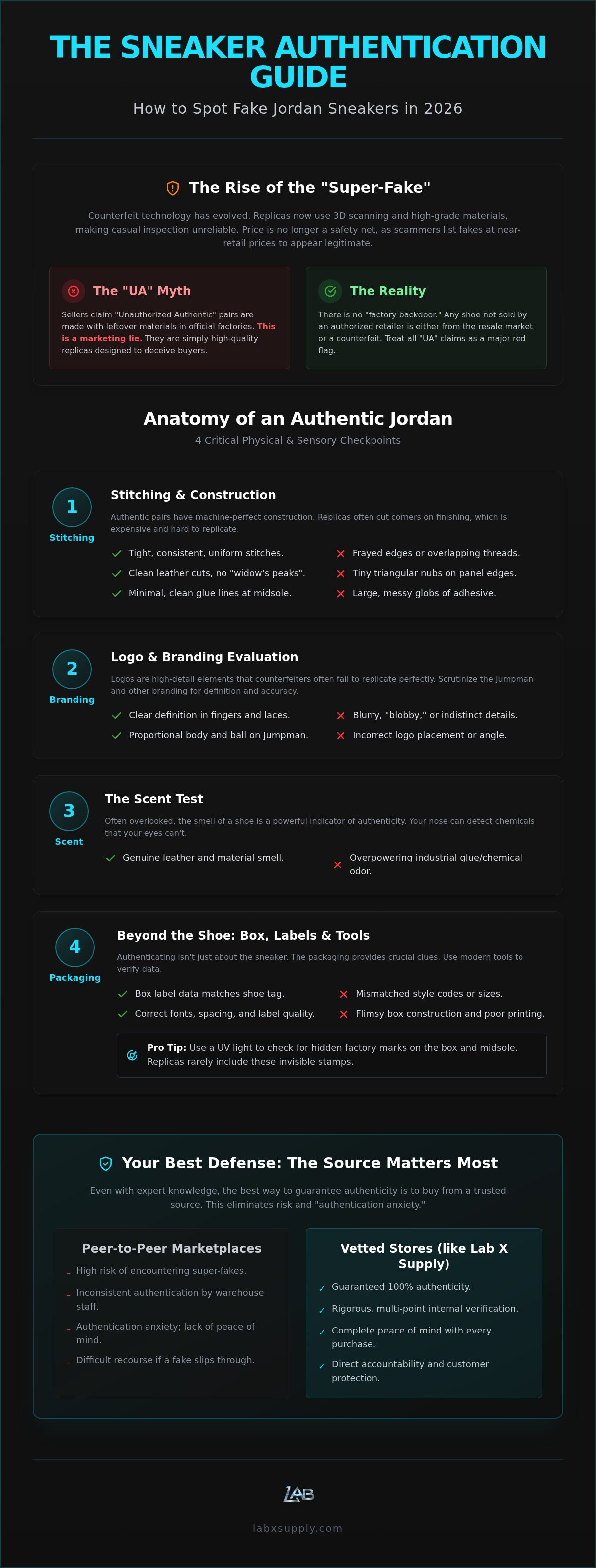
Physical inspection is your first line of defense against scammers. While replicas have improved, they often struggle to replicate the high-tension manufacturing processes used in official factories. To understand how to spot fake jordan sneakers, you must look past the overall aesthetic and focus on the technical execution of the build. Authentic pairs follow strict quality control standards that counterfeiters find expensive and time-consuming to mimic. By focusing on these four checkpoints, you can identify even the most convincing high-tier replicas.
Step 1: Inspecting the Stitching and Construction
Authentic Jordans feature tight, consistent stitching that maintains a uniform distance from the edge of each leather panel. Replicas often show frayed edges or overlapping stitches, particularly in high-stress areas like the heel and the "corner stitch" above the swoosh. Pay close attention to the leather cuts themselves. Authentic pairs are cut with precision; they never have "widow peaks," which are those tiny triangular nubs left behind when a die-cut machine isn't sharp or aligned. Finally, examine the midsole. While minor glue marks can appear on retail pairs, a genuine shoe will have a clean transition from the rubber to the upper without large, messy globs of industrial adhesive.
Step 2: Evaluating the Logo and Branding
The branding elements are often the hardest parts for replica factories to get right. On the Jumpman logo, look for distinct definition in the fingers, shoelaces, and the ball; fakes often look like a blurry or bloated silhouette. For Jordan 1 models, the Wings logo should be deeply and cleanly embossed into the leather. If the logo feels flat or the "AIR JORDAN" text looks smudged, it's likely a fake. Don't forget to check the "R" trademark symbol next to the logos. On authentic pairs, this symbol is crisp and legible even at a small scale. Replicas frequently make this "R" too large, blurry, or positioned incorrectly.
Material quality and structural integrity provide the final clues. Genuine Jordan leather has a natural, subtle grain that feels soft to the touch and bounces back when pressed. In contrast, many fakes use synthetic plastic coatings that feel stiff or look unnaturally shiny. If you're looking at a Jordan 1, check for the "hourglass" shape from the rear. The shoe should swell at the top, taper at the middle, and widen again at the heel. Replicas usually have a straight, boxy profile because they lack the internal reinforcement of the real thing. If you want to skip the guesswork, you can browse a curated selection of authentic sneakers at Lab X Supply, where every pair undergoes a professional vetting process.
Beyond the Shoe: Authenticating the Box, Labels, and Packaging
Many collectors make the mistake of focusing exclusively on the footwear, but the packaging is often the first place a replica factory cuts corners. High-quality "super-fakes" might get the leather right, but they frequently fail to replicate the specific printing standards and security features of retail boxes. Understanding how to spot fake jordan sneakers requires a "box-first" mentality. If the packaging shows signs of poor quality control, there's a high probability the shoes inside aren't genuine either.
The Box Label Litmus Test
The box label is a goldmine for authentication. On an authentic pair, the font weight is precise; the text is crisp and never looks bloated or blurry. Pay close attention to the spacing between letters and the alignment of the style code. One of the most common red flags is the "MSRP" perforated tab. On retail boxes, this tab is a separate, tear-away section. Replicas often print the MSRP price directly onto the label or use a fake perforated line that doesn't actually tear. Additionally, check for spelling errors in the translated sections. Typos in phrases like "Fabrique en Chine" are a dead giveaway of a low-tier fake.
If you have a UV light, perform the "Blacklight Test" on the label. Authentic Nike and Jordan labels often feature hidden factory stamps or specific glowing ink patterns that are invisible to the naked eye. Replicas usually lack these markings or use the wrong ink color under UV light. Also, verify the QR code and RFID chip found behind the label on newer releases. While some fakes now include QR codes, they often lead to dead links or spoofed websites rather than the official brand database.
Accessories and Extras
The internal contents of the box provide further clues. Authentic Jordans come with high-quality, crisp tissue paper, often featuring specific logos or patterns depending on the model. Look for the small, circular "YCM" anti-mold sticker; while fakes try to copy this, the font and sticker size are usually slightly off. The shoe inserts are another physical checkpoint. Retail pairs typically use sturdy, molded cardboard inserts that feature a size stamp on the bottom. If your "brand new" shoes come with flimsy plastic trees or inserts with no markings, be cautious.
Finally, examine the extra laces and hangtags. Authentic laces are usually tied in a specific, tight factory loop or packaged in a high-quality bag that matches the shoe's theme. Replicas often have messy, loose lace bundles. Even the "Nike Air" orange hangtags should have a specific thickness and a matte finish; fakes often feel thin or look overly glossy. This attention to detail isn't just for sneakers; it applies to the entire footwear market, including the growing popularity of slides. You can learn more about how design standards have shifted across categories in our look at The Evolution of the Slide Series. Mastering how to spot fake jordan sneakers means looking at the total package, not just the laces and leather.
Professional Legit Checking: Tools, Apps, and the Scent Test
Visual inspection is a strong start, but professional authenticators rely on sensory data and specialized tools to make a final verdict. If you're still unsure how to spot fake jordan sneakers after looking at the logos and stitching, it's time to dig deeper. Replicas often look perfect on the surface but fail when subjected to physical and technological tests. These advanced methods help you identify the subtle differences in chemistry and construction that replica factories simply can't afford to fix.
The Sensory Experience of Authenticity
One of the most reliable tools in your arsenal is your sense of smell. Authentic Jordans have a distinct, clean scent that comes from high-quality leather and specific factory-grade adhesives. In contrast, many replicas have a "toxic" chemical smell. This overpowering odor of industrial glue and cheap plastic is a massive red flag. If the scent gives you a headache, the shoes are likely fake. Beyond the smell, pay attention to the weight. Counterfeiters often use lower-density foam in the midsoles to save on costs, making the shoes feel significantly lighter than retail pairs. You can also perform a "squeeze test" on the heel. An authentic pair will feel firm and structurally sound, while a fake often collapses under pressure because it lacks proper internal reinforcement.
Leveraging Technology for Peace of Mind
A handheld UV (blacklight) lamp is a game-changer for serious collectors. When you shine a UV light over a replica, you might see "GUIDE" lines. These are invisible ink markings left by workers in replica factories to help them align panels and stitching. Authentic Nike and Jordan pairs are assembled with enough precision that these markings aren't necessary. A blacklight also reveals hidden factory stamps on the box and the midsole that are invisible to the naked eye. If your light reveals messy markings or glowing glue stains that shouldn't be there, you're likely looking at a counterfeit.
For a final layer of security, many people turn to third-party authentication apps like CheckCheck or LegitCheck.app. These platforms use a combination of AI and human experts to analyze your photos. To get an accurate result, you must take clear, high-resolution shots of the "Strobel" stitching. This is the stitching found directly under the insole on the footbed. On authentic pairs, this stitching is tight, uniform, and uses a specific thread color. Replicas often have loose, messy, or widely spaced Strobel stitches because they assume most buyers won't remove the insole. If you want to avoid this stress entirely, you can shop for verified, authentic sneakers and slides at Lab X Supply, where our team handles the technical vetting for you.
Securing 100% Authentic Jordans: Why the Source Matters Most
You can spend hours learning how to spot fake jordan sneakers, but the most effective way to protect your investment is by choosing a reputable seller from the start. Social media platforms are currently flooded with "plugs" offering deals that seem too good to be true. Usually, they are. These unverified accounts often use stolen photos of retail pairs to sell high-tier replicas. By the time you realize you've been scammed, the account is often deleted and your money is gone. Relying on a random reseller puts the burden of authentication entirely on you, which is a heavy weight when "super-fakes" are so convincing.
The sneaker community has seen a massive shift toward professionalized resale for this very reason. Buying from an established business isn't just about the shoes; it's about the security of a vetted supply chain. When you remove the peer-to-peer risk, you eliminate the "authentication anxiety" that ruins the excitement of a new pickup. It's always better to pay the market rate for a guaranteed authentic pair than to lose hundreds of dollars on a "bargain" that ends up being a replica.
Eliminating the Risk with Lab X Supply
Lab X Supply was built to be the solution to the growing counterfeit problem. We aren't just another marketplace; we are a trusted reseller focusing exclusively on authentic sneakers and slides for the US market. Our team understands that modern replicas are sophisticated, which is why we prioritize rigorous sourcing. Every item in our inventory is vetted before it ever reaches our warehouse. We provide a safe, professional alternative to unverified peer-to-peer marketplaces where scams are common. Our promise is simple: no fakes, no replicas, and no headaches for our customers.
Final Checklist for Your Next Purchase
Before you commit to your next pair of retros, run through this final checklist to ensure you aren't walking into a trap. Even if you feel confident in your ability to identify how to spot fake jordan sneakers, these steps provide an extra layer of defense:
- Vette the seller history: Look for established businesses with a track record of delivering authentic goods. Avoid brand-new social media accounts with no external website.
- Review the return policy: Check if the seller has a clear policy regarding authenticity issues. A seller who doesn't stand behind their products is a major red flag.
- Compare the price: If a pair is priced significantly below the current market value on trusted platforms, it's almost certainly a high-tier replica.
- Analyze the communication: Professional sellers are transparent about their sourcing and authentication steps. If a seller is vague or defensive, walk away.
Building a relationship with a trusted store ensures you can grow your collection without the constant fear of being scammed. If you're ready to skip the stress and secure your next pair with total confidence, Browse our verified selection of Jordans and Slides at Lab X Supply today.
Take Control of Your Collection Today
Mastering the technical details of modern manufacturing is the only way to stay ahead of the counterfeit market. You've learned that identifying the "super-fakes" of 2026 requires looking past the surface and into the scent of the materials, the precision of the box labels, and the hidden factory marks revealed by UV light. While knowing how to spot fake jordan sneakers gives you a powerful defensive edge, the most reliable way to protect your wallet and your reputation is to vet your source before you buy.
Lab X Supply serves as a dedicated US-based sneaker and slide marketplace specialized in sourcing authentic footwear for serious collectors. We handle the rigorous authentication steps for you, ensuring every pair meets collector-grade standards before it ever reaches your door. By choosing a vetted professional over a random reseller, you can focus on the joy of the hunt rather than the fear of a scam. Your rotation deserves nothing less than 100% retail quality. Shop 100% Authentic Sneakers & Slides at Lab X Supply and build your collection with total peace of mind.
Frequently Asked Questions
Can fakes have a real Nike QR code?
Fake Jordans often feature QR codes that look identical to retail versions, but they don't function correctly. While a scammer might link the code to the official Nike website, it won't pull up the specific manufacturing data for that individual pair. Modern "super-fakes" sometimes link to high-quality spoofed sites designed to look like official verification portals. Always verify the URL in your browser before trusting a digital scan.
What is the most common flaw on fake Jordan 1s?
The lack of a proper "hourglass" shape when viewed from the rear is the most consistent flaw. Authentic Jordan 1s swell at the top and bottom but taper significantly at the middle. Fakes usually have a straight, boxy profile. Additionally, the Wings logo on replicas is often shallow or uses a font that is slightly too thin. Learning how to spot fake jordan sneakers involves checking these structural silhouettes before looking at the details.
Do authentic Jordans always smell like leather?
Authentic pairs have a distinct scent profile consisting of high-quality leather and mild, factory-grade adhesive. It's a clean, professional smell that collectors recognize immediately. Replicas frequently emit a sharp, toxic odor of industrial glue and low-grade plastics. This chemical scent is often so strong that it's noticeable the moment you open the box. If the smell gives you a headache or feels "off," the materials are likely synthetic counterfeits.
How can I tell if a sneaker website is selling fakes?
Red flags include "full size runs" of long-sold-out releases and prices that sit far below the current market value. Most legitimate resellers, like Lab X Supply, price their inventory according to current demand. If a site has every size of a rare retro for a bargain price, it's a scam. Check for a physical US address, clear return policies, and professional product photography. Avoid sites that only accept untraceable payment methods.
Is it possible for retail Jordans to have quality control flaws?
Yes, Nike often has minor quality control issues like loose threads or small glue stains. However, these flaws are different from the systematic errors found on fakes. A retail flaw might be a single messy stitch; a replica flaw is usually a pattern of incorrect font, wrong materials, or structural misalignment. Understanding how to spot fake jordan sneakers means distinguishing between a minor retail imperfection and a shoe made with entirely different machinery.
What should I do if I accidentally bought fake Jordans?
Contact your bank or credit card company immediately to initiate a chargeback for "goods not as described." If you used a platform like PayPal, open a dispute and provide photos of the flaws compared to a retail pair. Don't send the shoes back until the payment provider instructs you to do so, as you might lose your evidence. Most importantly, report the seller's account to the marketplace to prevent others from being scammed.
Are third-party verification tags a guarantee of authenticity?
A plastic tag is never a guarantee because replica factories produce fake verification tags by the thousands. Scammers often attach these to counterfeit shoes to create a false sense of security. Never base your purchase solely on the presence of a tag or a "verified" receipt. Instead, perform a full physical inspection of the shoe and the box labels using the multi-sensory steps mentioned throughout this guide. Trust the shoe, not the accessories.
How do I use a blacklight to check my sneakers?
Shine the UV light over the stitching, the midsole, and the box label in a dark room. You're looking for "guide lines," which are glowing ink marks used by replica assemblers to align panels. Authentic pairs won't have these. You should also look for glowing glue stains around the midsole, which are common on fakes. Finally, check the box label for hidden factory stamps that only appear under UV light on many retail releases.