
The $2,000 pair of Travis Scott x Air Jordan 1s you're eyeing might look perfect, but in 2026, looking perfect is exactly what high-tier replicas do best. It's a common fear among collectors that a high-end fake will slip through the cracks, especially when you're dealing with the confusion of minor Nike factory variances. You want to know exactly how to spot fake jordan 1 pairs before you commit your hard-earned money to a resale market where some 'Shattered Backboards' can reach $1,500.
We understand that the anxiety of being scammed is real, especially with the rise of sophisticated 'Unauthorized Authentic' myths that cloud the truth. This guide will help you master the art of sneaker authentication by providing a professional-grade audit of structural architecture and manufacturing intent. You'll learn to identify the subtle red flags that even the best counterfeiters miss.
We're going to cover everything from the classic 'Big Three' visual indicators like the hourglass heel curve to Nike's latest patented digital authentication technology. By the end of this article, you'll have a definitive checklist and the confidence to make informed purchase decisions. We'll show you how to look past the hype and verify the true DNA of your sneakers.
Key Takeaways
- Learn to analyze the "Big Three" visual markers, including the specific embossing depth of the Wings logo and the precise taper of the Nike Swoosh.
- Discover how to use structural forensics to identify the corner stitch flaw and hidden factory markings that counterfeiters often overlook.
- Master the sensory red flags by understanding the "smell test" and checking for specific typographic errors on the box label.
- Gain a competitive edge by learning how to spot fake jordan 1 pairs across different replica tiers, from budget batches to high-end counterfeits like those showcased on sneakerdouble.net.
- Understand the importance of a multi-step authentication process to ensure your investment in rare or OG colorways is protected.
The Architecture of an Icon: Why Jordan 1 Authentication Matters
The sneaker market has reached a turning point. In 2026, the sophistication of the counterfeit industry makes it harder than ever to distinguish a retail pair from a high-end clone. Learning how to spot fake jordan 1 sneakers is now a necessity for any collector looking to protect their investment. With rare colorways seeing a 300% higher resale premium when production is limited to under 5,000 units, the incentive for counterfeiters to produce "perfect" fakes has never been higher.
Traditional visual checks are still important, but they're no longer 100% sufficient on their own. Nike's recent patent for a "Digital Authentication System" in early 2026 highlights this shift. This system uses invisible identifiers like conductive inks or magnetic materials embedded directly into the shoe. While these "fingerprints" are becoming the new standard for modern releases, older pairs in the secondary market still require a deep dive into structural forensics. You must also account for the release year. A pair from the 2026 lineup, like the "Royal" High OG scheduled for October and retailing at $185, will feature different factory "tells" than a pair released years ago. Knowing how to spot fake jordan 1 pairs requires understanding these evolving manufacturing standards.
The Myth of "Unauthorized Authentics" (UA)
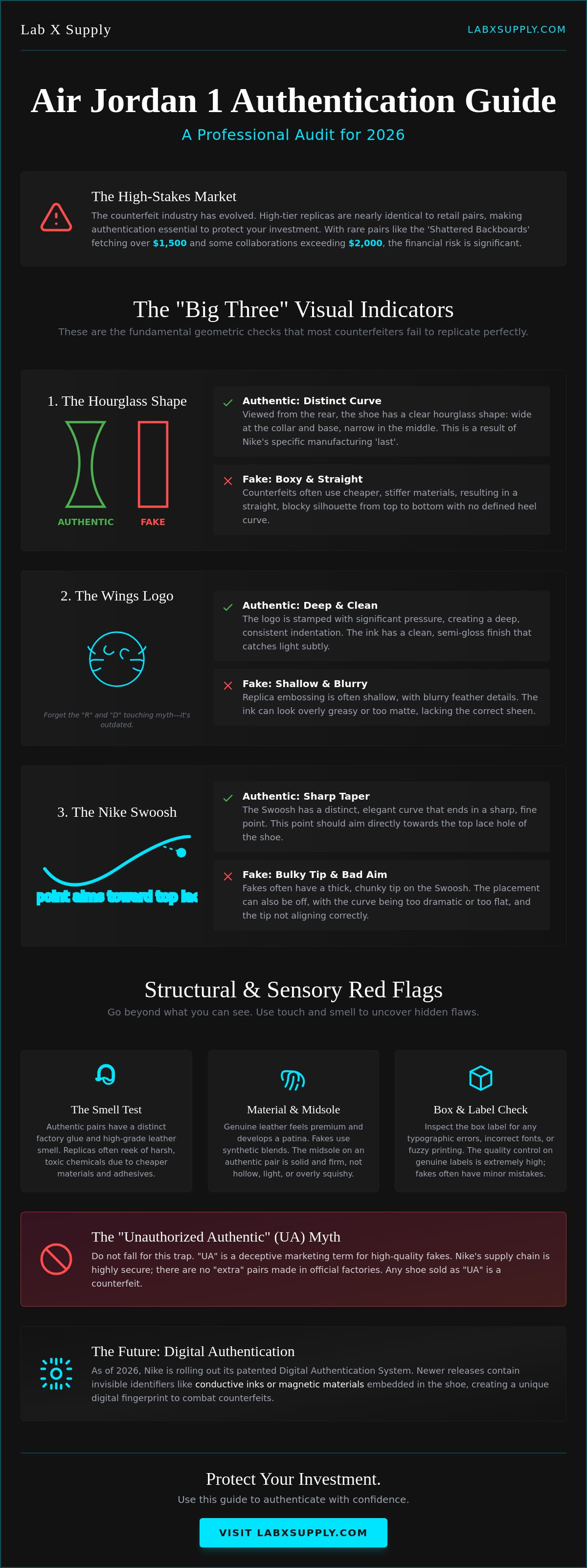
Don't fall for the "UA" trap. Sellers often claim their shoes are "Unauthorized Authentics" that were produced in the official factory but not authorized for sale. This is a complete myth designed to justify higher prices for replicas. Nike’s supply chain is far too secure for large-scale "extra" production to occur. These shoes are made in independent facilities that spend months reverse-engineering the original design. They might look similar, but they lack the manufacturing intent and quality control of a genuine product.
Anatomy of the Air Jordan 1
The Air Jordan 1 is a masterpiece of paneling and proportions. It consists of the toebox, the quarters, the collar, and the signature rubber midsole. Authentic pairs use high-grade leather that develops a specific patina over time, whereas fakes often rely on synthetic blends that smell of harsh chemicals. The midsole should provide a solid foundation; if it feels hollow or squishy, it's a major red flag. This attention to detail is what defined the Air Jordan history, turning a 1985 basketball sneaker into a high-value cultural icon. Understanding how these components are supposed to fit together is the first step in identifying a counterfeit.
The "Big Three" Visual Indicators of Authenticity
Visual inspection remains your primary defense against a bad deal. Even with Nike's new digital identifiers, understanding how to spot fake jordan 1 pairs through physical geometry is essential. Most high-tier replicas struggle to replicate the precise manufacturing tension that creates the iconic Jordan 1 silhouette. These visual markers are the physical expression of the structural architecture we discussed previously. We focus on the "Big Three": the logo, the shape, and the Swoosh.
Mastering the Wings Logo Audit
Forget the old advice about the "R" and "D" letters touching. By 2026, even mid-tier fakes have corrected this font flaw, making it an unreliable metric. Instead, look at the embossing depth and gloss finish. Authentic Wings logos are stamped with significant pressure, creating a deep, consistent indentation in the leather. The black ink should have a semi-gloss sheen that catches light without looking greasy. If the feathers in the wing look blurry or the embossing is shallow, you're likely looking at a replica.
The Hourglass Shape Test
The "hourglass" shape is the most discussed yet misunderstood indicator. When viewing an authentic Jordan 1 from the rear, it should be wide at the collar, narrow at the "waist" near the heel counter, and wide again at the base. This isn't just an aesthetic choice; it’s a result of the shoe being stretched over a specific "last" during production. Counterfeiters often use cheaper, stiffer internal heel boards that result in a boxy, straight silhouette. While this shape can soften with heavy wear, the structural curve of the heel counter remains a permanent fixture of an authentic pair. Mastering how to spot fake jordan 1 details requires looking at these structural curves rather than just the surface.
The Swoosh Geometry
The Swoosh is a study in precision. It should feature a sharp, tapered point that aims directly at the top lace hole. Fakes often have a "hook" at the tip or a rounded point that lacks the aggressive angle of the original. Check the placement height; the bottom of the Swoosh should sit just above the midsole without touching it. When you're paying the $185 retail price for a new release, these details should be flawless. Beyond the aesthetic risks, there are broader dangers of counterfeit goods, including the funding of illegal operations and the use of unregulated materials.
Toebox perforations also offer a quick tell. On a retail pair, the holes are punched cleanly with consistent sizing. Fakes often show "burrs" or jagged edges inside the holes because the punching tools aren't sharp enough. If you want to skip the guesswork and browse a curated selection of authentic sneakers, choosing a professional marketplace is always the safest move.
Structural Forensics: Stitching and Interior Details
External aesthetics are becoming easier for counterfeiters to mimic, so the internal construction often tells the real story. When you're learning how to spot fake jordan 1 sneakers, you've got to look at the structural forensics that happen behind the scenes. This involves inspecting the stitching tension and the hidden interior details that replica factories often rush to save time. While the outside might look like a $185 retail pair, the "bones" of the shoe usually reveal the truth. Understanding how to spot fake jordan 1 details requires a deep dive into the manufacturing process itself.
The Corner Stitch and Stitching Density
The corner stitch flaw is a classic tell that still persists in 2026. Traditionally, the 90-degree "L" shaped stitch above the Swoosh shouldn't touch the logo itself. While some newer retros show slight factory variance, a stitch that runs directly through or sits flush against the Swoosh is a major red flag. Authentic Nike machines operate at high tensions. This results in tight, uniform stitches with consistent length. If you see "double-stitching" where a needle has passed through the same hole twice, it's a sign of manual error common in replica shops. Also, look for tiny "dots" or blue ink lines. These are stitching guides that authentic, automated factories never leave behind.
Interior Label and Size Tag
The size tag inside the collar is a goldmine for authentication. Check the font weight on the production date and SKU. Authentic labels use a crisp, bold font that's perfectly centered. Replicas often have "fuzzy" print quality where the ink bleeds slightly into the fabric. You should also verify the UPC code. It must match the code on the shoebox exactly. Beyond the risk of losing money, there are significant dangers of counterfeit products, including the support of criminal enterprises and the use of toxic chemicals in unregulated factories.
The Insole and Footbed
Remove the insole to see the most definitive evidence: the Strobel stitch. This is the stitching that connects the upper to the midsole. On an authentic Jordan 1, these loops are tight, uniform, and evenly spaced. Fakes often show loose threads, long gaps, or messy "bird-nesting" of the thread. Check the glue pattern on the bottom of the insole too. Nike typically uses a pattern of horizontal or diagonal glue strips. If the glue is spread haphazardly or smells like heavy industrial solvent, you're likely holding a fake. The insole foam should feel dense and springy, not like cheap, airy craft foam that collapses under light pressure.
The Box and Sensory Red Flags: Beyond the Leather
Authentication doesn't end with the shoe itself. Counterfeiters often spend the majority of their budget on leather quality and logo accuracy, which leaves the packaging and sensory experience as the final giveaway. If you want to know how to spot fake jordan 1 pairs with total certainty, you have to look beyond the surface. The box, the smell, and even the way the materials react to light provide critical data points that a visual-only check might miss. These elements are the hardest for replica factories to replicate because they require expensive, specialized manufacturing equipment.
The Box Label and Font Weights
The box label is a study in typography. Authentic labels use a very specific font weight for the colorway name and SKU. Replicas often struggle with kerning; you'll see letters that are too close together or font that appears unnaturally bold. Pay close attention to the "Suggested Retail" perforated tab. On a genuine pair, this tab is cleanly perforated and easy to tear. Fakes often have a printed line that mimics a perforation or a tab that's impossible to remove without ripping the label. If you scan the QR code and it leads to a 404 error or a generic web search instead of a Nike-verified landing page, you're holding a counterfeit. For a new release like the 2026 "Royal" High OG, this label should be flawless.
Sensory Authentication: Smell and Feel
Your nose is one of your best tools for authentication. Authentic Jordan 1s have a distinct, slightly sweet "factory" scent from the high-quality adhesives Nike uses. In contrast, replicas often emit a pungent, gasoline-like hydrocarbon smell. This happens because budget-conscious replica factories use cheaper, toxic glues that haven't had time to off-gas. If the smell hits you the moment you open the box, it's a major red flag that the materials aren't retail grade. It's unmistakable once you've smelled a real pair.
Don't forget the tactile feedback. A genuine midsole has a specific density that provides resistance. Perform a "flex test" by gently trying to fold the shoe. An authentic pair will be firm and spring back instantly. Many fakes feel "mushy" or hollow because they lack the internal structural components of the original. Weight is another factor; while minor variances exist, fakes are often noticeably lighter because they use lower-density foam. If you want to avoid these headaches and ensure your collection is 100% authentic, you can shop our verified sneakers to get the real deal every time.
Finally, consider a UV light inspection. This technology reveals "invisible" factory marks that the naked eye can't see. Counterfeit factories often use UV-reactive ink to mark stitching lines or placement points during assembly. Under a blacklight, these marks glow bright blue or green. While Nike factories occasionally leave minor marks, a shoe covered in glowing stamps and lines is almost certainly a replica. Mastering how to spot fake jordan 1 details means using every tool at your disposal, from your eyes and nose to specialized tech.
Buying with Confidence: How to Secure Authentic Jordans in 2026
The sneaker world in 2026 is complex. Even with the $185 retail price for new releases like the "Royal" High OG, the secondary market is where most collectors find their grails. This is where the risk is highest. While you've learned the visual and structural red flags, a professional multi-step authentication process is your only 100% guarantee. Relying on a single person's eye is a gamble when thousands of dollars are on the line for pairs like the Travis Scott x Air Jordan 1 High "Cactus Jack."
Professional marketplaces offer the best protection because they act as a neutral third party. They have the volume and the specialized equipment to catch fakes that a casual buyer would miss. At Lab X Supply, we don't just look at the shoe; we audit the entire transaction. This includes checking the manufacturing batch data and verifying the supply chain integrity to prevent issues like "backdooring."
The Lab X Supply Authentication Standard
We maintain a rigorous vetting process for every pair of sneakers and slides we sell. Our team focuses on sourcing exclusively from verified collections and trusted retail partners. This ensures that the chain of custody is clear and the sneakers are legitimate. We don't rely on luck. We stay ahead of the curve by following the principles outlined in The Ultimate Guide to Authentic Sneakers in 2026. This guide covers the latest trends and tech, including Nike's new digital identifiers, that keep the counterfeit market at bay.
Before you hit the "buy" button on any platform, run through this final checklist:
- Check the seller's reputation and their specific return policy for high-value items.
- Verify the SKU and UPC match the release year and factory location.
- Look for clear, high-resolution photos of the Wings logo and the hourglass heel curve.
- Ask for a blacklight test if the pair is from a batch known to have high-quality replicas.
- Trust your gut. If a rare pair is priced significantly below the 300% resale premium typically seen for limited runs, it's likely a red flag.
Next Steps for Your Collection
Ready to add to your rotation? You can browse our curated selection of verified Jordans without the stress of performing a solo legit check. We handle the heavy lifting so you don't have to worry about how to spot fake jordan 1 flaws yourself. Sign up for our newsletter to get legitimate drop alerts and stay updated on the latest authentic releases. Our commitment is to provide you with the confidence that every purchase is the real deal.
Shop Authentic Sneakers at Lab X Supply
Secure Your Sneaker Legacy
Authentication in 2026 is about more than just a quick glance. You've learned to analyze the structural architecture of the shoe, from the precision of the hourglass curve to the hidden Strobel stitching under the footbed. You now know that the "smell test" and UV light inspections are just as critical as checking the Wings logo. Mastering how to spot fake jordan 1 sneakers requires this multi-layered approach to stay ahead of increasingly sophisticated replicas. It's about protecting your investment and your passion for sneaker culture alike.
Don't let the fear of "super-fakes" stop you from growing your collection. As a trusted US-based sneaker reselling platform, Lab X Supply takes the guesswork out of every transaction. Our team performs an expert multi-point authentication on every pair in our verified inventory of sneakers and slides. You deserve the peace of mind that comes with knowing your investment is 100% genuine, whether you're chasing an OG colorway or the latest collaboration. Take the next step in your collecting journey today with a partner you can trust.
Shop 100% Authentic Jordan 1s at Lab X Supply and step out with total confidence. Your dream rotation is waiting, and we're here to help you secure it.
Frequently Asked Questions
Do all fake Jordan 1s have the "corner stitch" flaw?
No, high-tier replicas have mostly eliminated this flaw to match retail standards. While budget batches still show the "L" shape touching the Swoosh, elite counterfeiters have adjusted their patterns. You shouldn't rely on this single marker alone. Instead, combine this check with other structural forensics like the density of the Strobel stitching to get a more accurate picture of the shoe's origin.
Can a UV light really help me spot a fake Jordan?
A UV light is an excellent tool because it reveals invisible factory stamps and guidelines. Authentic Nike pairs rarely have these markings, but replica factories often use UV-reactive ink to guide their manual assembly process. If you see glowing blue stamps or bright ink lines under a blacklight, it's a definitive sign of a counterfeit that didn't come from an authorized Nike facility.
What is the "smell test" for Jordan 1s?
The smell test involves checking for the heavy chemical odor of industrial solvents. Authentic Jordan 1s have a mild, slightly sweet scent from Nike's specific bonding agents. Replicas often use cheaper glues that smell like gasoline or strong hydrocarbons. This happens because they're produced in unregulated facilities with poor ventilation, leaving a pungent scent that hits you as soon as you open the box.
Is it possible for a real Nike pair to have minor quality control issues?
Yes, authentic Nike pairs frequently have minor quality control issues like loose threads or slight paint variances. These "flaws" can actually be a sign of authenticity. Replica factories often over-perfect their products to appear more legitimate than the real thing. Knowing how to spot fake jordan 1 pairs means distinguishing between a simple factory error and a fundamental structural manufacturing difference.
How can I check if the Jordan 1 box label is authentic?
Check the font thickness and the perforation on the "Suggested Retail" price tab. Authentic labels use a precise font weight that doesn't bleed into the paper. The price tab should be easy to tear away along a physical perforated line. Many fakes use a printed line that only mimics the look of a perforated edge, which is a major red flag for any collector.
Does the "Hourglass" shape disappear after wearing the shoes?
The hourglass shape will soften as the leather breaks in, but the structural curve of the heel counter stays intact. While the collar might lose some of its flare over time, the "waist" of the shoe remains narrower than the base. If a shoe looks completely straight or boxy even when brand new, it's likely a fake built with a cheap, stiff internal heel board.
Are "B-Grade" Jordans the same as fakes?
No, B-Grade Jordans are 100% authentic products that simply failed Nike's initial quality inspection for minor cosmetic reasons. They're typically sold at Nike outlets and feature a small "B" stamp on the interior size tag or the box. They differ from fakes because they're made with the same high-quality materials and official manufacturing intent as any other retail pair.
Why do some fake Jordans look better than the real ones?
Counterfeiters sometimes use higher-grade leather or more precise stitching to overcompensate for their lack of official branding. This "over-perfection" is a common trap for buyers who expect retail pairs to be flawless. Understanding how to spot fake jordan 1 details involves looking for specific manufacturing intent and factory signatures rather than just searching for the most aesthetically beautiful shoe.