
Your brand-new $125 Air Force 1s are most vulnerable the second they leave the box. It's a painful reality that even one afternoon of walking can leave permanent lines across that iconic white leather, which is why learning how to prevent creases in air force 1s is essential for any serious collector. You shouldn't have to resort to a stiff, awkward "duck walk" or suffer through painful plastic inserts just to preserve your style. We understand that keeping your sneakers looking pristine is a priority, but it shouldn't come at the cost of your comfort.
This guide shows you exactly how to master professional techniques to keep your AF1 toe boxes crisp and crease-free for years. You'll learn the three pillars of crease prevention: precision sizing, physical barriers, and mindful maintenance. We'll explore the latest 2026 gear, comparing standard $10 protectors with premium memory foam alternatives, and even show you how to fix existing damage. By the end of this article, you'll have the expert knowledge needed to maintain that straight-from-the-shelf look while walking with total confidence.
Key Takeaways
- Learn why sizing down by a half and using the pinky finger test prevents the excess room that leads to deep leather folds.
- Discover how to prevent creases in air force 1s by choosing between durable plastic shields and comfortable memory foam guards.
- Master the heel-to-flat walking technique to reduce the aggressive toe-off motion that creates permanent hinge marks.
- Understand the 24-hour rest rule to allow leather fibers to dry and contract naturally between every wear.
- Follow a safe, step-by-step steam-ironing method to lift existing damage and restore your sneaker's original shape.
The Anatomy of a Crease: Why Air Force 1s Are Vulnerable
Understanding the mechanical stress on your sneakers is the first step in learning how to prevent creases in air force 1s. Creasing isn't just a sign of wear; it's physics. It occurs when the leather upper undergoes natural compression during your gait cycle. As you walk, your foot bends at the ball, forcing the material above to fold inward. Because the Air Force 1 features a relatively flat and spacious toe box, it creates a natural hinge point where the material has nowhere to go but down, resulting in those deep, unsightly lines.
The specific vulnerability zone typically sits between the first and third eyelets. This is the high-stress area where the shoe must flex to accommodate your movement. While the Nike Air Force 1 history shows a transition from a performance basketball shoe to a lifestyle staple, the core architecture remains largely unchanged. Modern versions often utilize a synthetic-coated leather that's stiffer than premium, tumbled alternatives. This stiffness means that once a fold begins, it tends to stay, eventually cracking the outer coating if you don't take preventative steps.
The Science of Leather Compression
Your feet generate significant heat and moisture throughout the day. This internal environment softens the leather fibers, making them more pliable and prone to taking a new shape. The first 100 steps you take in a fresh pair are the most critical for setting the crease pattern. During the 'toe-off' phase of your stride, your heel lifts while your toes remain planted. This motion puts maximum pressure on the forefoot, creating the foundation for permanent damage before the day is even over.
AF1 Design Flaws vs. Features
The iconic chunky sole unit is a double-edged sword. While it provides excellent stability, its lack of mid-foot flexibility forces the entire shoe to pivot at the toe rather than arching with your foot. Along with the sole, the perforated holes on the toe box act like a perforated line on a piece of paper, encouraging the leather to snap and fold along those specific points. A toe box hinge is the primary cause of creasing as it concentrates all the mechanical force into a single horizontal line across the forefoot. Mastering how to prevent creases in air force 1s requires addressing this specific structural weakness before the leather's memory is permanently set.
Prevention Starts at Purchase: Sizing and Lacing Strategies
Most sneakerheads make the fundamental mistake of buying their standard size when picking up a fresh pair of Air Force 1s. These shoes are notorious for running large, often leaving a significant gap between the top of your foot and the interior of the leather. This "dead space" is the primary catalyst for structural failure. When you understand how to prevent creases in air force 1s, you realize that a snug fit is your first line of defense. Quality control begins even before you lace them up, starting with choosing authentic sneakers to ensure the leather density meets retail specifications.
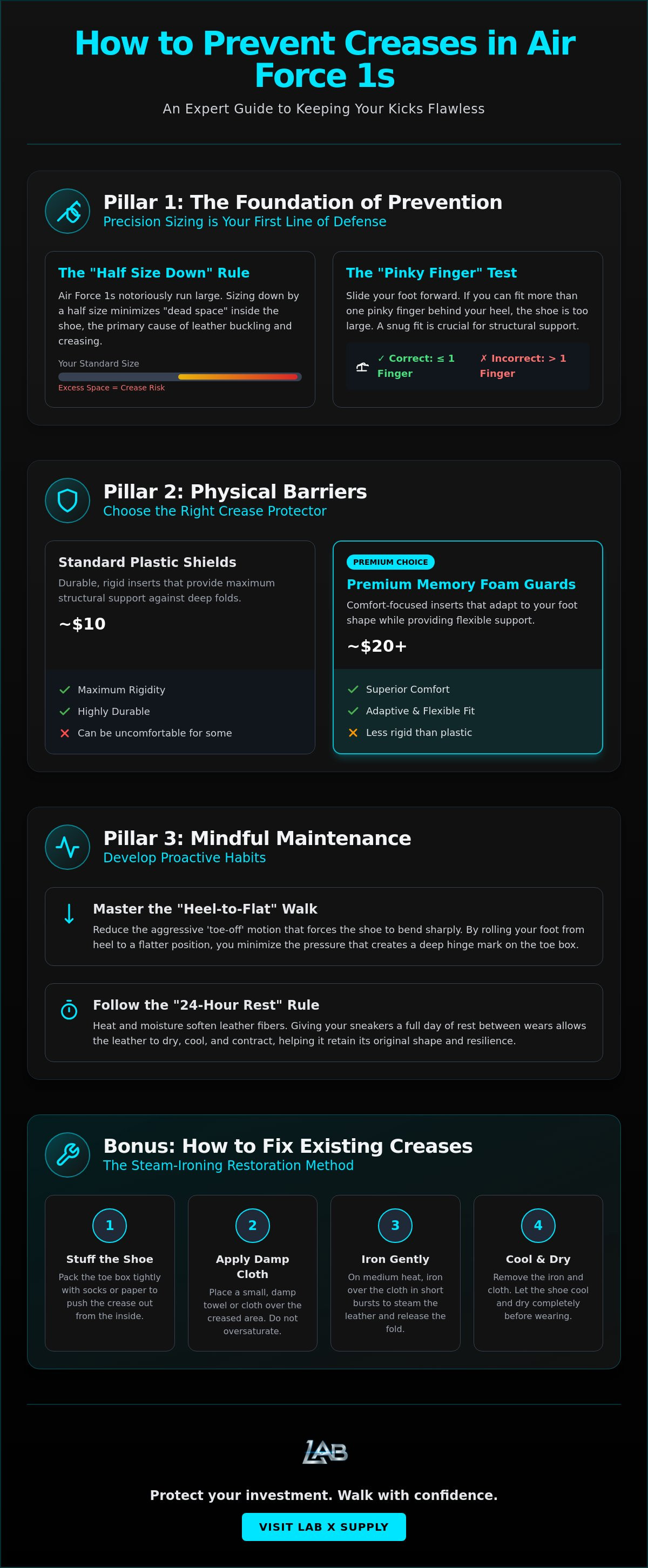
The "Half Size Down" rule is the industry standard for this silhouette. By sizing down, you minimize the room that allows leather to buckle inward. To verify your fit, use the "Pinky Finger" test. Slide your foot as far forward as possible. If you can fit more than one pinky finger behind your heel, the shoe is too large. Excess room at the heel causes your foot to slide forward with every step, forcing the toe box to hinge aggressively and creating deep, permanent folds in the leather.
The Impact of Dead Space
Visualize the leather upper as a bridge. Without the structural support of your foot directly underneath it, the material collapses into the void every time you flex your toes. This is why narrow feet are particularly prone to side-wall creasing. Since the foot doesn't fill the width of the shoe, the leather caves in from the sides as well as the top. Proper fit ensures the leather remains taut against your foot, distributing the pressure of your stride across the entire surface rather than concentrating it at a single hinge point. This structural preservation is a key part of long-term Leather Care Tips that experts recommend for all high-end footwear.
Lacing Techniques for Stability
Lacing isn't just an aesthetic choice; it's a mechanical tool. Tight lacing minimizes internal foot movement, which is essential when learning how to prevent creases in air force 1s. The "Over-Under" lacing method is superior to "Under-Over" because it provides a flatter profile across the bridge of the foot, offering more consistent support. Always utilize the top eyelet to perform a "heel lock." This technique pulls your foot back into the heel counter, preventing the forward sliding that causes the toe box to compress. If you're looking to upgrade your rotation, you can find the latest authentic sneakers and slides to test these lacing strategies yourself.
The Best Crease Protectors: Guards, Shields, and DIY Fixes
Once you have secured the right size, physical barriers are the most effective way to maintain structural integrity. These inserts act as an internal skeleton, preventing the leather from collapsing during the toe-off phase of your stride. When considering how to prevent creases in air force 1s, the market offers a wide range of solutions, from basic $8 multi-packs to premium $33 memory foam kits. While the previous section focused on sizing, these tools provide the literal backbone needed to keep that toe box flat and crisp.
Plastic vs. Foam: Which Should You Choose?
Choosing the right material depends on your priority: maximum protection or all-day comfort. Plastic shields offer the highest level of rigidity. They are virtually indestructible and provide a firm wall that stops leather compression entirely. However, they can be unforgiving for those with wide feet or sensitive pinky toes. Foam guards, particularly the memory foam varieties popular in 2026, offer a much softer experience. While they are breathable and comfortable, they tend to lose their structural memory after 3 to 4 months of heavy use. For the best of both worlds, gel-padded hybrids have emerged as the premium standard, featuring a rigid core with a soft outer layer to prevent skin irritation.
Proper Guard Installation
Even the best guard will fail if installed incorrectly. Always remove your sneaker's insole before sliding the protector into the toe box. This ensures the guard sits flush against the bottom of the shoe, preventing it from shifting and digging into your foot. Align the guard slightly toward the lateral side of the shoe, as this is where most AF1s begin their initial fold. Once the guard is in place, re-insert the insole to lock it down. This creates a sandwich effect that keeps the protector stable during movement.
If you find the edges of the guard are pinching your toes, use the 'Trim-to-Fit' technique. Most plastic shields have pre-marked lines that you can cut with standard kitchen scissors to customize the width. This is the secret to wearing guards without losing circulation or resorting to a stiff walk. It remains the most popular strategy for how to prevent creases in air force 1s while maintaining daily comfort. Beyond physical inserts, maintaining the shoe's surface is equally vital. Following Nike's official guide to cleaning sneakers helps keep the leather supple and resistant to the cracking that often accompanies deep creases. For those who prefer a DIY approach for storage, stuffing a clean pair of socks tightly into the toe box when the shoes aren't in use provides a cost-free way to maintain the silhouette overnight.
Mindful Maintenance: Walking Habits and Storage
While sizing and guards provide a physical defense, your daily habits dictate the long-term survival of your sneakers. Learning how to prevent creases in air force 1s involves more than just buying accessories; it requires a shift in how you move and store your footwear. Even the best crease protector can't overcome a destructive walking gait or poor environmental conditions. Professional maintenance is about consistency rather than quick fixes.
Adjusting Your Gait Without Looking Silly
The sneaker community often jokes about the "penguin walk," where people keep their knees locked to avoid bending their toes. This looks unnatural and is difficult to maintain for more than a few blocks. A more realistic approach is the "Heel-to-Flat" walk. Instead of pushing off aggressively with your toes at the end of every step, try to lift your foot slightly earlier. Shortening your stride length reduces the angle of the toe bend significantly, which keeps the leather from reaching its breaking point. When you are navigating stairs or steep inclines, focus on landing with a flat foot. This distributes your weight across the entire sole rather than forcing the toe box to act as a mechanical hinge.
The Role of Proper Storage
Leather is a porous material that absorbs sweat and atmospheric humidity throughout the day. This moisture weakens the collagen fibers in the hide, making them prone to collapsing under pressure. You should follow the 24-hour rest rule: never wear the same pair of AF1s two days in a row. This interval gives the leather time to dry and contract back to its original shape. If you need to build a rotation to give your favorites a break, you can browse our latest mens sneakers to find a secondary pair for daily use.
Storage environment is equally critical. You should never leave your AF1s in a hot car, as extreme heat can cause "leather memory." This permanently sets any folds that were present when the shoe was last worn. For the best results, use cedar shoe trees. Unlike plastic trees, cedar actively draws moisture out of the inner lining while maintaining the shoe's silhouette. If you don't have trees, the original cardboard inserts or tightly crumpled paper will suffice. Finally, ensure you clean dirt out of existing micro-creases regularly. Trapped grit acts like sandpaper, deepening the lines every time the shoe flexes. Ready to protect your investment? Shop our full collection of sneakers and slides to ensure you always have a fresh pair ready for your rotation.
How to Remove Existing Creases: The Ironing Method
While the previous sections focused on how to prevent creases in air force 1s from the first wear, you might already have a favorite pair showing deep folds. You don't have to retire them just yet. The ironing method uses controlled heat and moisture to "reset" the leather's shape. This process requires patience and precision to avoid damaging the finish, but it can effectively lift even stubborn hinge marks from the toe box.
The first step is stuffing the shoe to its absolute maximum capacity. Use clean socks, crumpled paper, or a rigid shoe tree to push the leather out from the inside. The surface must be as taut and flat as possible before you begin. Next, prepare a "Steam Buffer" by soaking a clean cotton washcloth in water and wringing it out until it is damp but not dripping. This cloth is your only defense against scorching the material.
Set your iron to a medium heat setting. Place the damp cloth over the creased area and apply the iron using consistent, circular movement patterns. Never let the iron sit in one spot for more than a second. The goal is to generate steam that penetrates the leather fibers without burning the outer coating. Finally, the "Cool Down" phase is the most important step. You must leave the stuffing inside the shoe for at least 24 hours until the leather is completely cold and dry. Removing the support too early will cause the warm fibers to collapse back into their old, creased memory.
Restoring the Leather's Memory
Steam reactivates the collagen fibers within the leather, making them pliable enough to be reshaped. You must keep the iron moving to avoid "burning" the white finish, which can turn yellow if exposed to direct, stationary heat. To lock the new shape in place, many professionals use the "Cold Shock" technique. This involves pressing a fresh, cold damp cloth onto the toe box immediately after removing the iron. the sudden temperature drop helps the fibers contract and set in a flat position more quickly.
Post-Restoration Care
Heat and steam inevitably strip the natural oils from the leather. Once the shoe is dry, apply a dedicated leather conditioner to replenish these oils. This keeps the material supple and prevents it from becoming brittle or cracking over time. It's vital to remember that a restored shoe is more prone to re-creasing because the internal structure has already been compromised. This is the ideal time to start using the guards and walking habits we covered earlier. If the leather is physically cracked or the synthetic coating has peeled, no amount of ironing will fix the damage. At that stage, the material has reached its limit, and it's time to consider a fresh pair.
Step Into a Crisper Sneaker Future
Maintaining that factory-fresh look requires a proactive approach from the moment you unbox your pair. By combining proper sizing with physical barriers and mindful walking habits, you have mastered the professional secrets of how to prevent creases in air force 1s. It is vital to remember that leather is a natural material that needs time to rest and recover between wears. Whether you're using the latest gel-padded guards or perfecting your "heel-to-flat" walk, these small adjustments ensure your rotation stays pristine for years. You don't have to settle for cracked leather or awkward movements when you have the right tools and knowledge at your disposal. Consistency in your maintenance routine is what separates a casual wearer from a true collector.
Ready to add another classic to your collection? Shop Authentic Air Force 1s and Premium Sneakers at Lab X Supply. We provide a curated selection of trending 2026 styles with 100% Authenticity Guaranteed and fast shipping across the US. Your next crisp pair is just a click away. Keep your rotation fresh, your toe boxes flat, and your style undeniable.
Frequently Asked Questions
Do crease protectors actually work for Air Force 1s?
Yes, crease protectors are highly effective because they provide a structural skeleton that prevents the leather from collapsing. In 2026, the market for these accessories is massive, with top-rated protectors on Amazon selling approximately 2,000 units every month. While they can feel slightly stiff initially, they are the most reliable method for anyone researching how to prevent creases in air force 1s from the very first wear.
How do I walk without creasing my AF1s?
You can minimize damage by adopting a "heel-to-flat" walking style that avoids an aggressive toe-off. Instead of pushing off with your toes, lift your entire foot slightly earlier in your stride. This technique is more practical than the locked-knee "penguin walk" often seen in sneaker communities. Shortening your steps also reduces the angle of the bend, keeping the toe box flatter for longer.
Can you fix creases in Air Force 1s once they happen?
You can significantly reduce the appearance of existing folds using the steam ironing method. By stuffing the shoe to its original shape and using a damp cloth as a heat buffer, you can reactivate the leather's collagen fibers. While it won't make the shoe brand new if the leather has already cracked, it is the best reactive solution for maintaining a crisp aesthetic after damage has occurred.
What size crease protector should I get for my shoes?
Most protectors are sold in size ranges like Small or Large to match the internal volume of the shoe. Since every foot shape is different, look for trim-to-fit models that allow you to cut away excess plastic or foam with scissors. This customization prevents the edges from digging into your pinky toe while still providing full support across the toe box.
Does the 'ironing method' damage the leather over time?
Excessive heat can definitely damage leather by stripping away natural oils and making the material brittle. If you use the ironing method, you must follow up with a high-quality leather conditioner to replenish that lost moisture. Repeated steaming without proper aftercare will eventually cause the synthetic coating on modern AF1s to peel or crack prematurely.
Why do my Air Force 1s crease on the side instead of the toe?
Side-wall creasing usually happens when there is too much dead space between your foot and the sides of the shoe. This is common for people with narrow feet who wear standard-width AF1s. When the shoe isn't filled out laterally, the leather caves inward from the sides during movement rather than just hinging at the toe box.
Is it better to buy AF1s a half size smaller to prevent creases?
Buying a half size smaller is one of the best ways to learn how to prevent creases in air force 1s because it eliminates the excess room that causes folding. Since AF1s are known to run large, a tighter fit ensures the leather stays taut against your foot. This structural support prevents the material from having the space it needs to buckle inward during your stride.
How often should I use shoe trees in my sneakers?
You should use shoe trees every single time your sneakers are in storage. They are most critical during the first 24 hours after wear when the leather is still warm and moist from your feet. Cedar trees are the preferred choice because they absorb humidity and odors while holding the toe box in its original, flat position.