
Did you know that while the global sneaker resale market is projected to exceed $30 billion by 2034, profit margins for most individual resellers have actually tightened to between 10% and 25%? This shift has created a significant buyer's market, yet many collectors still feel overwhelmed when figuring out how to buy sneakers after release date. It's stressful to watch a retail site sell out in seconds, especially when you're worried about accidental fakes or hidden fees on secondary platforms. You shouldn't have to gamble with your hard-earned money just to get the shoes you want.
We'll show you how to master the secondary market so you can secure the pairs you missed on drop day without falling for replicas or overpaying. This guide provides a clear strategy for 2026, covering exactly when price dips occur and how to navigate different marketplace structures safely. You'll learn to identify reliable sources for authentic, deadstock pairs and understand the timing required to get the best possible deal.
Key Takeaways
- Learn the "Week After" rule to identify the specific window when resale prices typically dip following a major retail drop.
- Understand how to buy sneakers after release date by navigating the different fee structures and verification processes of major secondary marketplaces.
- Develop a professional eye for authentication by focusing on three critical areas: box labels, stitching consistency, and the authentic "new shoe" scent.
- Find out how to bypass the long shipping delays of anonymous platforms by sourcing already-authenticated sneakers and slides from curated, ready-to-ship inventories.
The Post-Release Landscape: What Happens After the "Sold Out" Sign?
Watching a "Sold Out" screen is a rite of passage for anyone in the sneaker collecting subculture. Once the retail window closes, the shoe enters the secondary market. This secondary market is a supply-and-demand ecosystem driven by collector sentiment. Understanding the mechanics of this market is the first step in learning how to buy sneakers after release date without overspending. The immediate aftermath of a drop is often defined by the "Hype Cycle," where prices spike due to Fear Of Missing Out (FOMO). Resellers capitalize on this initial panic, but savvy buyers know that the first price you see isn't necessarily the price you'll have to pay.
When you are researching how to buy sneakers after release date, you'll find that "Deadstock" (DS) is the industry standard. This means the pair is unworn, includes the original box, and has all the factory accessories. Occasionally, you might see "Very Near Deadstock" (VNDS) listings, which typically refer to pairs that were tried on once or worn briefly. For the 2026 market, focusing on DS pairs is the safest way to ensure you are getting a product that hasn't been altered or worn, preserving both the aesthetic and the long term value of your sneakers or slides.
Understanding the 72-Hour Market Shift
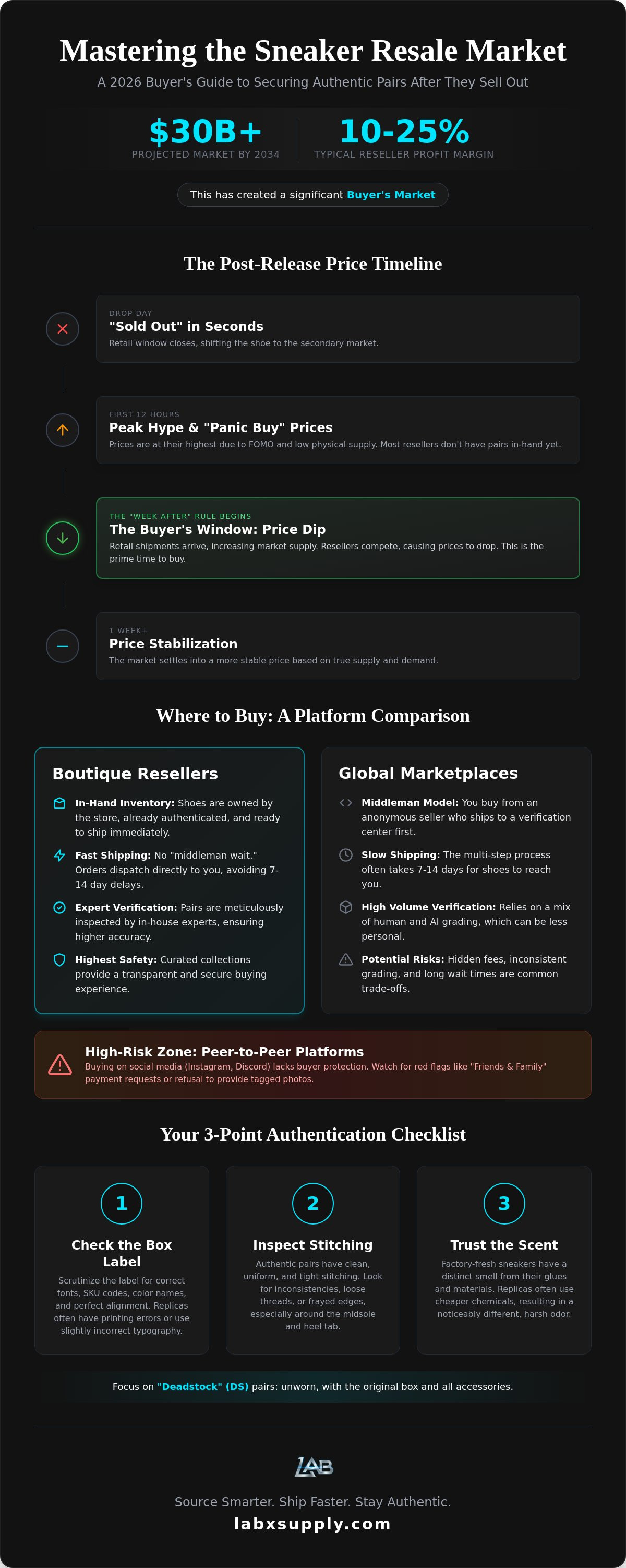
The 72 hours following a release are the most volatile. In the first 12 hours, you'll see "Panic Buy" prices. These are inflated because the physical supply is still low; most resellers don't actually have the shoes in hand yet. As retail shipments begin to land on doorsteps over the next three days, the market supply increases. This influx often causes a temporary price dip as sellers compete to undercut one another to secure a quick sale.
Retail vs. Resale: Adjusting Your Expectations
Retail price is a fixed number set by the brand, but once that stock is gone, retail is no longer the benchmark. Scarcity becomes the primary driver of value. If only 5,000 pairs were made, the market value will naturally stay high. However, with reseller profit margins cooling to 10% or 25% in 2026 compared to the 100% margins seen in previous years, the gap between retail and resale is often smaller than you might expect for many general releases.
Where to Buy Sneakers After the Official Release Date
Once the initial retail drop ends, your options for sourcing a pair generally fall into three categories: global marketplaces, consignment shops, and boutique resellers. Each path offers a different balance of price, speed, and security. Understanding these differences is essential when learning how to buy sneakers after release date because the "cheapest" price on an app often comes with hidden trade-offs. While large aggregators provide a massive volume of listings, specialized boutiques often provide a more transparent and faster experience by holding "in-hand" inventory.
Global marketplaces operate on a middleman model. When you buy a pair, the seller ships it to a verification center first. This process adds significant transit time, often taking 7 to 14 days before the shoes reach your door. An analysis of the secondary sneaker market suggests that these platforms thrive on volume, which can sometimes lead to a more automated, less personal verification process. In contrast, boutique resellers typically own their stock. This means the shoes have already been inspected by experts and are sitting on a shelf ready for immediate dispatch.
Global Marketplaces vs. Boutique Resellers
Large platforms frequently rely on high-volume authentication methods, sometimes incorporating AI to assist human graders. While efficient, this doesn't always match the precision of an expert human inspection found at a dedicated boutique. Shipping speed is another major differentiator. Because boutiques don't wait for a third-party seller to ship the item, you avoid the "middleman wait." When you're evaluating sneaker website credibility, look for stores that clearly state they have the product in stock. If you're looking for curated pairs that are already authenticated and ready to ship, browsing a trusted boutique collection is often the most efficient path.
The Risks of Peer-to-Peer Social Media Buying
It's tempting to hunt for deals on Instagram, Discord, or TikTok, but these are high-risk environments for most buyers. These platforms lack the built-in buyer protections found on professional websites. Common red flags include sellers who insist on "Friends and Family" payments or those who refuse to provide tagged photos with a specific date and time. Without an invoice-based transaction, you have almost no recourse if the shoes are fake or simply never arrive. Stick to established businesses that offer clear return policies and secure payment gateways to protect your investment.
Market Timing: When is the Best Time to Buy Resale Sneakers?
Timing the secondary market is an art form that separates casual buyers from savvy collectors. While the 72-hour window following a drop is known for its volatility, the real opportunities often emerge slightly later. Understanding how to buy sneakers after release date requires looking past the initial hype to find the "market floor." This floor is the lowest price a shoe reaches before supply begins to dry up and long term appreciation starts. For those hunting for "Personal Pairs" to wear, patience is your greatest asset. Conversely, "Investment Pairs" require a quicker trigger finger before they disappear into private collections forever.
Much like how professional traders use auspexterminal.com to monitor volatility and data in prediction markets, sneaker collectors must stay informed to avoid overpaying during the initial hype cycle.
Restocks also play a massive role in shifting value. When a brand unexpectedly drops more inventory of a previously "sold out" model, the resale price often craters overnight. We've seen this happen frequently with popular slides and heritage silhouettes. Seasonal trends offer another layer of strategy. For instance, slides are typically much more affordable during the winter months when demand for open-toed footwear hits its annual low. Buying out of season is one of the most effective ways to secure a deadstock pair for a fraction of its peak summer price.
The Dip: Spotting the Market Floor
The "Week After" rule is a proven strategy for 2026. Data shows that a typical 10-15% price correction occurs 7 to 10 days after a wide release as thousands of retail shipments finally land in resellers' hands. This influx of physical supply forces sellers to compete, driving prices down to their lowest point. You can use price history tools to track these trends. If you see a steady decline over five days, you're likely approaching the floor. Buying during this window also minimizes the risk of encountering the dangers of counterfeit sneakers, as legitimate sellers are eager to move their authentic retail pairs quickly.
Hype vs. Longevity: Predicting Price Curves
General Releases (GR) and high-profile collaborations follow very different paths. A GR pair might sit near retail for months or even drop below it if the brand overproduced the style. High-heat collaborations, however, often see a "V-shaped" recovery. They dip briefly during the delivery week and then climb steadily as the "deadstock" supply vanishes. You can use our Ultimate Guide to Authentic Sneakers to help identify which models have the DNA for long term value. Understanding these curves ensures you don't wait too long on a pair that's destined to double in price by next year.
Authentication and Safety: Ensuring Your Pair is Legitimate
The biggest hurdle when figuring out how to buy sneakers after release date is the fear of receiving a high-quality replica. In 2026, counterfeits have become incredibly sophisticated, often mimicking materials and colors with startling accuracy. However, brands have fought back by integrating RFID tags and encrypted digital certificates into their newest releases. These technologies allow buyers to verify a shoe's origin with a simple smartphone scan. If a seller can't provide a digital trail or if the shoe lacks these security features when it should have them, it's a clear signal to walk away. You should never buy from a site or seller that doesn't offer a 100% authenticity guarantee as part of their service.
Beyond digital tech, physical inspection remains vital for any post-release purchase. You should focus on three specific areas to verify your pair:
- Box Labels: Look for crisp fonts, correct spacing, and consistent ink saturation. Fakes often get the "CM" or "EUR" sizing fonts slightly wrong or use the wrong adhesive on the label itself.
- Stitching Patterns: Authentic pairs use high-grade machinery that produces uniform, tight stitches. Loose threads, inconsistent spacing, or "double stitching" where there should only be one line are immediate red flags.
- The Scent: Authentic deadstock pairs have a distinct "new shoe" smell from the factory glue. Replicas often have a harsh, chemical odor or a pungent plastic scent that is hard to ignore.
Common Red Flags in Post-Release Resale
If a price seems too good to be true, it almost certainly is. In a market where profit margins have stabilized between 10% and 25%, no legitimate seller is going to list a high-demand pair for significantly less than the current market floor. When browsing listings, avoid sellers who only use stock photos from the brand's website. You need to see "tagged" photos. These are images of the actual shoes with the seller's username and the current date written on a piece of paper nearby. Additionally, ask for the original proof of purchase from the retailer. While not a foolproof guarantee, it adds a layer of accountability to the transaction.
Professional Authentication Services
Sometimes, even an experienced eye needs a second opinion. Third-party authentication apps can provide a digital "legit check" by analyzing detailed photos you upload. It's important to distinguish between "factory flaws" and "replica indicators." Even authentic pairs can have minor glue stains or slight leather variations. Professional authenticators know how to tell the difference between these minor production errors and the systemic flaws found in mass-produced fakes. At Lab X Supply, we eliminate this stress by using a rigorous multi-point inspection process for all authentic sneakers we carry. If you want to skip the guesswork and secure a verified pair today, shop our authenticated inventory for total peace of mind.
Why Lab X Supply is Your Best Post-Release Destination
Lab X Supply offers a third, more efficient path. We've eliminated the "Middleman Wait" by holding our entire inventory in-hand. When you buy from us, you aren't waiting for a third-party seller to ship their pair to a verification center. Our sneakers and slides are already authenticated by experts and ready to ship directly to your door from our facility. This drastically reduces the time between "Buy Now" and the first time you lace up your new pair, often utilizing professional logistics solutions like Boost3PL to maintain shipping efficiency across the USA.
Our commitment to transparency means every pair undergoes a rigorous multi-point inspection before it ever reaches our digital shelves. We understand the anxiety of the 2026 secondary market, where replicas are becoming harder to distinguish from the real thing. By choosing a curated destination, you bypass the volatility of anonymous listings and the confusion of tiered fee structures. We focus exclusively on 100% authentic mens sneakers and slides, ensuring you can secure the pairs you missed on drop day without the typical stress of the "hype cycle" discussed earlier in this guide.
Curated Selection vs. Mass Market Chaos
Instead of sifting through thousands of low-tier listings, you'll find a hand-picked selection of the most coveted styles. Large marketplaces often feel like digital warehouses where quantity overrides quality. At Lab X Supply, we prioritize the heritage models and high-heat collaborations that collectors actually want. If you've recently taken an "L" on a major sneaker drop, you might find comfort in exploring the Slide Series Evolution, which highlights how iterative design has redefined comfort in 2026. Our personalized support is also a far cry from the automated bots used by global aggregators, giving you a human point of contact for every purchase.
Ready to Secure Your Pair?
Securing your next pair shouldn't feel like a second job. Our checkout process is streamlined for speed, and we provide fast shipping across the United States to get your shoes on your feet as quickly as possible. Whether you're looking for a classic silhouette or the latest limited release, we provide a safe, professional environment to complete your collection. Shop the latest authentic sneaker arrivals at Lab X Supply and experience a better way to navigate the resale market today.
Master Your Post-Release Strategy
Securing your favorite pairs after the "Sold Out" sign appears isn't a matter of luck; it's a matter of strategy. By waiting for the supply-driven market floor and prioritizing platforms with expert human authentication, you can avoid the common pitfalls of the secondary market. Mastering how to buy sneakers after release date allows you to build a high-value collection without the anxiety of drop-day chaos or the fear of sophisticated fakes.
At Lab X Supply, we've simplified this journey by providing a curated selection of the most wanted 2026 releases. Every pair in our inventory is held in-hand and backed by a 100% Authenticity Guarantee, ensuring you get exactly what you paid for without the long wait times of anonymous marketplaces. With our fast US-based shipping and dedicated support, your next grail is closer than you think.
Secure your 100% authentic pair at Lab X Supply today. You've done the research and learned the market curves. Now it's time to step out in style with total peace of mind.
Frequently Asked Questions
Is it safe to buy sneakers from resellers after they sell out?
It's safe to buy sneakers from resellers if you stick to professional businesses that verify every pair. Buying through established boutiques or marketplaces with a 100% authenticity guarantee protects you from receiving fakes. You should avoid peer-to-peer sales on platforms like Instagram or Discord, as these lack the buyer protections necessary for high-value transactions.
Why are sneakers so much more expensive on the resale market?
High resale prices are the result of basic supply and demand. Once a limited release sells out at retail, the brand doesn't produce more, creating a fixed supply. If thousands of collectors still want the shoe, the market value climbs. In 2026, you'll find that while some "hype" pairs remain expensive, many others have smaller margins due to a cooling market.
How long should I wait after a release to buy a pair of sneakers?
The optimal time to learn how to buy sneakers after release date is usually 7 to 10 days after the drop. This window, often called the "delivery dip," occurs when resellers receive their retail shipments and compete to sell them. This influx of physical supply often drives prices down by 10% or 15% before they stabilize or begin to rise again.
Can I get scammed on major sneaker marketplace apps?
While major marketplace apps use authentication centers, no system is perfectly flawless. Sophisticated replicas occasionally pass through, though the risk is very low on top-tier platforms. If you're concerned, buying from a boutique that holds in-hand inventory offers an extra layer of scrutiny, as experts inspect the shoes before they're even listed for sale.
What does "Deadstock" mean when buying sneakers after release?
Deadstock refers to a pair of sneakers or slides that is brand new and has never been worn or tried on. For a pair to be truly deadstock, it must include the original box, factory lacing, and any accessories like extra laces or hangtags. This is the gold standard for collectors and ensures you're the first person to ever put the shoes on.
How can I tell if a sneaker website is selling authentic products?
Authentic websites usually feature a clear, written authenticity guarantee and provide detailed, non-stock photos of their products. Check for secure checkout options like PayPal or credit card processors that offer buyer protection. A legitimate business will also have a professional "About Us" page and clear contact details rather than just an anonymous email address.
Do resale prices ever go back down to retail?
Resale prices can return to retail or even drop below it if a brand releases a massive restock. This is common for "General Release" models that aren't tied to a specific collaboration. If you are patient, you might find that the shoe you missed on release day eventually hits a lower price point once the initial trend has passed.
What happens if I receive a fake pair of sneakers from a reseller?
If you receive a counterfeit pair from a professional reseller, you are typically entitled to a full refund. Most reputable platforms and boutiques have strict policies to protect their reputation. You must document the flaws, keep the original shipping box, and contact their customer support team immediately. Professional sellers will investigate the claim and resolve the issue to maintain your trust.