
With the global sneaker market valued at approximately $110 billion in 2026, the incentive for counterfeiters to produce "super fakes" has never been higher. You've likely felt that pit in your stomach when browsing a resale listing, wondering if those "Grails" are the real deal or just a high-quality replica. It's frustrating to sift through conflicting Reddit threads and YouTube videos that only add to the confusion. Learning how to authenticate sneakers is no longer just a hobby; it's a necessary skill to protect your investment from sophisticated scams.
We understand that the complexity of brand-specific details can feel overwhelming, but you don't have to guess. This guide will help you master the art of sneaker authentication by combining professional-grade DIY inspection techniques with a clear breakdown of the top expert services available today. We'll provide a definitive checklist for your own inspections and compare the leading professional platforms to give you total peace of mind for your collection.
Key Takeaways
- Learn a specific 5-point DIY inspection process to identify low-tier replicas before you commit to a purchase.
- Discover how to authenticate sneakers by examining box labels, stitching patterns, and construction details that counterfeiters often miss.
- Compare app-based authentication for quick checks against in-hand expert services for high-value investment pieces.
- Identify unique brand nuances, including texture tests for slides and the specific hourglass shape required for authentic high-tops.
- Understand why purchasing through a verified resale platform like Lab X Supply is the most effective way to ensure your collection stays authentic.
Understanding the 2026 Sneaker Authentication Landscape
The sneaker market has reached a staggering valuation of $110 billion in 2026. This massive financial scale has transformed the way collectors and casual buyers approach their purchases. A sneaker authentication service in 2026 isn't just a person looking at a shoe; it's a multi-layered verification process that uses high-resolution imaging, vast databases of manufacturing specs, and human expertise to confirm a product's origin. As "Super Fakes" become indistinguishable to the untrained eye, understanding how to authenticate sneakers has shifted from a casual hobby into a critical security measure.
The current market relies on a hybrid model of AI and human intuition. AI systems can scan thousands of data points in seconds to flag deviations in SKU or UPC codes. However, humans are still required to feel the grain of the leather or the density of the foam. This dual-verification is essential within the modern sneaker collecting culture, where a single pair can represent a significant financial investment. Beyond personal satisfaction, these checks are now mandatory for insurance appraisals and maintaining high resale values on secondary markets.
The Evolution of Counterfeit Technology
Counterfeiters have moved far beyond simple "knock-offs." In 2026, many factories use the same 3D printing technology and advanced synthetic materials as major brands. This makes traditional DIY checks like the "smell test" increasingly unreliable. Older fakes were famous for a pungent chemical odor from cheap glue, but modern replicas often use high-grade adhesives that mimic the authentic scent. Today, experts rely on database-backed verification, checking every digit of a UPC against known production runs to find discrepancies that physical appearance alone can't reveal.
Why a Professional Service is Non-Negotiable
While learning how to authenticate sneakers yourself is a great first line of defense, professional services provide a necessary safety net. Platforms like eBay, which acquired the experts at Sneaker Con, have integrated these services into their fees to offer buyer protection. There's a clear distinction between different levels of service:
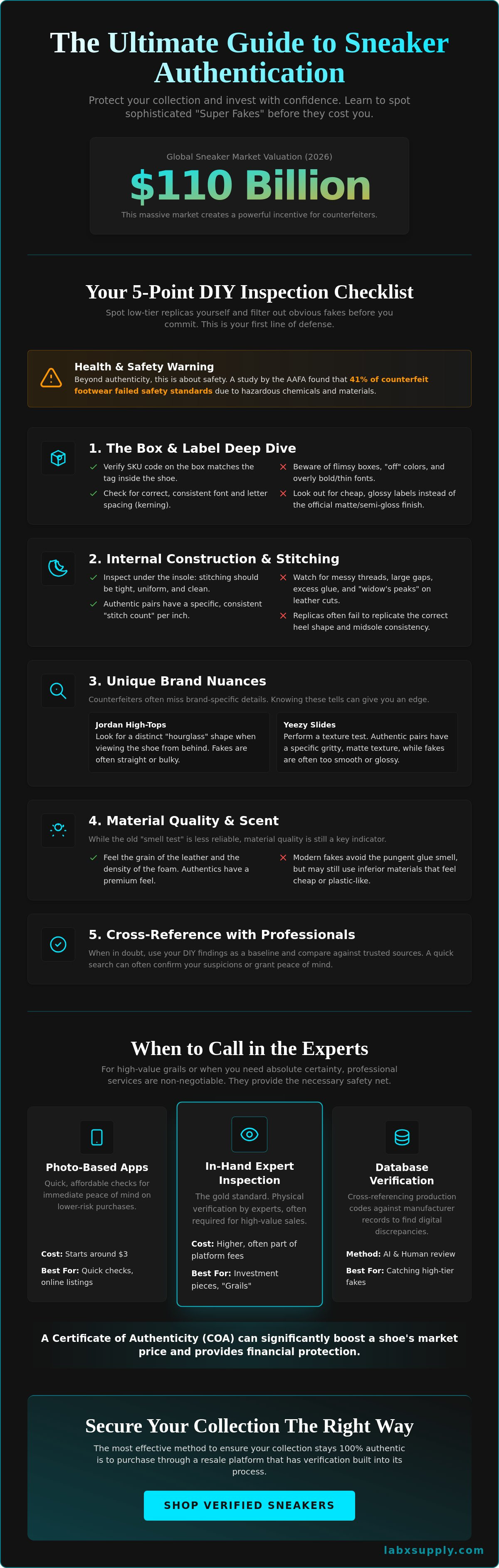
- Photo-Based Apps: Quick, affordable checks (often starting around $3) for immediate peace of mind.
- In-Hand Inspection: Physical verification by experts, often required for high-value sales.
- Database Verification: Cross-referencing production codes against manufacturer records.
A physical Certificate of Authenticity (COA) can significantly boost a shoe's market price. It transfers the liability of the check from the buyer to the service provider. For anyone dealing in high-value grails, this professional layer is the only way to guarantee financial security and legal protection under reselling laws.
How to Authenticate Sneakers: A 5-Point DIY Inspection
Before you pay for a professional service, you can often spot a replica yourself with a systematic check. Mastering how to authenticate sneakers at home saves time and helps you filter out obvious fakes. Beyond the financial risk, authenticating your gear is a matter of health; studies on the dangers of counterfeit products show that 41% of fakes tested by the AAFA failed safety standards due to hazardous chemicals. Use this logic-based checklist to inspect your next pickup.
The Box and Label Deep Dive
The box is your first line of defense. Check the label for font consistency and kerning, which is the spacing between letters. Counterfeiters often use fonts that are slightly too bold or thin. Verify that the SKU code on the box matches the tag inside the shoe and cross-reference it with official brand databases. Look closely at the finish of the label; most authentic brands use a specific matte or semi-gloss finish that fakes struggle to replicate. If the box feels flimsy or the colors look "off," proceed with extreme caution.
Internal Construction and Stitching
Consistency is key when looking at the heel and midsole. Professional authenticators use a "Stitch Count" rule, as authentic pairs maintain a specific number of stitches per inch. Look for "widows peaks," which are small triangular protrusions on leather cuts that often signal a lower-tier replica. The most telling sign is often found under the insole. Lift it up to inspect the footbed stitching. It should be tight, uniform, and clean. If you see messy threads, large gaps, or excess glue, you're likely looking at a fake.
Don't stop at the surface. Inspect the insole for hidden factory stamps and use a UV light to scan the entire shoe. Many modern brands include invisible markings or stamps that only appear under blacklight to deter counterfeiters. Finally, check the hardware and accessories. RFID chips in the tongue should scan correctly, and hangtags should have the correct weight and texture. If you want to skip the stress of DIY checks, purchasing from a curated selection of authentic sneakers and slides ensures you're getting the real deal every time.
Checking these details requires patience and a steady hand. If the shoe passes these five points, it's a strong candidate for a final expert verification. Remember that "super fakes" can sometimes pass these basic tests, which is why a professional second opinion remains the gold standard for high-value investments.
Comparing Top Sneaker Authentication Services
If your DIY check leaves you with lingering doubts, it's time to bring in the professionals. Understanding how to authenticate sneakers through third-party services is the final step in securing your investment. In 2026, the market is split between digital convenience and physical certainty. Choosing the right service depends on whether you're at a local meetup or waiting for a high-value shipment to arrive at your door.
App-based services like CheckCheck and LegitApp have lowered the barrier to entry. With authentication checks starting at just $3, these platforms are ideal for initial screenings. They work by having you upload specific photos of the box, size tags, and interior stitching for expert review. While they offer incredible speed, often returning a verdict in minutes, they have limitations. A photo cannot capture the exact weight of a midsole or the specific chemical scent of authentic materials, which is why digital checks are best used as a preliminary filter rather than a final word on high-value grails.
For total peace of mind, physical inspection remains the gold standard. Major marketplaces have integrated this into their business models to build consumer trust. eBay's Authenticity Guarantee is a prime example; for sneakers priced at $75 and above, experts from Sneaker Con physically inspect the shoes. While the service is free for sellers, US buyers pay a flat shipping fee of $14.95. Other giants like StockX and GOAT include verification in their standard transaction fees, which typically range from 9% to 9.5% for most sellers. These physical services provide a level of security that an app simply cannot match because the experts can feel and smell the product in hand.
App vs. Physical Inspection
Deciding when a photo is enough comes down to the "replacement cost" of the shoe. If you're verifying a standard GR (General Release) pair, a $3 app check is often sufficient. However, for limited collaborations or vintage pairs where "super fakes" are prevalent, physical handling is non-negotiable. Digital-only checks struggle with subtle texture differences and the density of foam materials. If the resale value exceeds $300, the $14.95 shipping fee for a physical service is a minor expense compared to the risk of losing your entire investment to a high-quality replica.
What to Do if Your Sneakers Fail
Receiving a "Fail" result is frustrating, but it provides you with the legal and financial leverage needed to get your money back. Most professional services issue a digital or physical certificate explaining exactly why the item was flagged. You should immediately attach this certificate to a dispute claim through PayPal, Venmo, or your credit card provider. These financial institutions generally recognize expert authentication verdicts as valid proof for "Significantly Not As Described" cases.
Once your refund is secured, take the extra step to report the fraudulent seller to the platform. Sharing the specific reasons for the failure in collector communities can also help others avoid the same trap. By documenting these cases, you contribute to a safer market for everyone. Remember that while the law allows for the reselling of authentic goods, the sale of counterfeit sneakers is illegal under the Trademark Counterfeiting Act, and your report could prevent further criminal activity.
Brand-Specific Nuances: Yeezy, Jordan, and Luxury
Generic checks only get you so far when you're dealing with high-demand releases. Each major brand has a unique manufacturing DNA that counterfeiters struggle to replicate perfectly. To truly master how to authenticate sneakers, you must learn the specific "tells" for the most faked models of 2026. Whether it's the density of a foam slide or the embossing depth on a classic high-top, these details are where fakes usually fail.
Yeezy and Adidas Special Considerations
The "Boost" technology found in many Yeezy models is notoriously difficult to copy. Authentic Boost should feel like a collection of distinct, soft pellets rather than a single piece of hard plastic. Look for the small "nipples" or circular stamps on the Boost sole; they should be placed in a specific, consistent pattern. For those focusing on the popular slide silhouettes, you can reference this guide on Yeezy Slides to understand the material technology and texture nuances that define an authentic pair. Pay close attention to the sizing tags, as the font and spacing often vary slightly depending on whether the pair was manufactured in China, Vietnam, or India.
The Jordan Brand Checklist
Jordan 1 authentication requires a magnifying glass for the "Air Jordan" Wings logo. On authentic pairs, the logo is deeply embossed into the leather, creating a tactile 3D effect, whereas fakes often have a flat, printed appearance. The height of the tongue is another major indicator; it should be tall and stiff, maintaining its shape even without laces. When viewed from directly behind, an authentic Jordan 1 should feature a distinct curve that narrows at the ankle and widens at the heel, creating a silhouette that mimics a traditional hourglass. If the heel looks blocky or perfectly straight, it's a significant red flag.
Luxury collaborations, such as Dior or Off-White releases, require even higher scrutiny. Inspect the "Air Dior" monogramming for perfect alignment and consistent thread weight. For Off-White pairs, the signature Helvetica text on the medial side should have a slightly "fuzzy" edge from the printing process, not a sharp, clean sticker-like finish. However, don't panic if you see a minor glue stain or a stray thread. Even retail pairs have "factory flaws" that occur during mass production. These imperfections are often asymmetrical, whereas counterfeit flaws tend to be consistent across an entire batch of fakes. If you're looking for a guaranteed authentic pair without the stress of manual checks, shop our latest sneakers and slides where every item is pre-verified.
Secure Your Collection: Why Verified Resale is the Standard
Mastering how to authenticate sneakers is a valuable skill, but the ultimate peace of mind comes from knowing you don't have to use it on every delivery. While the 2026 market offers many tools for verification, the most efficient way to protect your investment is to eliminate the risk at the point of sale. Buying from a trusted source removes the burden of proof from the buyer and places it on experts who have handled thousands of pairs. This shift toward verified resale has become the industry standard for serious collectors who want to avoid the stress of "super fakes" entirely.
While learning how to authenticate sneakers protects you in the wild, building a relationship with a specialized boutique offers a different level of security than a faceless marketplace. Large platforms often prioritize volume, which can lead to oversight. A curated boutique focuses on quality and reputation, providing a personalized service that includes detailed provenance for every pair. As we move further into 2026, we're also seeing the rise of blockchain ledgers and NFC-integrated pairs. These technologies provide a permanent, digital "birth certificate" for shoes, making it nearly impossible for counterfeiters to replicate the digital signature of an authentic product.
The Lab X Supply Commitment
At Lab X Supply, we don't just sell footwear; we protect the culture. Our internal verification process involves a multi-stage inspection for every pair of sneakers and slides that enters our inventory. We source our products exclusively from verified retail and distribution channels, ensuring that the chain of custody is never broken. This rigorous approach allows you to browse our collection of authentic sneakers with total confidence, knowing that the heavy lifting of authentication has already been done by professionals.
Final Steps for New Collectors
Even when buying from trusted sources, savvy collectors follow a few final steps to protect their investment. Always document your unboxing process with a continuous video; this provides undeniable proof of the item's condition and tags upon arrival. Store your physical authentication certificates and original receipts in a cool, dry place, as these documents are essential for maintaining high resale value in the future. To stay ahead of the market, keep yourself updated on the latest 2026 sneaker trends and technological shifts. By combining expert sourcing with your own knowledge, you can build a world-class collection that is 100% authentic and financially secure.
Step Into the Future of Sneaker Collecting
Collecting in 2026 requires a sharp eye and the right partnerships. By mastering a 5-point DIY inspection and understanding brand-specific nuances, you've taken the first step toward protecting your investment. You now know how to authenticate sneakers by looking for consistent stitching, correct box labels, and the telltale hourglass shape of authentic high-tops. While these skills are essential for navigating the secondary market, the most secure strategy remains sourcing your grails from a trusted partner who handles the verification for you.
As a trusted US-based sneaker reselling boutique, we take the guesswork out of your next pickup. Every pair in our curated selection of 2026 trending styles is verified by our in-house experts to ensure 100% authenticity. Whether you're looking for limited-edition releases or everyday essentials, we provide the transparency you need to buy with certainty. Shop Authentic Sneakers and Slides at Lab X Supply today and build your collection with total confidence. Your passion for footwear deserves the security of genuine products. Stay vigilant, keep learning, and enjoy the peace of mind that comes with a verified collection.
Frequently Asked Questions
How long does a sneaker authentication service take?
App-based services usually provide results within 30 minutes to 24 hours. Physical marketplace services like eBay or StockX typically take 2 to 5 business days once the item arrives at their facility. This timeframe doesn't include the shipping time from the seller to the authenticator or from the authenticator to you. Digital checks offer speed, while physical inspections prioritize thoroughness over a quick turnaround.
Can I trust a free sneaker authentication app?
Free authentication apps often rely on community voting or unverified AI algorithms, which can be inconsistent. Most reliable digital platforms charge a small fee to ensure a trained expert reviews your photos. While free tools are okay for a casual second opinion, they shouldn't be your only method when learning how to authenticate sneakers for a high-value purchase. Expert-led reviews provide much higher accuracy.
What is the most accurate sneaker authentication service in 2026?
Physical, in-hand inspection by multi-expert teams is considered the most accurate method in 2026. Services like eBay's Authenticity Guarantee, powered by Sneaker Con, allow experts to feel materials and check for scents that digital apps miss. While digital services are convenient for quick checks, they can't match the precision of a physical review performed by specialists who handle thousands of authentic pairs daily.
Do fakes have the same SKU numbers as real sneakers?
High-quality replicas almost always feature the correct SKU and UPC numbers copied from authentic pairs. Simply matching the numbers on the box to a Google search isn't enough to prove a shoe is real. You must look at the font style, the spacing between numbers, and the print quality of the label itself. Counterfeiters often get the numbers right but struggle with the precise manufacturing standards of the labels.
What should I do if my sneakers are flagged as fake by an app?
If an app flags your pair as a replica, you should immediately halt the transaction and document the "Fail" certificate. Use this documentation to open a dispute with your credit card company or payment platform like PayPal. Most platforms require professional proof to process a refund for counterfeit goods. Don't attempt to resell the pair, as selling fakes is illegal and can lead to permanent bans from marketplace communities.
How much does it cost to get sneakers professionally authenticated?
Professional authentication costs vary based on the depth of the inspection. Digital app checks typically range from $3 to $5 per pair. For physical inspections, marketplaces like GOAT and StockX build the cost into their transaction fees, which are usually around 9% to 9.5%. Buyers on other platforms may pay a flat fee, often around $14.95, to cover the expert review and secure shipping.
Are StockX and GOAT authentication processes 100% reliable?
No authentication process is 100% reliable because human error and "super fakes" are constant challenges. While StockX and GOAT have high success rates and handle millions of transactions, occasional mistakes do happen. These platforms are generally very reliable for modern releases, but collectors often seek additional third-party opinions for extremely rare or vintage "grails" to ensure total certainty before finalizing a high-dollar investment.
What is an RFID tag in sneakers and how does it help with authentication?
An RFID (Radio Frequency Identification) tag is a small chip embedded in the sneaker's tongue or box label that stores unique production data. Brands use these chips to track inventory and verify that a product originated from an authorized factory. Learning how to authenticate sneakers in 2026 often involves scanning these chips with a smartphone to see if the digital data matches the physical product in your hands.