
In the past year, StockX intercepted over 100,000 suspected fake products, including $30 million worth of counterfeit footwear that almost reached unsuspecting closets. If you've ever wondered how sneaker authentication works, you aren't alone. Most collectors feel a sting of anxiety when eyeing a high-value pair, worried that even the most convincing "super fakes" might slip through. It's exhausting to sift through conflicting opinions from online forums when your hard-earned money is on the line.
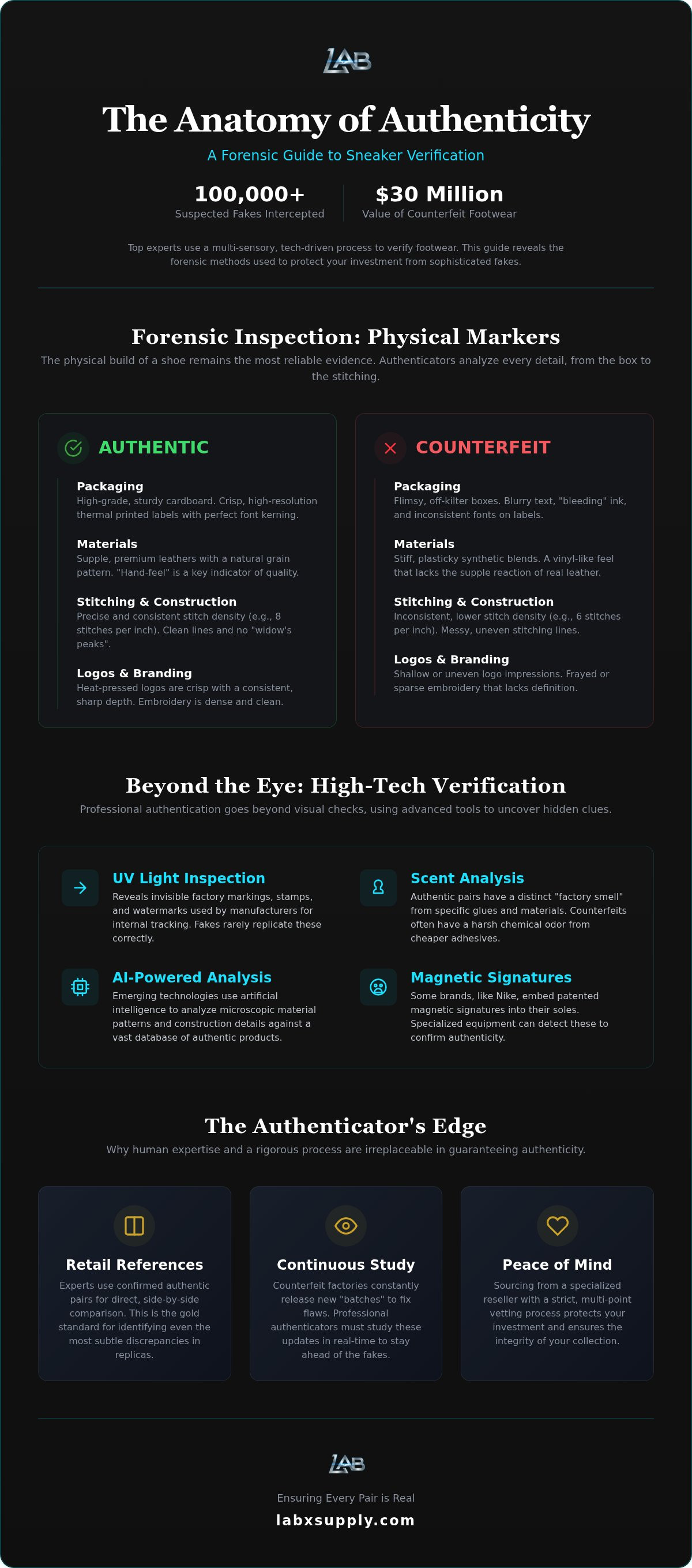
This guide reveals the forensic methods used by top experts to protect your investment. You'll discover the multi-sensory and tech-driven process used to verify your footwear, ranging from microscopic stitching patterns to Nike's patented magnetic signatures in the soles. We'll preview the professional workflow used at Lab X Supply and identify the specific markers you can look for to ensure your collection remains authentic. From AI-powered material analysis to chemical scent tests, you're about to see how the industry stays one step ahead of the counterfeiters.
Key Takeaways
- Understand that authentication is a rigorous multi-point inspection designed to ensure every detail matches original manufacturer specifications.
- Learn to spot physical discrepancies by examining stitch density, embroidery consistency, and the precise kerning of logo fonts.
- Discover how professional authenticators use UV light and scent analysis to detect invisible factory markings and industrial glues.
- Compare the effectiveness of digital apps versus physical hubs to understand how sneaker authentication works at the highest industry levels.
- Identify why sourcing from a specialized reseller like Lab X Supply provides peace of mind through a strict vetting process for all sneakers and slides.
What is Sneaker Authentication? Defining the Verification Standard
Sneaker authentication is a forensic process that validates material, construction, and provenance. At its core, it's a multi-point inspection that ensures a product meets every original manufacturer specification. As the secondary market expands, understanding how sneaker authentication works has become the primary defense for collectors against sophisticated fakes. It's no longer just about looking at a shoe; it's about verifying its entire identity.
By 2026, the rise of "Unauthorized Authentic" (UA) pairs and high-tier replicas has changed the game. These aren't the obvious knockoffs found in street markets decades ago. They often use high-quality materials that mimic the originals. Within the wider Sneaker collecting culture, the need for professional verification has skyrocketed. Authenticators must now look for microscopic details that the average buyer would easily miss.
The process also varies depending on the shoe's condition. Verifying "Deadstock" pairs focuses on factory-fresh indicators like the smell of the glue and the crispness of the box labels. Used shoes require a different set of skills. Experts analyze wear patterns and material aging to ensure the shoe's history aligns with its production date. Each pair tells a story through its construction.
The Role of the Authenticator
Experts aren't made overnight. It takes years of exposure to thousands of retail pairs to build the necessary knowledge. One of the most critical components of this job is the use of "Retail References." This means having a confirmed authentic pair on hand to compare against the suspect shoe. Because replica factories release new "batches" frequently to fix their mistakes, authenticators must constantly study new counterfeit versions. Learning how sneaker authentication works at this level requires staying ahead of factory updates in real-time. Experience is the ultimate tool.
Why 'Legit Checking' is No Longer Optional
The financial risk is simply too great to ignore. With rare pairs often selling for hundreds or thousands of dollars, a single mistake is expensive. Trust is everything. Proper authentication protects the integrity of your sneakers collection and ensures your investment holds its value over time. Beyond the money, it provides psychological peace of mind. You shouldn't have to guess if your footwear is genuine. At Lab X Supply, we believe this rigorous vetting is the only way to maintain a trusted marketplace for enthusiasts.
Forensic Inspection: The Physical Markers of Authenticity
While digital tools are evolving, the physical build of a shoe remains the most reliable evidence. Professionals treat every pair like a crime scene, looking for microscopic inconsistencies in manufacturing. Understanding how sneaker authentication works at this level requires an eye for industrial standards. Authenticators don't just look at the shoe; they analyze the machinery that must have created it. If the factory equipment isn't identical to the brand's official specs, the product will show it.
The packaging is often the first red flag. Authentic boxes use high-grade cardboard with specific structural integrity. Replica boxes frequently feel flimsy or have slightly off-kilter dimensions. Labels are a major tell. Brands use high-resolution thermal printers for their box tags. If you see blurry text, inconsistent font kerning, or "bleeding" ink, you're likely looking at a fake. Even the depth of a heat-press logo on the tongue can reveal a counterfeit. Official logos have a consistent, crisp depth that cheaper replica presses can't replicate.
Material quality provides the "hand-feel" experts rely on. Premium leathers should feel supple and develop natural creases. Replicas often use synthetic blends that feel stiff or plasticky. When you press your thumb into the leather, it should react with a specific grain pattern. If it feels like a solid block of vinyl, it's a sign of a lower-tier factory. You can find these high-quality standards in every pair of sneakers and slides at Lab X Supply, where physical inspection is the baseline for every listing.
Stitching and Construction Forensics
Stitching precision is the ultimate test of factory discipline. Authenticators measure stitch density, which is the number of stitches per inch. If a retail pair has eight stitches across a specific panel and the suspect pair has six, the machine calibration is wrong. Experts also look for "widow's peaks," which are small triangular nubs on leather edges. These occur during specific die-cutting processes used by major brands. Replicas often have perfectly smooth edges because their cutting machines are different. Don't forget the "Strobel board" stitching under the insole. It's often messy or uses the wrong thread weight on fakes because factories assume you'll never look there.
The Geometry of the Silhouette
Every sneaker model has a specific "DNA" in its shape. For high-top models, the "hourglass" shape when viewed from behind is a vital marker. Fakes often look blocky or straight. The slope of the toe box is another primary indicator. If the angle is too steep or the toe is too "boxy," it suggests the factory used an incorrect mold. This level of scrutiny mirrors the Forensic Analysis of Footwear Impression Evidence used in legal investigations. By applying architectural measurement standards to a shoe's proportions, experts can spot a replica from across the room. It's about geometry, not just aesthetics.
Beyond the Eye: Sensory and High-Tech Verification Methods
Visual inspection is just the first layer of a professional defense. To truly understand how sneaker authentication works, you have to go beyond what's visible to the naked eye. Modern authenticators use high-tech sensors and human senses to catch details that even the best "super fakes" can't hide. Weight verification is a prime example of this scientific approach. Authentic sneakers are manufactured with precise material densities. By comparing the weight of a shoe in grams to official manufacturer data, experts can spot if a replica factory used cheaper, heavier, or lighter substitute materials. Even a few grams of difference can expose a counterfeit.
Technology is also moving into the digital realm to create a permanent record of authenticity. Many brands now embed RFID or NFC chips directly into the shoe's tongue or sole. These chips provide a digital fingerprint that proves origin and prevents tampering. Academic research into blockchain-based sneaker authentication suggests that linking physical products to digital tokens is the future of the industry. This dual-layer approach makes it nearly impossible for high-tier replicas to pass as genuine stock without the corresponding encrypted data. It's a level of security that didn't exist just a few years ago.
The Scent of Authenticity
The "Smell Test" remains one of the most reliable human-led checks in the authentication workflow. Authentic leathers and rubbers have a distinct, clean scent that collectors recognize instantly. In contrast, many replica factories use low-grade industrial glues that emit a sharp, chemical odor often described as smelling like vinegar or gasoline. This happens because those factories prioritize speed over curing time, leaving the toxic scent trapped in the box. While storage conditions or moisture can alter a shoe's scent over time, experts can still distinguish between a naturally aged smell and the toxic fumes of a fresh counterfeit.
UV Light and Hidden Markers
UV light analysis is a staple in any "Lab" environment. When placed under a blacklight, hidden factory markings often appear that are invisible to the naked eye. Replica manufacturers frequently use invisible ink stamps for quality control during production. These "ghost" markings glow brightly under UV exposure, serving as a dead giveaway. Authenticators also look for glue stains that shouldn't be there. High-end brands have strict quality control that limits excess adhesive, whereas replicas often show messy, glowing residue around the midsole. Some threads or panels also have specific "glow" properties under UV that fake materials fail to replicate perfectly.
Digital vs. Physical: How Modern Resale Platforms Verify Stock
Choosing between an app-based check and a physical inspection center depends on your level of risk. Digital authentication offers speed and convenience by using high-resolution photos to look for obvious red flags. However, photos can't capture the weight, scent, or texture of the materials. This is why shipping shoes to a central hub remains the gold standard for high-value transactions. In a physical setting, experts can apply the multi-sensory tests that define how sneaker authentication works in a professional environment.
One of the most confusing aspects for new collectors is the "Retail Flaw" paradox. It's a common misconception that every authentic shoe is flawless. In reality, mass-production standards at major brands often lead to minor glue stains, slightly asymmetrical panels, or stray threads. Replica factories sometimes try so hard to be perfect that they eliminate these human errors, resulting in a shoe that looks "too good to be true." Distinguishing a factory flaw on a real pair from a manufacturing error on a fake requires a deep database of retail references. Replicas often fail because they lack the specific "imperfections" found in official factory runs.
The Rise of AI in Authentication
Machine learning has revolutionized the speed of verification. Modern AI models are trained on millions of data points from popular sneaker releases and the latest slide series. These systems can identify patterns in leather grain or font spacing that are invisible to the human eye. While AI handles the high-volume initial screening, human intuition is still vital. An algorithm might flag a legitimate material variation as a flaw, whereas an experienced authenticator knows that certain leather batches naturally vary. This hybrid approach ensures both efficiency and accuracy for the end user.
The Physical Verification Workflow
When a pair arrives at a professional facility, it follows a strict protocol. The intake team first checks the box and accessories for immediate discrepancies. Next, the shoe undergoes an initial screen using UV light and digital scales. If it passes, a senior authenticator performs a deep-dive review of the internal stitching and material quality. Only after passing every stage does the shoe receive a Certificate of Authenticity (COA) or a specialized security tag. If you want to skip the stress of doing this yourself, you can buy authentic sneakers and slides that have already cleared these rigorous hurdles. Platforms also have dispute processes for second opinions, ensuring that the final verdict is backed by consensus rather than a single person's view.
Trusting the Source: How Lab X Supply Ensures Every Pair is Real
Lab X Supply functions as the final destination where the forensic science of footwear verification meets the consumer. Our commitment to a zero-fake policy for all sneakers and slides means we take on the burden of proof so you don't have to. Understanding how sneaker authentication works is our primary focus, allowing you to focus on the style and fit of your next pair. We operate with the precision suggested by our name, ensuring that every item in our curated marketplace has cleared a gauntlet of physical and sensory tests before it ever reaches our inventory.
Our sourcing strategy is built on long-term relationships with vetted partners. We don't just scan for obvious errors; we vet the entire chain of custody for every shipment. This is especially important for "at-risk" models like Yeezy slides or high-end luxury sneakers that are frequently targeted by high-tier replica factories. By focusing on these high-demand items, we protect the most vulnerable part of the secondary market. We bridge the gap between technical material analysis and customer trust by maintaining a transparent workflow that prioritizes accuracy over volume.
Curated for Authenticity
We don't try to sell everything. Instead, we focus on high-demand items where professional authentication is most critical. This curated approach allows us to dedicate more time to each pair, staying ahead of the latest "super-fake" manufacturing trends. When replica factories update their "batches" to fix common flaws, our team is already studying the changes. We prioritize transparency in our sourcing and shipping process because we believe you deserve to know the history of your footwear. It's about maintaining a standard that casual marketplaces simply can't match.
The Lab X Supply Guarantee
We provide a safe haven for collectors who are tired of the "legit check" anxiety that plagues the secondary market. You shouldn't have to spend hours in online forums hoping for a consensus on your latest purchase. Our role in the global sneaker community is to act as a trusted filter, removing the risk from the buying experience. We invite you to explore our authenticated collection of adidas slides and sneakers, knowing that the scientific heavy lifting has already been done. At Lab X Supply, your peace of mind is as important as the shoes on your feet.
Securing Your Collection in the Age of Super Fakes
Footwear resale has shifted from simple visual checks to a forensic discipline. You've learned that true verification requires a multi-sensory approach, combining the "smell test" with high-tech tools like UV light analysis and precision weight scales. Understanding how sneaker authentication works empowers you to spot discrepancies in stitching density or material quality before you commit your hard-earned money. It's about recognizing that authentic manufacturing isn't always perfect, but it's always consistent with brand standards.
You don't have to navigate this technical terrain alone. By choosing a trusted destination with expert-vetted stock and US-based reliability, you can skip the anxiety of the "legit check" process entirely. We maintain a dedicated focus on authentic resale and offer global shipping to ensure your rotation stays genuine. Shop our 100% authenticated collection at Lab X Supply and buy with total confidence. Your collection deserves the protection of professional science, so start building your future rotation today.
Frequently Asked Questions
Can fakes have real-looking receipts and tags?
Yes, replica factories often forge receipts from major retailers and clone QR codes. These accessories are much easier to replicate than the footwear itself. You shouldn't rely on paper documentation as a primary proof of authenticity. Instead, focus on the physical construction and material analysis discussed earlier. Professional authenticators treat paperwork as a secondary indicator rather than a definitive confirmation of a product's origin.
What is a 'UV light check' in sneaker authentication?
A UV light check involves using a blacklight to reveal invisible factory stamps, guidelines, or glue residue. Major brands typically have clean production lines, whereas replicas often show glowing "ghost" markings used for quality control in unauthorized factories. This tool helps experts understand how sneaker authentication works on a microscopic level. It exposes inconsistencies in thread fluorescence and adhesive application that are completely invisible under standard room lighting.
Does a manufacturing flaw mean my sneakers are fake?
No, minor imperfections like glue stains or stray threads are common on authentic retail pairs due to high-volume production. Authenticators look for specific "retail flaws" that align with known factory errors from official releases. Replicas are often ironically "too perfect" because they lack these human inconsistencies. The key is distinguishing between a standard factory variance and a structural error that suggests the use of incorrect machinery or molds.
How accurate is AI-based sneaker authentication?
AI-based systems are highly accurate for scanning visual patterns, but they aren't foolproof on their own. These models analyze millions of data points to identify discrepancies in logo placement and font kerning. While they offer a fast initial screening, they can't feel the texture of the leather or detect chemical scents. A hybrid approach combining machine learning with human expertise remains the most reliable method for verifying high-value sneakers and slides in 2026.
What should I do if I think I bought a replica?
If you suspect your pair is a replica, stop wearing them immediately and document the discrepancies with high-quality photos. Reach out to the seller or platform where you made the purchase to initiate a dispute. Many reputable marketplaces have buyer protection policies for unverified goods. You can also seek a second opinion from a professional authentication service to provide evidence for your claim. Avoid trying to resell the item yourself once you have doubts.
Are 'Unauthorized Authentics' actually made in the same factory?
The claim that "UA" pairs are made in the same factory with "leftover materials" is almost always a marketing myth. Authentic brands have strict inventory controls for their raw materials and scrap. Most UA pairs are simply high-tier replicas manufactured in separate facilities using reverse-engineered patterns. While the quality may be higher than a cheap knockoff, they don't meet the official quality control standards required for a genuine retail release.
Why do some authentic sneakers smell like glue?
Authentic sneakers can have a faint glue smell if they were recently manufactured and shipped in a sealed box before the adhesive fully cured. However, this scent is usually mild and dissipates quickly. Replicas often have an overpowering, toxic chemical odor because factories use low-grade industrial adhesives to save on costs. Distinguishing between these scents is a vital part of how sneaker authentication works when experts perform a sensory intake of new stock.
How can I check the authenticity of Yeezy slides?
Checking Yeezy slides requires a close look at the EVA foam texture and the "Made in" engraving inside the strap. Authentic pairs have a specific matte finish and a soft yet supportive density. Look for consistent font depth on the footbed logo and check the outsole traction for sharp, well-defined ridges. Replicas often feel overly stiff or have a glossy sheen on the surface. Sourcing from a trusted reseller like Lab X Supply eliminates this guesswork entirely.